 USA
USA UK
UK Australia
 UAE
UAE Canada
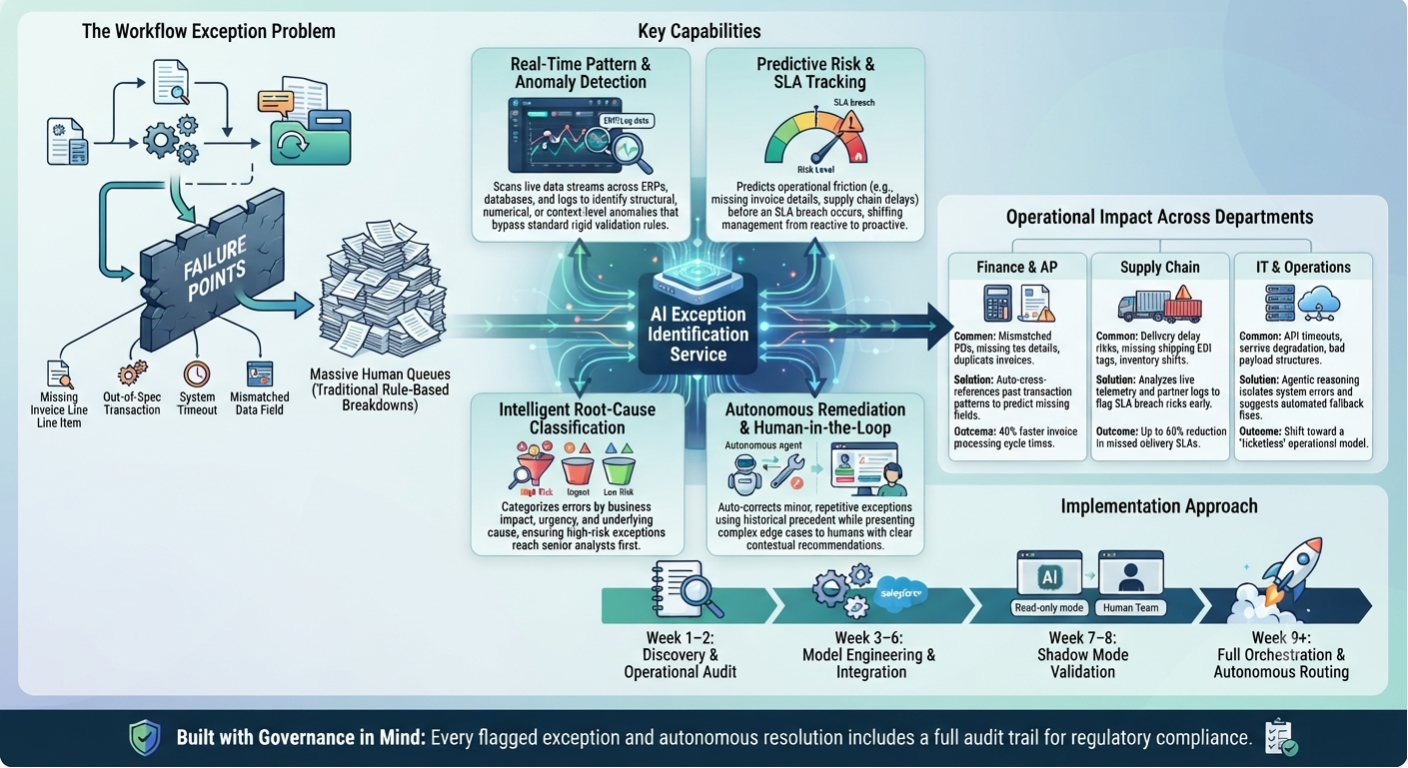
Every automated business workflow eventually hits a wall: a missing invoice line item, a out-of-spec transaction, a system timeout, or a mismatched data field. Traditional rule-based automations break when these exceptions occur, throwing the task into massive human queues.
Our AI Exception Identification Service deploys machine learning models and intelligent agents that continuously scan operations, spot deviations in real time, predict failure points before they cascade, and route anomalies for resolution.
Key Capabilities
Real-Time Pattern & Anomaly Detection
Scans live data streams across ERPs, databases, and logs to identify structural, numerical, or context-level anomalies that bypass standard rigid validation rules.
Predictive Risk & SLA Tracking
Predicts operational friction (e.g., missing invoice details, supply chain delays) before an SLA breach occurs, shifting management from reactive to proactive.
Intelligent Root-Cause Classification
Categorizes errors by business impact, urgency, and underlying cause, ensuring high-risk exceptions reach senior analysts first.
Autonomous Remediation & Human-in-the-Loop
Auto-corrects minor, repetitive exceptions using historical precedent while presenting complex edge cases to humans with clear contextual recommendations.
Operational Impact Across Departments
| Department | Common Exception Types | AI Identification Solution | Business Outcome |
|---|---|---|---|
| Finance & AP | Mismatched POs, missing tax details, duplicate invoices | Auto-cross-references past transaction patterns to predict missing fields. | 40% faster invoice processing cycle times. |
| Supply Chain | Delivery delay risks, missing shipping EDI tags, inventory shifts | Analyzes live telemetry and partner logs to flag SLA breach risks early. | Up to 60% reduction in missed delivery SLAs. |
| IT & Operations | API timeouts, service degradation, bad payload structures | Agentic reasoning isolates system errors and suggests automated fallback fixes. | Shift toward a "ticketless" operational model. |
Implementation Approach
1.Discovery & Operational Audit:Weeks 1–2.
We analyze historical error logs, manual ticketing queues, and process failure points to identify top exception patterns and data readiness.
2.Model Engineering & Integration:Weeks 3–6.
We deploy custom ML anomaly detection algorithms and connect them directly to your existing software stack (SAP, Salesforce, internal APIs) via event-driven hooks.
3.Shadow Mode Validation:Weeks 7–8.
The AI runs alongside human teams in a read-only "shadow mode". We benchmark accuracy, refine confidence thresholds, and eliminate false positives.
4.Full Orchestration & Autonomous Routing:Week 9+.
Go live with automated exception classification, autonomous remediation for low-risk issues, and context-rich escalations for human reviewers.
Built with Governance in Mind: Every flagged exception and autonomous resolution includes an audit trail detailing why the decision was made, maintaining full regulatory compliance and zero "black box" risk.
Software We Use


