USA
USA UK
UK Australia
 UAE
UAE Canada
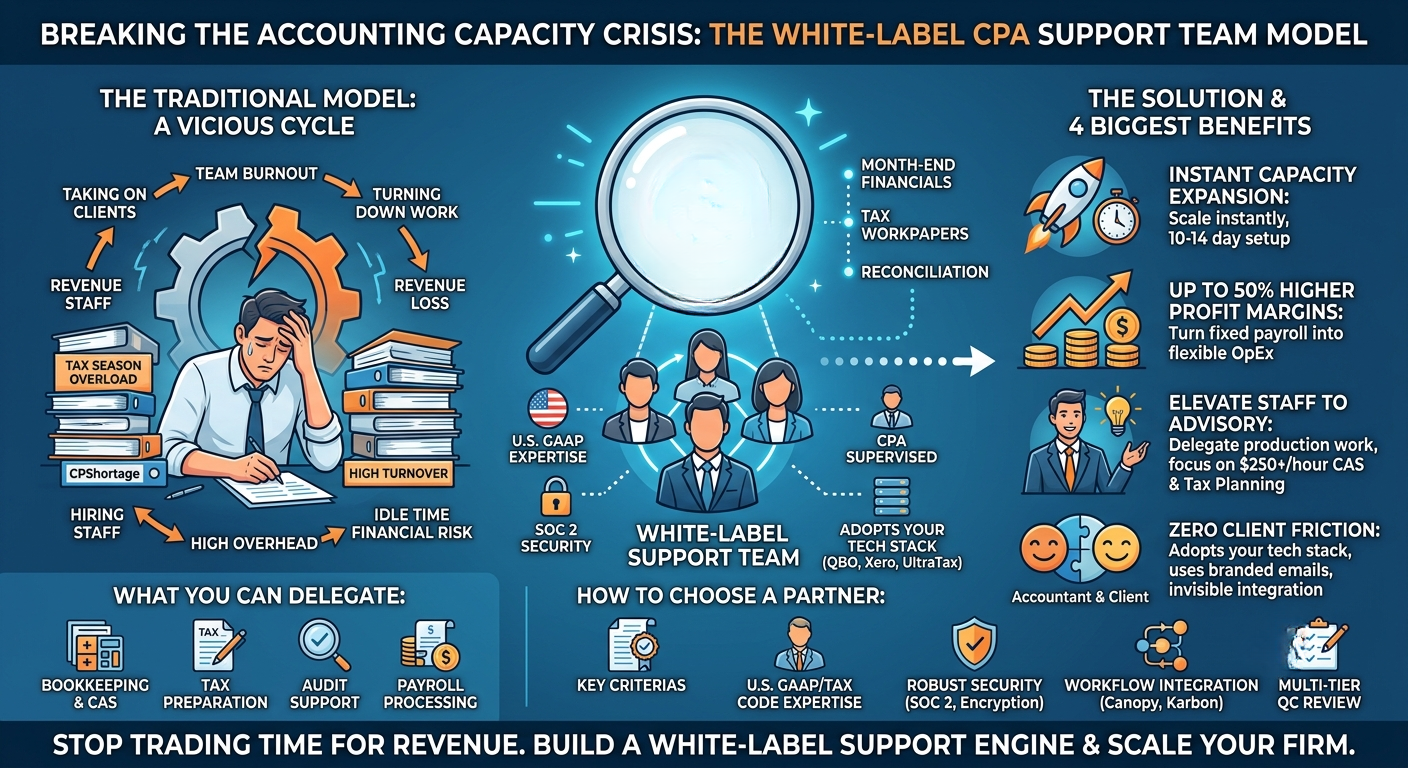
The accounting industry is facing a quiet crisis. Ask almost any managing partner what their top growth barrier is today, and you’ll get the exact same answer: capacity.
Finding qualified accounting and tax talent has become an uphill battle. The shortage of CPAs, coupled with rising salary expectations and high turn-over during busy seasons, leaves firm owners trapped in a vicious cycle:
You take on new clients, but your internal team gets overworked and burned out.
You turn down work, leaving revenue and high-value advisory opportunities on the table.
You hire full-time staff, driving up overhead while taking on financial risk during off-peak months.
To break out of this trap, forward-thinking CPA practices are turning to a proven model that tech and agency sectors have used for years: White-Label CPA Support Teams.
What Exactly Is a White-Label CPA Support Team?
A white-label accounting partner operates as an invisible, fully integrated backend engine for your firm.
Unlike traditional outsourcing—where third-party providers interact directly with your clients under their own branding—a white-label team functions completely under your name, your domain, and your guidelines.
When your clients request a month-end financial package, tax workpaper, or reconciliation, your white-label team completes the work in the background. The final deliverable carries your firm’s logo, adheres to your internal SOPs, and is delivered directly by your team.
To the outside world, your practice simply looks like a seamless, highly productive power firm.
The 4 Biggest Benefits for CPA Practices
1. Instant Capacity Expansion (Without the Hiring Drag)
Recruiting, onboarding, and training a mid-level accountant takes months and thousands of dollars in recruitment fees. A white-label support team can be plugged into your firm in as little as 10 to 14 days. Whether you need 20 hours a week for routine bookkeeping or 200 hours of tax prep during Q1, you can scale your operations up or down instantly.
2. Up to 50% Higher Profit Margins
Full-time internal employees come with significant fixed overhead: health benefits, 401(k) matches, software licenses, office space, and idle-time payroll during slow seasons. White-label models transform these fixed payroll costs into a flexible operational expense, allowing you to capture significantly higher margins per engagement.
3. Elevate Senior Staff to High-Margin Advisory Services
Your senior CPAs shouldn't spend 60% of their day doing basic data entry, bank reconciliations, or simple tax preparation work. By delegating lower-level production work to your white-label backend, your experienced staff can pivot to Client Accounting Services (CAS), tax planning, and strategic advisory work—services that comfortably command $250+ per hour.
4. Zero Client Friction
Because the white-label team adopts your tech stack (QBO, Xero, UltraTax, Drake, Karbon) and uses your branded email addresses, your clients experience zero operational friction. They continue dealing with their trusted advisors while enjoying faster turnaround times and higher-quality work.
What Services Can You Delegate to a White-Label Partner?
A comprehensive white-label partner can support almost every core workflow in your practice:
Bookkeeping & CAS: Monthly close, AP/AR management, bank reconciliations, and custom reporting.
Tax Preparation: Individual (1040) and entity (1065, 1120, 1120-S) tax prep and workpaper tie-outs.
Audit & Assurance Support: Schedule preparation, detail testing, and PBC (Provided by Client) list management.
Payroll Processing: Multi-state payroll runs, payroll tax filings, and end-of-year processing.
How to Choose the Right White-Label Partner
Not all white-label providers offer equal service levels. When evaluating potential partners, look for these non-negotiable criteria:
U.S. GAAP & Tax Code Expertise: Ensure their staff are CPA-supervised and thoroughly trained in U.S. accounting standards.
Robust Security Standards: Confirm SOC 2 compliance, 256-bit data encryption, and strict non-disclosure agreements (NDAs) to protect sensitive client data.
Workflow Integration: The provider should adapt to your practice management tool (e.g., Canopy, Jetpack Workflow, Karbon), not force you to adopt theirs.
Multi-Tier Quality Control: Look for teams that include internal manager-level reviews before workpapers are passed back to your firm for final approval.
Conclusion: Stop Trading Time for Revenue
The traditional model of scaling a CPA practice—working 80-hour weeks in spring and hiring expensive local talent—is no longer sustainable.
By building a white-label support engine behind your brand, you gain the operational leverage needed to grow your top-line revenue, increase profit margins, and protect your team from seasonal burnout.
White-Label CPA Support Teams
Instant Capacity Expansion
Up to 50% Higher Margins
Shift to High-Value Advisory
100% Invisible Integration
Do You Want To Manage Your Finances Effortlessly By Hiring Accountants Cost-Effectively?
Do You Have Any Questions?