USA
USA UK
UK Australia
 UAE
UAE Canada
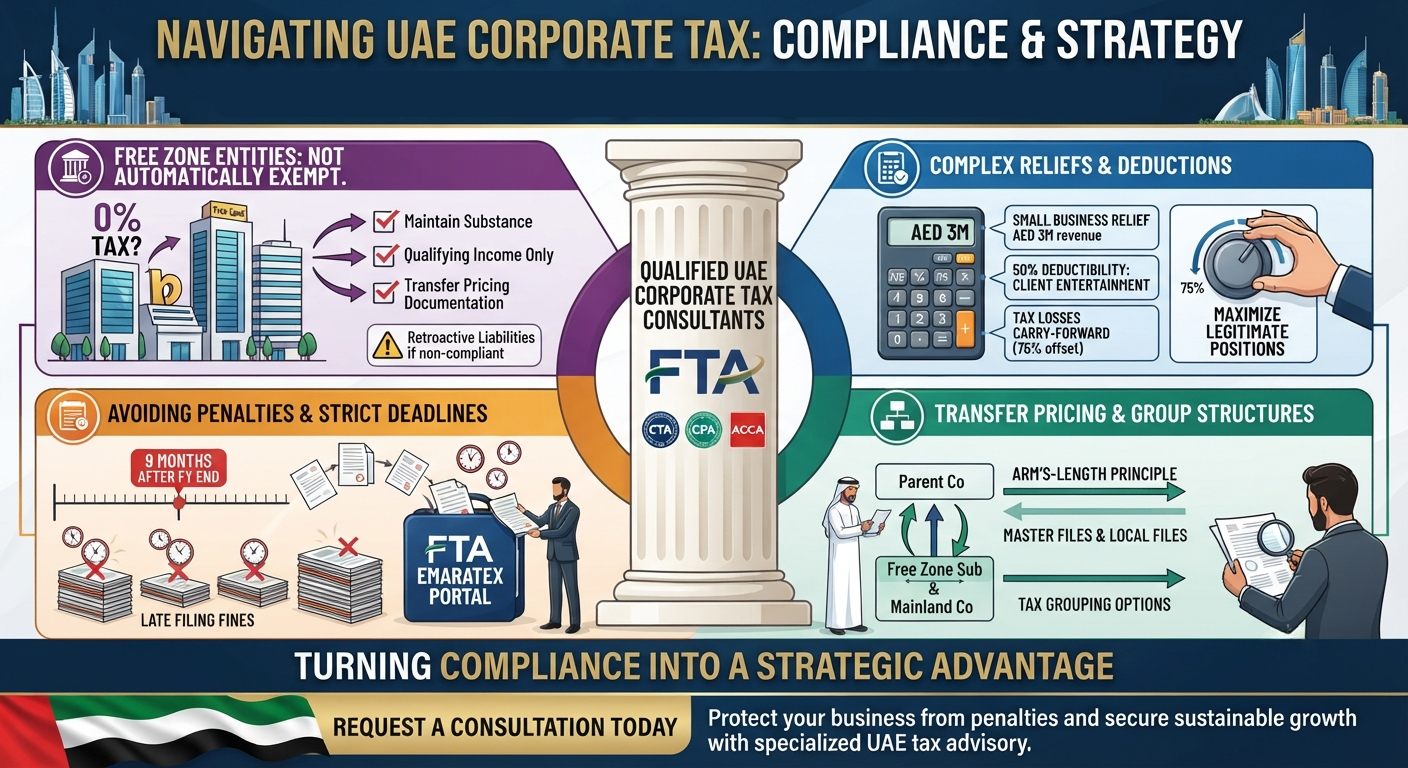
For decades, operating a business in the United Arab Emirates meant navigating a virtually tax-free corporate ecosystem. However, with the full rollout of Federal Decree-Law No. 47 of 2022 and the strict filing schedules enforced via the Federal Tax Authority (FTA) EmaraTax platform, corporate taxation in the UAE has shifted from a novelty to a critical daily compliance requirement.
Whether you run a mainland enterprise, an international subsidiary, or a Free Zone company, navigating the standard 9% tax rate (on taxable income above AED 375,000) demands specialized knowledge. Below, we explore why engaging qualified UAE Corporate Tax Consultants is no longer just an operational expense—it is an essential line of defense for your business.
1. Free Zone Entities Are Not Automatically Exempt
One of the most widespread misconceptions among business owners in Dubai, Abu Dhabi, and the broader Emirates is that operating within a Free Zone guarantees a 0% tax rate.
While Qualifying Free Zone Persons (QFZPs) can benefit from a 0% rate on "Qualifying Income," the criteria are stringent:
Entities must maintain adequate substance in the UAE.
Non-qualifying income (such as mainland commercial activities) or failure to comply with de minimis thresholds can result in losing QFZP status.
Free Zone companies must still maintain audited financial statements under IFRS and prepare Transfer Pricing documentation.
A dedicated Corporate Tax Consultant evaluates your revenue streams, drafts compliant intercompany contracts, and ensures your Free Zone entity maintains its 0% tax treatment without triggering unexpected retroactive liabilities.
2. Navigating Complex Reliefs & Deductions
Tax compliance isn't just about paying what you owe—it’s also about ensuring you don't overpay.
Small Business Relief (SBR): Eligible resident entities with gross revenues below AED 3 million in applicable tax periods can elect for Small Business Relief. However, SBR requires an active election on the EmaraTax portal—it is not applied automatically.
Expense Deductibility Rules: Certain expenses, such as client entertainment, are capped at 50% deductibility. Non-business expenses, penalties, and transactions with connected persons that do not meet the "arm's-length" principle are non-deductible.
Tax Losses: Tax losses can be carried forward to offset up to 75% of taxable income in future tax periods, provided ownership continuity criteria are met.
Tax consultants bridge the gap between your accounting records and taxable income adjustments, maximizing your legitimate tax positions.
3. Avoiding Severe Penalty Structures
The FTA enforces strict deadlines and monetary penalties for non-compliance.
Filing Deadlines: Tax returns and payments are due within 9 months following the end of your company's financial tax year (e.g., September 30 for companies following a January–December calendar fiscal year).
Reformed Penalty Framework: Missing registration or return filing deadlines triggers fixed late-filing fines alongside accruing monthly interest on unpaid taxes.
Outsourcing tax management to certified FTA Tax Agents removes the operational burden from internal teams, ensuring every filing milestone is met on time.
4. Transfer Pricing (TP) & Group Structure Realignment
If your business engages in transactions with related parties or connected persons (e.g., sister companies, shareholders, directors), the UAE Transfer Pricing rules apply under OECD guidelines.
Corporate tax consultants perform crucial TP services, including:
Conducting benchmark studies to verify arm's-length pricing.
Preparing mandatory Master Files and Local Files for qualifying group turnover levels.
Evaluating options for UAE Tax Grouping—allowing parent and subsidiary entities to file a consolidated return, offsetting profits and losses across group entities.
What to Look For When Hiring a UAE Tax Consultant
When evaluating external tax advisory firms or hiring embedded consultants, look for the following benchmarks:
Credentials & Certifications: Look for CTA (Chartered Tax Adviser), CPA, ACCA, or registered FTA Tax Agent credentials.
GCC / UAE Track Record: Ensure hands-on familiarity with Ministry of Finance Cabinet Decisions, Ministerial Decisions, and EmaraTax portal operations.
Sector-Specific Experience: If you operate in real estate, financial services, cross-border e-commerce, or Free Zone trading, hire specialists who understand your industry's specific tax treatments.
Conclusion: Turning Compliance Into a Strategic Advantage
Tax compliance in the UAE is no longer an afterthought—it is a cornerstone of sound financial leadership. By partnering with experienced UAE Corporate Tax Consultants, you protect your company from regulatory penalties, streamline financial reporting, and position your organization for sustainable growth.
Ready to Secure Your Tax Compliance Strategy?
Whether you need a full-time dedicated tax manager, quarterly advisory oversight, or project-based return preparation, our pre-vetted UAE tax specialists are ready to support your business.
UAE Tax Consultants
Free Zone Exemption Management
Optimization of Reliefs & Deductions
Deadline Protection & Penalty Prevention
OECD-Compliant Transfer Pricing & Grouping
Do You Want To Manage Your Finances Effortlessly By Hiring Accountants Cost-Effectively?
Do You Have Any Questions?