USA
USA UK
UK Australia
 UAE
UAE Canada
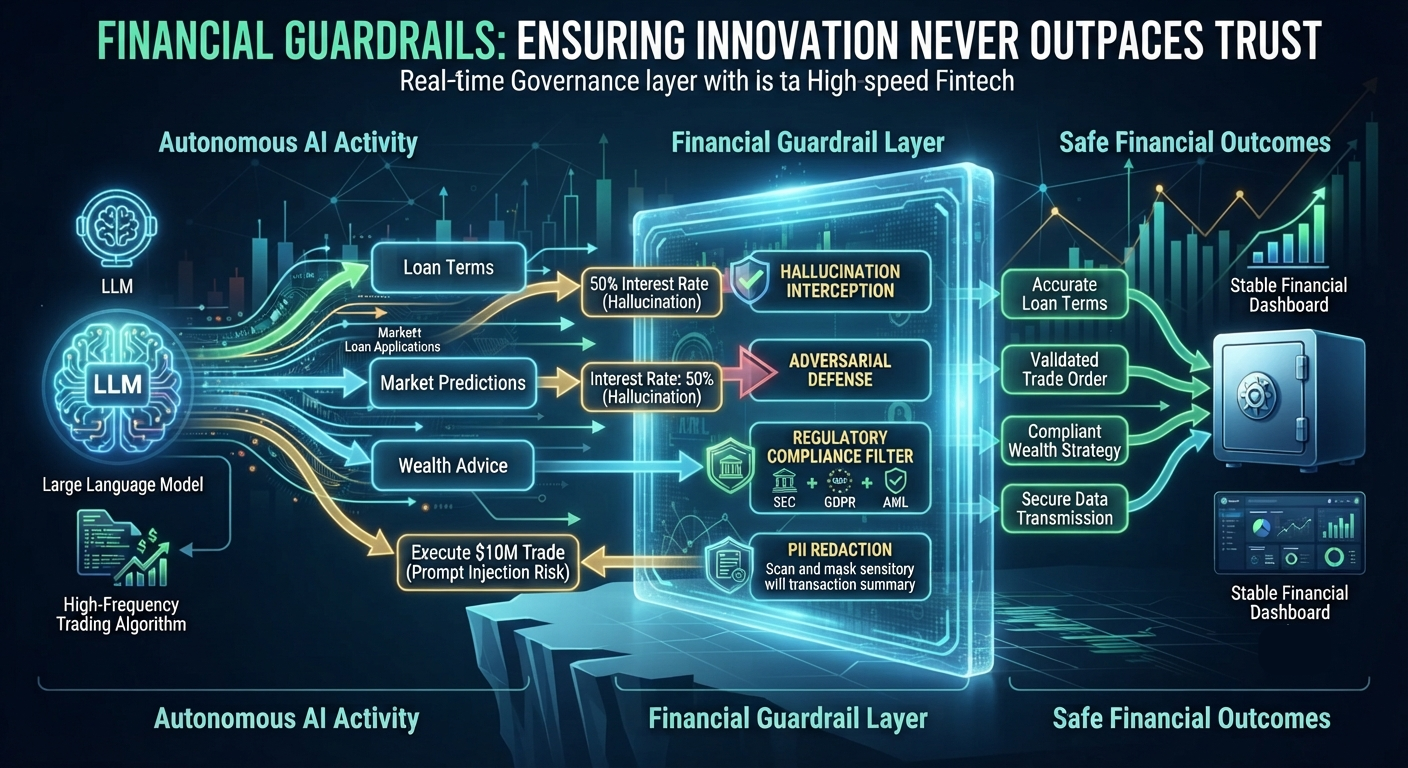
The fintech landscape has shifted permanently. Autonomous AI agents, generative copilots, and real-time algorithmic models are no longer experimental—they are processing loans, executing trades, and offering personalized wealth advice at a scale and speed humans simply cannot match.
But with this immense capability comes an unprecedented risk. In finance, an AI doesn't just make a harmless mistake—it triggers a compliance nightmare, exposes sensitive consumer data, or authorizes erroneous transactions worth millions.
Enter the AI-Powered Financial Guardrail: the invisible infrastructure ensuring that innovation never outpaces trust.
What Are AI Financial Guardrails?
Think of guardrails as the safety barriers on a winding mountain road. The car (the Large Language Model or autonomous algorithm) can drive fast and reach its destination efficiently, but the guardrails ensure it never veers off a cliff.
In technical terms, financial guardrails are a real-time governance layer positioned between users and AI models. They intercept inputs and outputs to enforce strict determinism, compliance, and safety before a decision is executed or displayed.
Core Functions of a Guardrail System:
Hallucination Interception: Preventing LLMs from making up interest rates, loan terms, or investment returns.
Regulatory Compliance Filters: Automatically checking outputs against frameworks like SEC, GDPR, and anti-money laundering (AML) protocols.
Adversarial Defense: Blocking prompt injection attacks designed to trick a banking bot into bypassing transfer limits.
PII Redaction: Ensuring Social Security Numbers, account numbers, and private financial data never leak into model training or output loops.
Why Standard AI Safety Isn't Enough for Finance
General-purpose AI guardrails protect against hate speech, toxicity, and general misinformation. While important, they are completely inadequate for the financial sector.
Finance requires absolute precision. A general model might tolerate a 95% accuracy rate; a banking application requires a near-zero tolerance for regulatory or arithmetic failure. Financial guardrails must understand complex financial semantics, interpret shifting regulatory policies across state and international lines, and execute validation checks in milliseconds so the user experience remains seamless.
The Engineer's Dilemma: Speed vs. Safety
Building these guardrails introduces a fascinating engineering challenge. If your safety checks add too much latency, the real-time trading algorithm or customer service chatbot becomes sluggish.
The most successful fintech teams are solving this by building layered validation architectures:
Deterministic Pre-Filters: Fast, rule-based regex and pattern matching to instantly catch obvious anomalies or forbidden inputs.
Semantic Guardrails: Lightweight embedding checks to evaluate the intent of an LLM's response against financial policy vectors.
Async Post-Audits: Deep compliance checks running concurrently to log and flag edge cases without slowing down the primary transaction path.
The Future Belongs to Safe Innovation
The companies that win the next decade of fintech will not be the ones that build the wildest, most unrestrained AI models. They will be the ones that build the most reliable ones.
Regulators are watching closely, and consumer trust is fragile. By investing in robust AI-powered financial guardrails, organizations can unlock the full potential of artificial intelligence while keeping their capital, their customers, and their compliance standing secure.
AI Financial Guardrails
Hallucination Interception
Regulatory Compliance Filters
Adversarial Defense
PII Redaction
Do You Want To Manage Your Finances Effortlessly By Hiring Accountants Cost-Effectively?
Do You Have Any Questions?