USA
USA UK
UK Australia
 UAE
UAE Canada
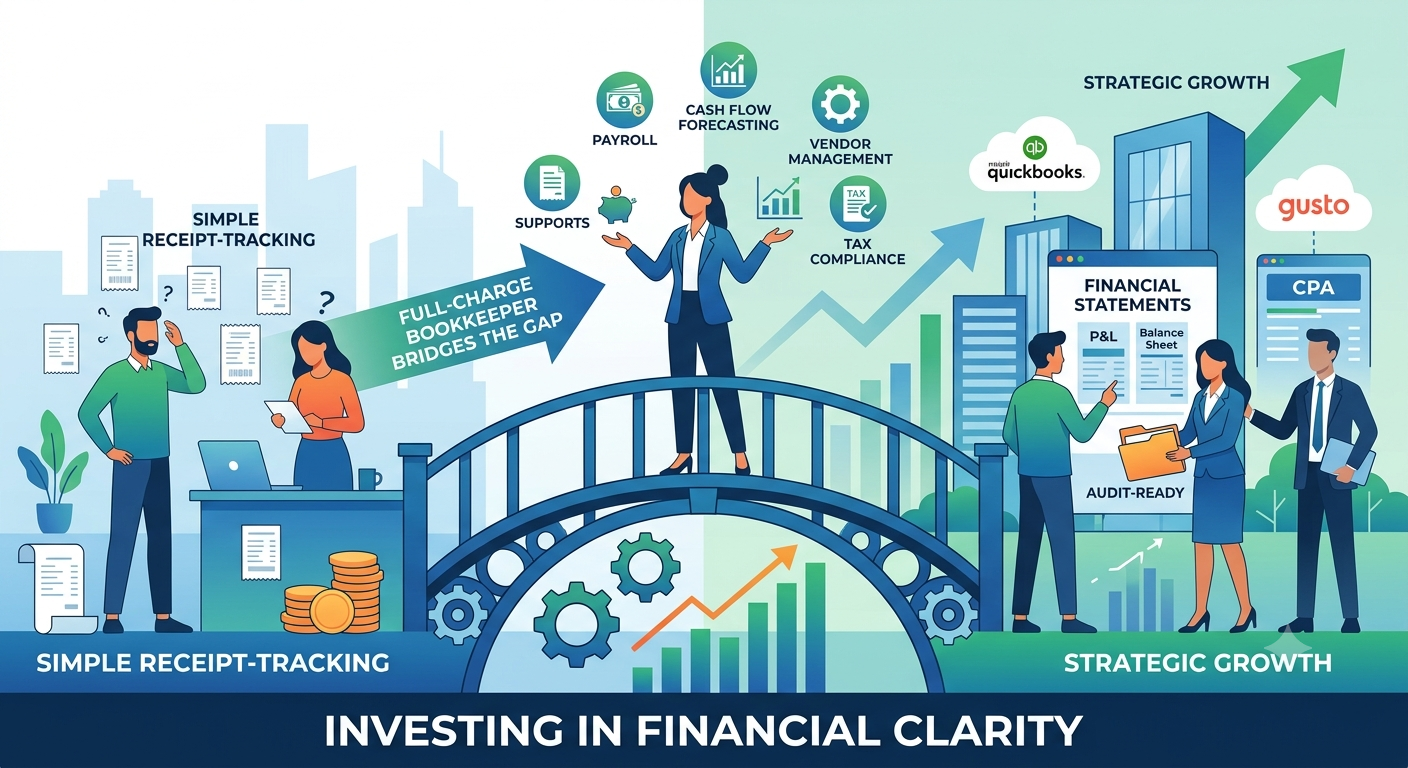
As a business grows, financial management quickly transitions from simple receipt-tracking to a complex web of payroll, cash flow forecasting, vendor management, and tax compliance.
At a certain point, a basic data-entry bookkeeper isn’t enough—yet hiring a full-time, high-salaried Controller or Chief Financial Officer (CFO) isn't in the budget.
This is where a Full-Charge Bookkeeper (FCB) comes in.
An FCB bridges the gap between basic data entry and high-level financial strategy. In this post, we’ll explore what a Full-Charge Bookkeeper actually does, why they are a game-changer for growing businesses, and how to hire the right one.
What is a Full-Charge Bookkeeper?
Unlike standard bookkeepers who handle specific tasks like recording invoices or categorizing expense receipts, a Full-Charge Bookkeeper manages the complete accounting cycle independently.
They take full ownership ("full charge") of your financial operations from day-to-day transaction processing all the way to preparing financial statements for your CPA. They operate without needing daily supervision from an internal accountant or controller.
Full-Charge Bookkeeper vs. Standard Bookkeeper vs. CPA
| Role | Primary Focus | Level of Independence |
|---|---|---|
| Standard Bookkeeper | Data entry, logging receipts, simple AP/AR. | Requires oversight and instruction. |
| Full-Charge Bookkeeper | Complete accounting cycle, payroll, month-end closing, financial statements. | Fully autonomous day-to-day operations. |
| CPA / External Accountant | Strategic tax planning, auditing, complex tax filings. | High-level consulting (usually external). |
Key Signs You Need a Full-Charge Bookkeeper
If you resonate with any of the following scenarios, it’s likely time to hire an FCB:
Month-end close takes weeks: Your books are perpetually delayed, meaning you are making business decisions based on outdated financial data.
The founder is still doing payroll and AP: You are spending high-value strategic hours chasing down invoices, calculating PTO, or running payroll.
Tax time is a nightmare: Your CPA demands clean files at year-end, but you deliver a messy spreadsheet, resulting in huge accounting fees to clean up the books.
Cash flow surprises happen too often: You lack visibility into upcoming liabilities, vendor payment schedules, or collection timelines.
Essential Skills to Look for When Hiring
When drafting your job description or reviewing candidate resumes, prioritize these critical competencies:
1. Full-Cycle Accounting Mastery
They should understand General Ledger management, accrual vs. cash accounting, accruals/deferrals, fixed asset depreciation, and bank reconciliations.
2. Software Expertise
Look for candidates who know your accounting software inside out—whether that’s QuickBooks Online, Xero, or NetSuite—along with modern integration apps like Bill.com, Gusto, or Dext.
3. Financial Statement Preparation
An FCB must be capable of generating accurate Balance Sheets, Income Statements (P&L), and Cash Flow Statements that give you an honest snapshot of your company’s health.
4. Communication & CPA Hand-off
They will be the primary liaison between your operational team and your external CPA. Clear communication and audit-ready organization are essential.
3 Red Flags to Avoid in Interviews
They can't explain how they troubleshoot balance sheet errors. A true FCB knows how to track down reconciliation discrepancies systematically rather than making arbitrary entries.
Over-reliance on manual processes. If they don't leverage cloud integrations, bank feeds, or automation tools, your operations will quickly bottleneck as you scale.
Confusion around accrual accounting. While small businesses often operate on a cash basis initially, a qualified FCB should be well-versed in accrual concepts to handle growing liabilities and receivables properly.
Final Thoughts: Investing in Financial Clarity
Hiring a Full-Charge Bookkeeper isn't just an operational expense—it's an investment in financial visibility. By handing off your complete accounting cycle to a capable professional, you gain accurate financial insights, ensure tax compliance, and free up your executive bandwidth to focus on growth.
Full-Charge Bookkeepers
The Growth Dilemma: The Financial Management Gap
Complete Ownership: What an FCB Actually Does
Warning Signs: When to Upgrade Your Accounting
Hiring Criteria: Core Skills & Key Red Flags
Do You Want To Manage Your Finances Effortlessly By Hiring Accountants Cost-Effectively?
Do You Have Any Questions?