USA
USA UK
UK Australia
 UAE
UAE Canada
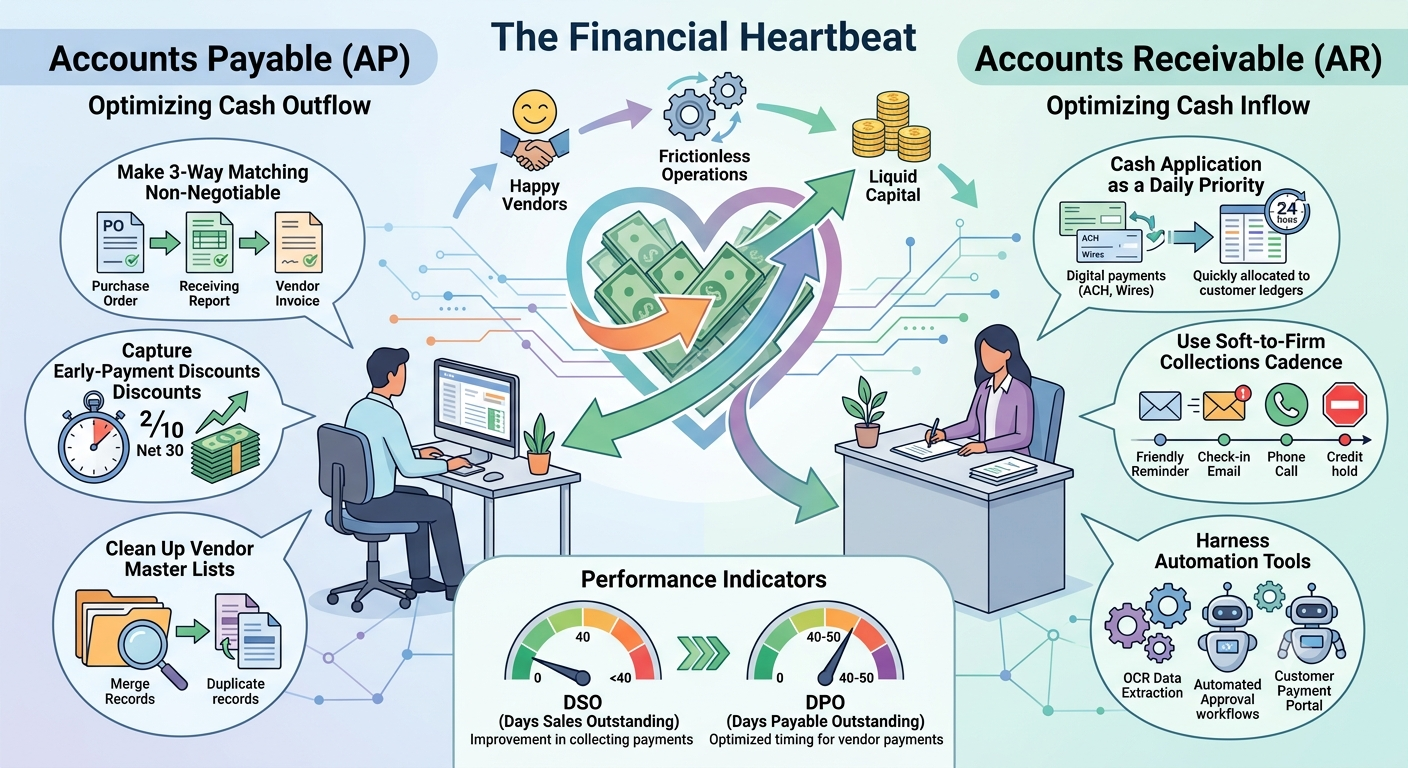
Managing Accounts Payable (AP) and Accounts Receivable (AR) is often described as the financial heartbeat of a business. When cash flow flows smoothly, the company thrives: vendors stay happy, operations run without friction, and liquid capital is readily available for growth. But when invoice bottlenecks or uncollected receivables stack up, even profitable businesses can quickly find themselves in a tight spot.
Whether you're stepping into your first finance role or looking to level up your accounting workflow, mastering the dual AP/AR discipline requires more than just knowing how to use software. It takes a strategic mindset.
Here are 7 core habits that distinguish top-tier AP/AR specialists from the rest of the crowd.
1. They Make 3-Way Matching Non-Negotiable
In Accounts Payable, haste makes waste—and double payments. Top AP specialists strictly enforce 3-way matching:
$$\text{Purchase Order (PO)} \quad \longleftrightarrow \quad \text{Receiving Report} \quad \longleftrightarrow \quad \text{Vendor Invoice}$$
Before approving a single dollar, verify that:
The PO matches what was approved.
The Receiving Report proves the goods or services actually arrived.
The Invoice reflects the correct agreed prices and quantities.
Catching line-item discrepancies before payment saves hours of tedious credit-memo chasing later.
2. They Treat Cash Application as a Daily Priority
In Accounts Receivable, receiving money is only half the battle— posting it correctly is the other half. Letting payments sit in an unapplied cash account creates two major headaches:
Inaccurate Aging Reports: Customers who have already paid will accidentally receive past-due notices, damaging relationships.
Skewed Cash Metrics: Management gets a distorted view of actual working capital.
High-performing specialists apply incoming checks, ACH transfers, and wires to customer ledgers within 24 hours of receipt.
3. They Use a Soft-to-Firm Collections Cadence
Collections outreach doesn't have to be adversarial. The best AR professionals view collections as a customer service extension. Most late payments stem from missing invoices, billing address errors, or internal approval delays on the client’s side—not refusal to pay.
A structured, predictable dunning cadence keeps accounts healthy:
5 Days Before Due Date: Send a friendly automated reminder with the invoice attached.
1–15 Days Past Due: Send a polite check-in email ("Did you receive everything okay with this invoice?").
30 Days Past Due: Escalate to a phone call to understand the bottleneck.
60+ Days Past Due: Place a temporary credit hold on new orders until the balance is resolved.
4. They Capture Early-Payment Discounts
Why leave free money on the table? Vendors frequently offer payment terms like 2/10 Net 30 (a 2% discount if paid within 10 days, otherwise full payment due in 30 days).
On a $50,000 invoice, a 2% discount yields $1,000 in direct bottom-line savings. By keeping an organized vendor schedule and streamlining internal approval routes, great AP specialists consistently capture these discounts, turning the AP department into a profit center.
5. They Clean Up the Vendor & Customer Master Lists
Duplicate vendors (e.g., ACME Corp vs. ACME Corp Inc.) lead to double payments, lost 1099 filings, and messy reporting. Periodic ledger hygiene is a hallmark of an organized specialist.
Quarterly Hygiene Checklist:
Audit duplicate vendor entries and merge sub-accounts.
Ensure updated W-9 forms are on file before processing year-end 1099s.
Inactivate dormant client accounts to keep your active AR queue lean and accurate.
6. They Harness Automation Tools
Manual data entry is prone to human error and burns valuable hours. Leading specialists lean heavily on modern ERP and automation toolsets:
OCR Data Extraction: Automatically pulling invoice metadata into system fields.
Automated Approval Workflows: Routing invoices directly to department managers based on pre-set dollar limits.
Self-Service Customer Portals: Giving clients direct access to pay invoices online via ACH or credit card.
Automating mundane tasks frees up time to focus on variance analysis, vendor negotiations, and resolving complex disputes.
7. They Benchmark Key Metrics (DSO & DPO)
Top specialists don't just clear queues—they track performance indicators to measure cash efficiency:
Days Sales Outstanding (DSO): Measures how quickly your company collects payments. Lower is better (target: $<40\text{ days}$).
Days Payable Outstanding (DPO): Measures how long your company takes to pay vendors. Optimizing DPO keeps cash in the bank longer without harming vendor goodwill (target: $40\text{--}50\text{ days}$).
The Bottom Line
An exceptional AP/AR Specialist bridges the gap between accounting and operational strategy. By blending disciplined workflows with smart tech integration and proactive communication, you protect the company’s cash flow while building trust with both clients and suppliers.
AR/AP Specialists
Disciplined Verification & Accuracy
Proactive Cash Flow Management
Customer-Centric AR & Collections
Automation & Strategic Benchmarking
Do You Want To Manage Your Finances Effortlessly By Hiring Accountants Cost-Effectively?
Do You Have Any Questions?