 USA
USA UK
UK Australia
 UAE
UAE Canada
Outsourcing a company's financial work means avoiding the need to hire in-house staff to handle miscellaneous financial tasks such as bookkeeping, revenue and expense reconciliation, and instead entrusting all these tasks to an external third-party professional team. When this model was first promoted, it was claimed to deliver three tangible benefits: first, it cuts miscellaneous day-to-day operating costs, eliminating the need to maintain a full in-house financial team year-round; second, when a business needs to expand or scale down, the workload of the financial department can be adjusted flexibly accordingly, removing the hassle of urgently hiring or laying off staff in-house; third, companies can access top-tier professional financial capabilities without spending large sums to recruit senior industry experts.
Yet once the financial work is actually handed over, numerous financial leaders and company operation leaders have run into pitfalls, and the actual situation has fallen far short of the initially promoted effects: every month, when the deadline arrives to reconcile all monthly financial revenues and expenditures and close the books, the task is never completed on time; on the balance sheet that tracks the company's assets and liabilities, unexplained account mismatches keep emerging, and no amount of investigation can pinpoint the source of the problem; what is even more exhausting is that to obtain updates on even the most basic work progress, one has to endlessly send emails to the outsourcing team to follow up, and there are always endless matters that require chasing.
Even when problems arise with outsourced bookkeeping and accounting services, they are rarely caused by the staff assigned to the work lacking professional accounting knowledge. Nearly all of these disruptions stem from flaws in structural loopholes within operational processes, from misaligned connections and poorly coordinated mechanisms across the entire workflow, rather than insufficient professional competence of any individual. First identifying all these process-hidden bottlenecks that slow down progress is the first step to building a reliable and accurate financial operation system.
3 Core Operational Gaps Destroying Your Outsourced Accounting
Accounting outsourcing risks usually manifest in three distinct operational bottlenecks:
Vacuum of responsibility (Unclear Escalations)
The most common cause of problems in bookkeeping services is that both parties fail to clearly define the boundary of responsibilities. The outsourcing service provider only waits to receive instructions from the client to carry out work, and refuses to position itself as a cooperative partner integrated into the client's team. When encountering rare, special circumstances that cannot be fitted into conventional procedures, no one is able to take charge or manage the issue, and it slips through the gaps between the two sides with ease.
The client thinks: Since we have outsourced the bookkeeping work, the outsourcing team will definitely proactively review those unclassifiable transactions and sort out all irregularities.
The service provider thinks: The client will naturally point out these abnormal items when they conduct their own checks, so there is no need to put extra effort into them.
The final outcome is that no one takes ownership of the final account data, errors and omissions remain in the accounts and cannot be eliminated, and after accumulating for a year, when a unified adjustment is required at the end of the year, everyone can only rush to complete the work in a panic, with no time left to conduct careful checks.
Broken Hand-off Processes
To ensure accurate financial data, it is entirely dependent on the collection of raw data that is fast, comprehensive, and solid; every single invoice and every record must be free of errors. If data handover between the two parties can only rely on sending emails with attachments temporarily, or piling files randomly in a disorganized shared cloud storage space with no clear starting or ending point, various problems will arise:
Invoices get lost, and the bills that should have been recorded in the accounts cannot be found.
No one can explain the ins and outs behind special transactions; the key context of why the money was spent and where it was spent is cut off.
The internal team spends several hours answering various basic verification questions raised by the outsourcing team, and the month-end closing work that should have proceeded on schedule is naturally delayed.
Black Box communication
Many risks of accounting outsourcing stem from the client having no visibility into the service provider's daily work progress; they have no idea what the other side has done in the accounts each day or what problems they have handled. If communication with the accounting service provider only occurs once a month when the final report is received, with no updates at all from the start to the end of the month, a series of troubles will follow:
When the report is finalized and enters the stage where random changes are no longer allowed, discrepancies in the numbers are only discovered then, and the differences are completely inexplicable.
To correct these errors, the already closed financial cycle must be reopened for adjustments, disrupting all processes that had been properly sorted out.
The strategic planning that can only proceed after waiting for the other party to send the revised numbers can only come to a complete standstill; no work can be done, and everything is stuck in place waiting for updates.
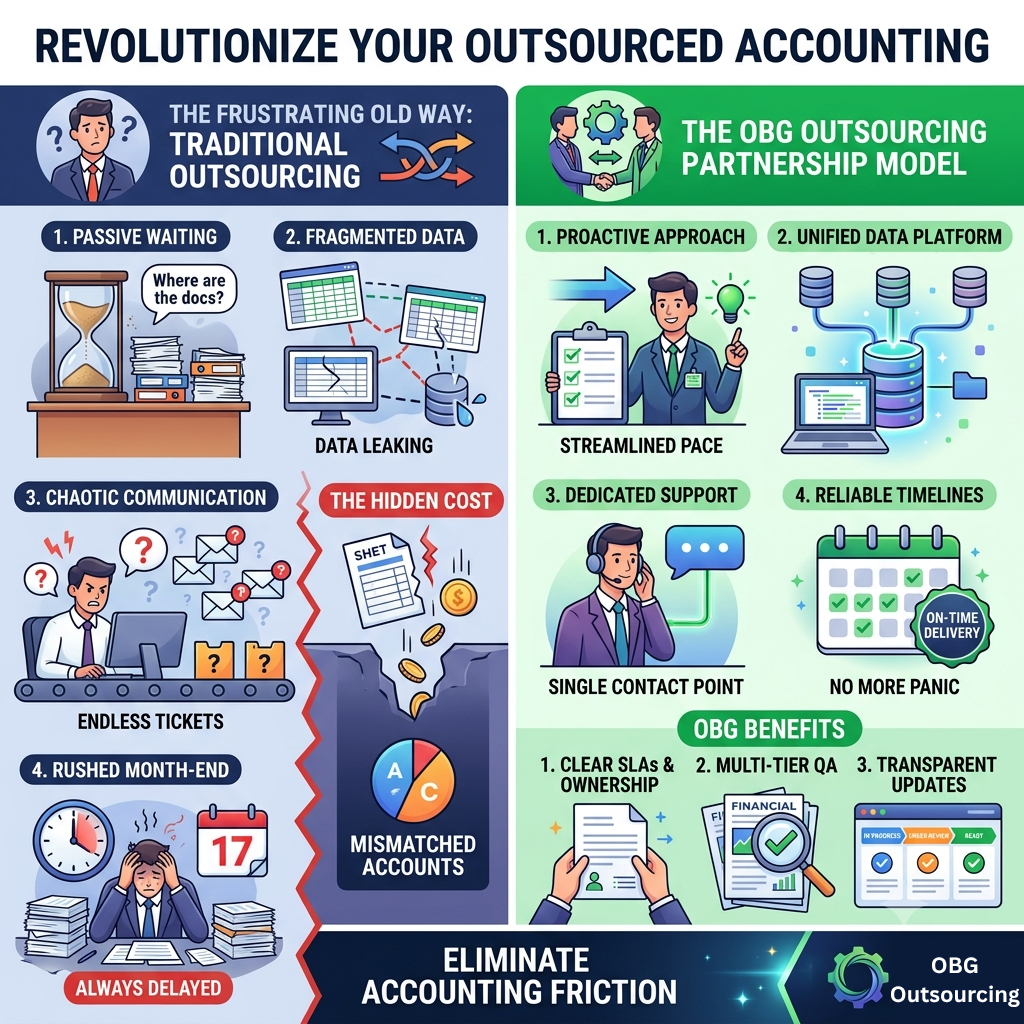
First, let me break down the differences between the two finance outsourcing models for you; after reading this, you will understand why the traditional approach is frustrating, and what makes the new partnership model superior.
The first is the common Traditional Outsourcing that you see on the market, and the second is the embedded partnership outsourcing of OBG, that is, OBG Outsourcing. Let us compare them one by one:
First is the logic of work advancement: Traditional Outsourcing only passively waits for you to deliver all required documents before it starts working; OBG Outsourcing proactively advances work, with uniform service standards overseeing the pace throughout the process, and never waits idly for tasks to come.
Second is data management: Traditional Outsourcing stores Data FlowFragmented across several unconnected spreadsheets, so when you need to look up information, you have to piece it together in chaos; OBG Outsourcing integrates all data into a single data source, so any information you need can be pulled up immediately, with no scattered confusion.
Third is communication and coordination: Traditional Outsourcing requires you to submit a service ticket first, then coordinate back and forth through endless email disputes, and you cannot reach anyone when problems arise; OBG Outsourcing assigns you a dedicated account manager who regularly sends you clear work updates, so you only need to contact that one person, and will never feel lost trying to reach the right person.
Fourth is who takes responsibility for quality: Traditional Outsourcing throws the finished work at you, so all verification and inspections fall on you, and you are the only one held accountable for any errors; before OBG Outsourcing delivers its results to you, it completes Multi-Tier Quality Assurance internally, catching all issues before handover.
Fifth is the reliability of timelines: Traditional Outsourcing has no fixed end-of-month closing date, so you never know when the current month's books will be settled; OBG Outsourcing commits to a fixed delivery cycle with you in advance, and delivers on time every time, never holding you back.
With all these problems laid out, how does OBG Outsourcing fix all these loopholes?
We built OBG Outsourcing's bookkeeping and accounting services specifically to fill in the process gaps that drag down enterprise operations. We do not stop at simply processing every financial transaction; we fully integrate into your existing work system, and deliver accurate, clearly accountable financial data to you according to the agreed schedule.
Our model has several concrete pillars that straighten out all ambiguous areas for you:
First is Clear SLAs and Ownership Frameworks: every client's account has a well-defined role division table, so for specific tasks such as reconciling accounts, accruing expenses, and verifying payroll, there is never a situation where a task is left unattended or responsibilities are vague.
Second is Streamlined Data Pipelines: we implement unified, standardized document collection rules, which greatly reduce the manual hassle of chasing clients for materials, and also help you cut down the time spent on end-of-month closing, so you no longer have to pull all-nighters to meet deadlines.
Third is Multi-Tier Quality Assurance: no matter what financial statement it is, before it reaches you, it will go through a complete internal review process to ensure the data inside is 100% accurate, and we will never dump a mess in your lap.
Fourth is Transparent Communication: you will receive regular, stable work progress updates, and you only have one dedicated point of contact throughout the process—they will not be switched out every few days to confuse you. Our accounting team integrates seamlessly with your work pace, just like an internal department of your company, as if we are your own in-house team.
Are you ready to Eliminate Accounting Friction in your accounting work?
Stop wasting your energy rushing to fix emergencies, patch up unexpected errors, and resolve process delays that disrupt your rhythm every single end of month. Partner with an outsourcing team that prioritizes accurate data, clear responsibilities, and strict adherence to deadlines, and you will never have to suffer through this again.
Contact OBG Outsourcing right now. We will first help you sort out and audit your current financial workflows, work with you to build an accounting foundation that can support your company's scaling, and help you lay a solid groundwork for your finance function.
_(6).jpg)


1.png)
_(5).jpg)
.jpg)
_(4).jpg)
_(1).jpg)
_(2).jpg)
.png)