 USA
USA UK
UK Australia
 UAE
UAE Canada
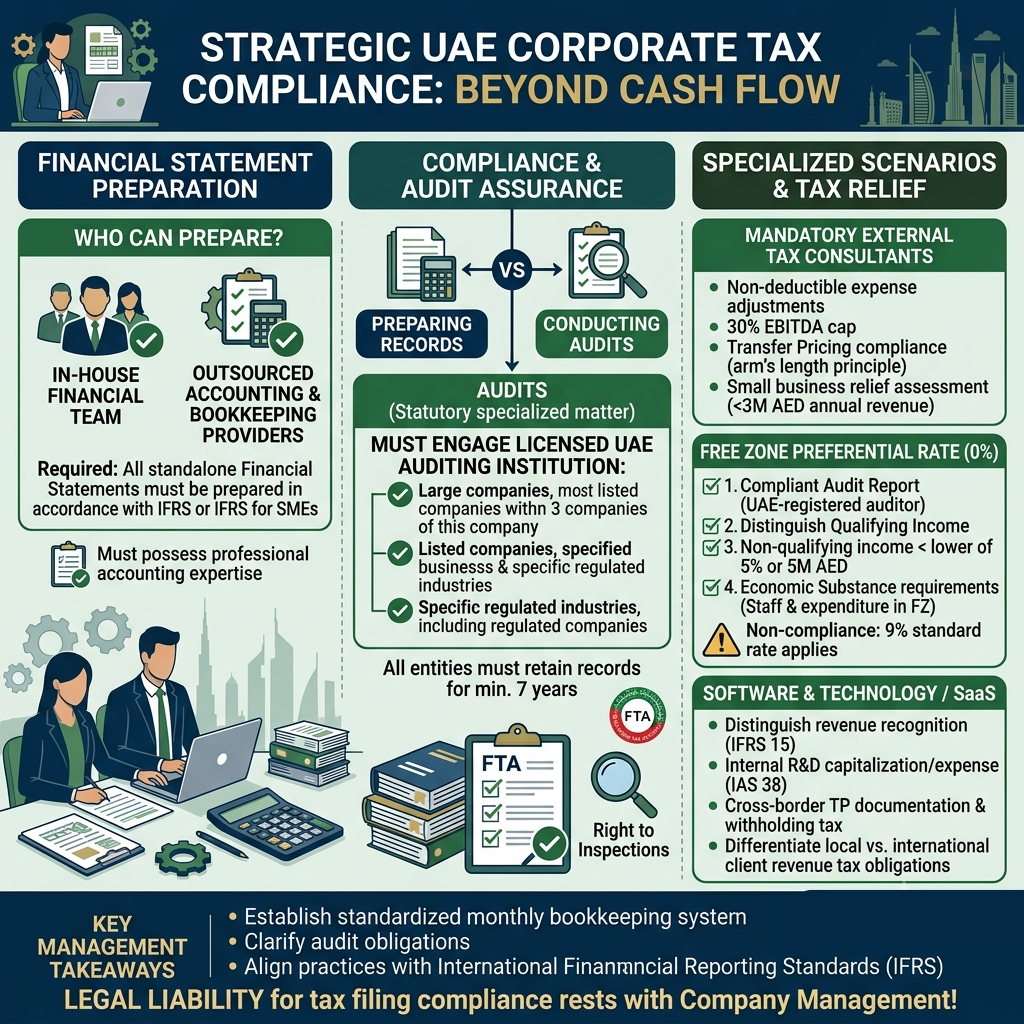
Adapting to the United Arab Emirates (UAE) corporate tax framework must never remain limited solely to the basic level of cash flow tracking. Pursuant to UAE Federal Decree No. 47 of 2022, all local taxable entities are required to prepare standalone financial statements in accordance with International Financial Reporting Standards (IFRS) or the IFRS for Small and Medium-sized Entities (SMEs).
A large number of local SME owners and financial managers commonly hold uncertainties about who holds the legal qualifications to prepare these financial statements, and when they need to engage external consultants. The following sections will carry out a compliance breakdown across three pre-set dimensions.
Regarding the core issue of who is eligible to prepare corporate financial statements under the framework of the UAE Corporate Tax Law, a common misconception must first be clarified: this law does not mandate that such statements may only be prepared exclusively by licensed external firms or registered tax agents. Legally eligible preparers include an enterprise’s in-house financial team and outsourced accounting and bookkeeping service providers. All financial statements must meet the compliance requirements of IFRS or IFRS for SMEs.
We first clarify the core differences between the preparation of a company’s standard financial records and the conduct of audits: preparing financial records only requires sufficient professional accounting expertise to complete, while auditing is an entirely distinct statutory specialized matter. Drawing on UAE Ministerial Decision No. 82 of 2023 and the updated, currently effective regulatory provisions, we outline three categories of business entities that are required to engage a licensed UAE auditing institution to conduct an audit of their financial statements.
Enterprises not included in the mandatory audit scope must still comply with the fallback compliance requirements; the UAE Federal Tax Authority (FTA) holds the right to conduct inspections, all enterprises must retain their financial records for a minimum of 7 years, and all official proper nouns retain their original English forms to facilitate local audiences’ cross-reference with official documents.
For enterprises in the United Arab Emirates (UAE), only those operating simple business models can manage their own tax declaration processes independently. The core operation of tax compliance is to convert accounting profits into taxable income. Enterprises that fall into any of the following four scenarios must engage external accounting and tax institutions to complete their compliance procedures:
Tax adjustment exemption scenarios involving non-deductible expenses and the 30% EBITDA interest deduction cap;
Transfer pricing compliance scenarios that require filing related-party transaction records in line with the arm's length principle;
Application scenarios for small business tax relief, which require eligibility assessment for enterprises with annual revenue below 3 million dirhams; fourth, preparation scenarios for audits by the UAE Federal Tax Authority (FTA), which require alignment between general ledgers and tax filings for all applicable tax types.
Although enterprises operating in the United Arab Emirates (UAE) free trade zones can access a range of exclusive policy benefits, they must strictly comply with regulatory requirements to retain their eligibility for the 0% preferential corporate tax rate. Before filing tax declarations, they must complete four core verifications:
They must hold a compliant audit report issued by a UAE-registered auditor;
They must accurately distinguish between qualifying and non-qualifying sources of income
Their non-qualifying income must not exceed the lower value of either 5% of total income or 5 million UAE dirhams
They must meet the economic substance requirements that align their staffing and expenditures within the free trade zone. Non-compliance will result in losing the preferential eligibility, and the standard 9% corporate tax rate will apply.
Software, technology, and SaaS companies operating in the United Arab Emirates (UAE) face industry-specific accounting and tax sub-issues when applying International Financial Reporting Standards (IFRS). Before filing tax returns, these firms must verify four core compliance items, as any violation will directly distort taxable profits or revenues:
Distinguish the recognition timing of upfront implementation fees, multi-year software license fees, and ongoing SaaS subscription fees in accordance with IFRS 15
Classify the expense or capitalization nature of internal R&D costs per the requirements of IAS 38
Retain transfer pricing documentation for cross-border team setups and IP licensing, and handle withholding tax in full compliance;
Differentiate the distinct tax obligations applicable to revenues generated from domestic versus international clients.
For business owners in the United Arab Emirates (UAE), regardless of whether you choose to prepare financial statements in-house or entrust an external institution to produce them, the legal liability for tax filing compliance rests with your company’s management. Please establish a standardized monthly bookkeeping system, clarify your audit obligations, and align your practices with International Financial Reporting Standards (IFRS) to successfully complete your corporate tax declaration.
_(6).jpg)


1.png)
_(5).jpg)
.jpg)
_(4).jpg)
_(1).jpg)
_(2).jpg)
.png)