 USA
USA UK
UK Australia
 UAE
UAE Canada
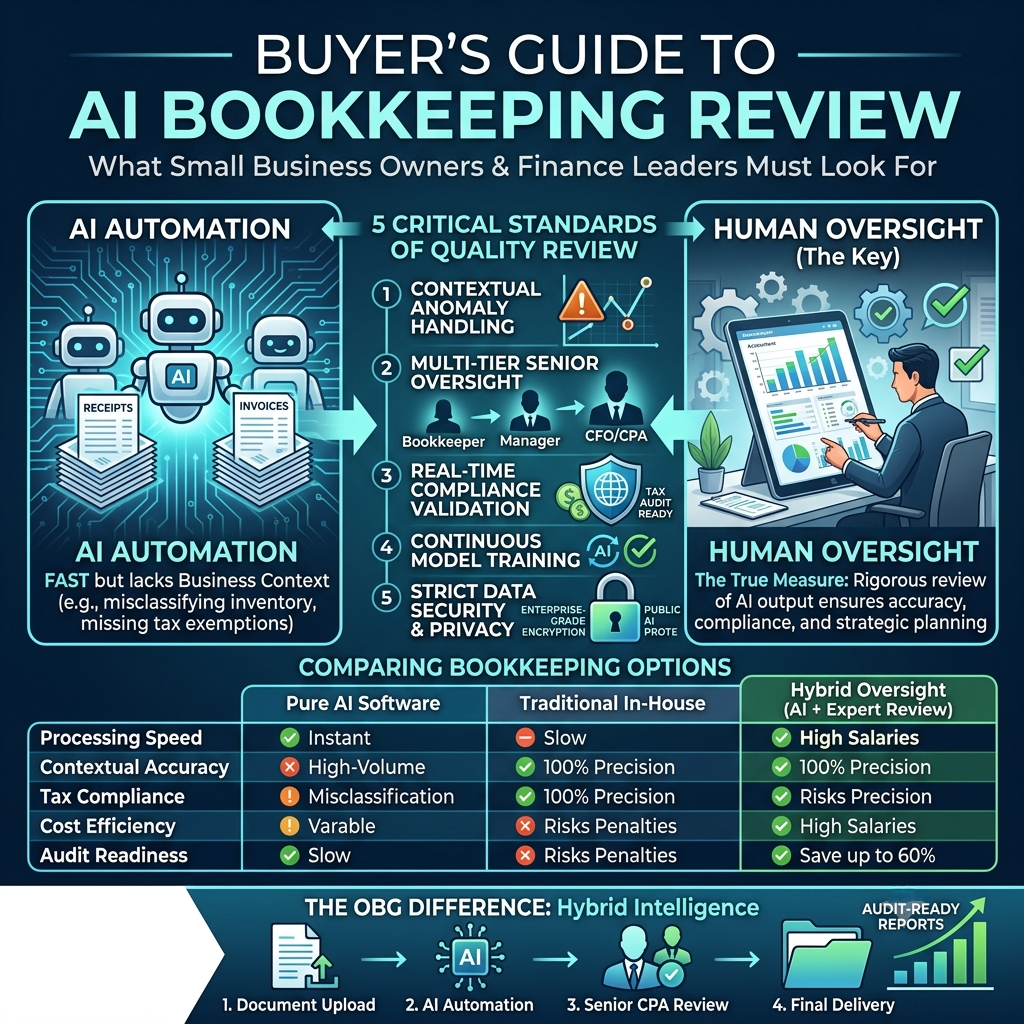
Automation has completely reshaped the financing and bookkeeping model of micro, small, and medium-sized enterprises (MSMEs). Machine learning models can extract receipt data, categorize bank transaction records, and complete transaction reconciliation quickly. However, automation that lacks qualified human oversight
will trigger risks such as missed tax credit claims, incorrect asset classification, and accumulated audit liabilities. This paper proposes a practical framework for evaluating the depth, processes, and qualifications of the human oversight layer, to help these enterprises expand their financial operations with peace of mind.
1. CPA-Led Verification vs. Basic Data-Checking
Not all manual audit processes meet required quality standards. Many low-cost bookkeeping service providers outsource audit work to data entry staff who have no formal accounting background. These staff only check whether supplier names match the information on receipts, a task that does not qualify as accounting work at all—it is merely basic data verification.
When reviewing an audit service provider’s audit model, please check for three core elements:
Accounting qualifications: Is the audit led or supervised by qualified accountants or certified public accountants? These professionals must be able to understand tax implications, the completeness of balance sheets, and GAAP/IFRS standards.
Scenario adaptation analysis: Will audit staff assess whether an expense aligns with your specific industry, rather than blindly following AI recommendations?
Threshold-triggered escalation mechanism: Are large-value transactions, intercompany transfers, and invoices from abnormal suppliers automatically routed to senior accounting staff for processing?
2. Clear Exception Handling and Feedback Loops
An efficient hybrid bookkeeping system not only identifies errors but also continues to learn from these errors. The human audit layer of the system must carry out long-term training of its AI model to reduce recurring anomalies, while consistently upholding strict compliance requirements. You may ask your potential suppliers how they address the following issues:
Ambiguous transactions: When the AI flags a suspicious entry, in what format will this information be shared with you? You should receive a structured, regular list of queries, rather than a stream of scattered, fragmented requests every day.
Continuous learning: If an accountant corrects the AI’s classification of an entry, will the system store this rule for your ledger, so you do not have to correct the same error again the following month?
Audit traceability and visibility: Every entry must display a complete record of its processing history—including the AI’s initial proposal, the identity of the auditor who reviewed it, and the reason for any correction made to the entry.
3. Industry-Specific Chart of Accounts Oversight
General-purpose AI models often force various financial transactions into overly broad, vague categories such as "office supplies" or "miscellaneous expenses". Over time, this messy classification greatly weakens a company's financial visibility and makes tax filing extremely difficult. Standardized manual reviews can deliver three core values:
Custom Mapping: All expenses can be matched to the enterprise's customized Chart of Accounts (COA), rather than forcing them into a rigid one-size-fits-all template.
Revenue Recognition Integrity: For complex scenarios such as SaaS recurring revenue, inventory cost of goods sold, and progress-based invoicing for construction projects, verification is completed by professionals who are proficient in revenue recognition timing.
Tax Deductibility Optimization: Qualified reviewers mark deductible items that standard algorithms often misclassify, such as equipment purchases covered by Section 179 of the U.S. tax code and specific business travel expenses.
4. Month-End Reconciliation and Financial Accuracy Guarantees
AI can keep daily ledger feeds clean, but month-end closing still requires structured financial judgment. True AI-assisted bookkeeping must culminate in a rigorous month-end close process led by experts.
Ensure your provider performs:
Three-Way Reconciliation: Verifying bank, credit card, and merchant processing accounts against balance sheet figures.
Accrual Adjustments: Handling depreciation, prepaid expenses, deferred revenue, and accrued liabilities that AI cannot automate on its own.
Executive-Ready Reporting: Delivering reviewed Profit & Loss statements, Balance Sheets, and Cash Flow statements with commentary on notable variances.
Evaluating Hybrid Bookkeeping Models
The authors of this paper designed an accounting supervision authenticity scorecard for bookkeeping solutions. This scorecard can distinguish between genuine professional supervision and mere formal compliance, and matches corresponding evaluation criteria one by one across three service levels and five core dimensions.
The OBG Outsourcing Advantage
OBG Outsourcing Private Limited deeply integrates cutting-edge automation technologies with rigorous accounting standards. Our services combine two core strengths: intelligent AI data collection tools, and a dedicated full-time accounting team that manages monthly bookkeeping, conducts audits, and reconciles accounts. We deliver both technological efficiency and professional reliability to owners of small and micro businesses and financial leaders. The financial statements we produce always meet tax filing requirements, reach investor-grade standards, and are completely accurate. Are you looking to upgrade your accounting system? Contact us today to access error-free bookkeeping services.
_(6).jpg)


1.png)
_(5).jpg)
.jpg)
_(4).jpg)
_(1).jpg)
_(2).jpg)
.png)