 USA
USA UK
UK Australia
 UAE
UAE Canada
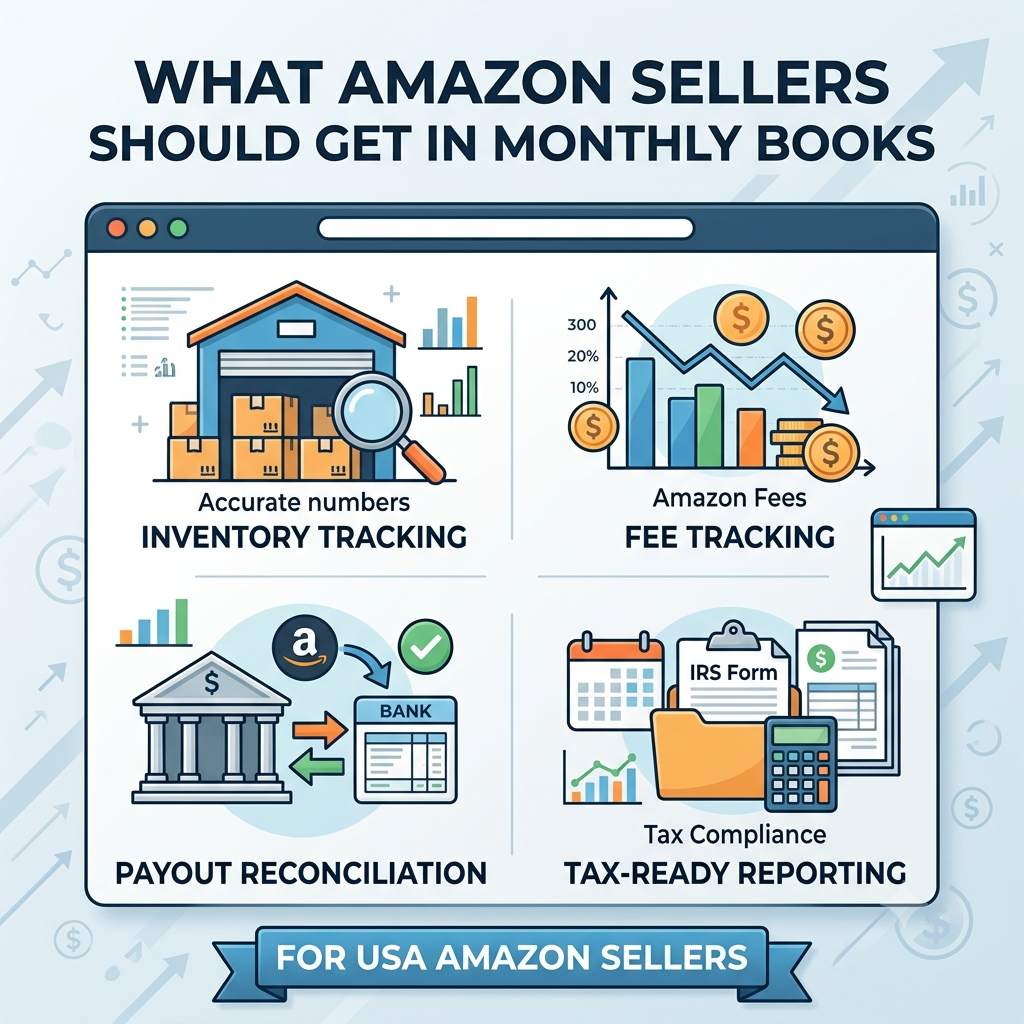
This article targets growing Amazon e-commerce sellers, and it first debunks a common misconception before laying out correct practices: if you directly record the $15,000 in bank deposits transferred to your corporate account from Amazon every two weeks as sales revenue, you will commit a core mistake in the common cash-basis bookkeeping method.
That sum is a net amount after deductions for referral fees, FBA fulfillment fees, storage fees, advertising costs, refunds, and reserve funds. Such erroneous accounting will distort your profit margins, conceal hidden costs, and leave you in a vulnerable position during tax season. Professional bookkeeping for Amazon sellers does not merely reconcile cash flow statements; it aims to achieve three key goals: enabling scalable profit growth, maintaining compliance, and providing auditable data for investors. The following sections will elaborate on the specific contents of a monthly financial reporting package.
Bi-Weekly Payout Reconciliation & Clearing Account Control
To manage the monthly bookkeeping for an Amazon store, three core bookkeeping requirements must be implemented: First, export all settlement reports of the current month from Seller Central, and split them into four independent line items: total sales, refunds, platform fees, and promotion fees. Second, set up a dedicated Amazon clearing account on the balance sheet to collect all payouts, and the account balance must return to zero after all payments are settled. Third, the unavailable balance reserved by the platform for chargebacks and returns must be listed as a current asset on the monthly balance sheet.
Granular Breakdown of Amazon Fees & Advertising Costs
Amazon’s fee structure is complex and multi-layered. If all platform fees are lumped into a single expense account labeled “Amazon fees”, you will not be able to identify exactly which stages are eroding your profit margins. Core expense categories to track on a monthly basis:
Referral fees: A percentage-based commission paid to Amazon for each completed sale, with the rate determined by the product’s category.
FBA fulfillment fees: The per-unit cost for Amazon to handle picking, packing, and shipping an individual customer order.
Warehouse fees: Itemized accounts that separate standard monthly FBA storage fees from long-term storage surcharges.
Sponsored Products pay-per-click (PPC) ads: Split records for advertising expenses that are deducted directly from seller disbursements, and those charged to an external credit card.
Inbound Transportation & Placement Fees: Shipping fees for sending stock to FBA fulfillment centers.
Refund and return processing fees: Separated from general platform fees to enable tracking of the actual return rate.
Accrual COGS & Active Inventory Asset Tracking
If you record product costs at the time you pay your suppliers, you will distort your financial statements. Spending $40,000 to purchase inventory in April does not mean your business operated at a loss that month—it was simply an exchange of cash for an inventory asset.
Proper cost of goods sold (COGS) management achieves these core goals:
Accrued COGS: Recognize costs only in the month when the corresponding goods are actually sold, to match revenues and expenses and calculate an accurate gross profit margin.
Landed cost calculation: COGS must include production costs plus inbound shipping fees, tariffs, port charges, and inspection fees.
Inventory asset valuation: The balance sheet must accurately reflect the value of all valid inventory stored in Amazon FBA warehouses, third-party 3PL warehouses, or in transit.
Reimbursement and impairment adjustments: Track Amazon’s reimbursements for lost or damaged inventory separately, and correctly write off unsellable or destroyed goods.
Tax-Ready Compliance & 1099-K Reconciliation
Every tax season, the Internal Revenue Service (IRS) directly obtains 1099-K forms from Amazon that record sellers' unadjusted total sales. If the income a seller reports on their tax return does not match the data on this form, an automatic audit alert will be triggered.
Core monthly compliance tasks: Maintain traceable records for 1099-K audits: Create a monthly reconciliation table to directly match the total monthly sales from the profit and loss statement with the total amount displayed on Amazon's internal tax dashboard.
Verify platform-collected sales tax: While Amazon remits sales tax on behalf of sellers for most U.S. states, collected sales tax and operating revenue must be clearly distinguished in accounting books to avoid double taxation or misreported tax obligations.
Track nexus and physical inventory across states: Monitor the location of inventory stored in Amazon FBA warehouses to ensure compliant tax filing in all states that impose nexus requirements.
Benchmark: Bank-Feed Bookkeeping vs. E-Commerce Bookkeeping
When general-purpose bank-based synchronized bookkeeping is adapted to Amazon cross-border e-commerce operations, it is riddled with flaws. It misidentifies net bank deposits as revenue, and hides platform fees within payout records. In contrast, e-commerce bookkeeping software purpose-built for this use case can split and separate operating revenue, categorize and aggregate platform fees, and accurately match the cost of goods sold. It can also isolate monthly operating activities, align with IRS compliance requirements, and resolve all these pain points.
Core Monthly Reporting Deliverables You Should Receive
At the end of each month, your bookkeeping partner must deliver a well-organized financial package tailored to support your decision-making needs, which includes the following content: Accrual-based profit and loss statement (P&L): This statement clearly lists total revenue, net revenue, cost of goods sold, gross margin, channel operating expenses, and net operating income.
Updated balance sheet: This document accurately presents the closing balances of cash, clearing accounts, inventory assets, Amazon reserves, liabilities, and owner’s equity. Cash Flow Statement: Revealing where cash went (e.g., inventory purchases, owner distributions, debt paydowns) beyond P&L profits.
Executive summary and key performance indicators: The analysis focuses on SKU-level gross margin, TACoS (total advertising cost of sales), inventory consumption rate, and payment collection trends.
Need Your Amazon Books Cleaned Up?
If your current monthly books only show bi-weekly deposits or leave inventory valuation as a mystery, it's time for a system built specifically for e-commerce accuracy.
_(6).jpg)


1.png)
_(5).jpg)
.jpg)
_(4).jpg)
_(1).jpg)
_(2).jpg)
.png)