 USA
USA UK
UK Australia
 UAE
UAE Canada
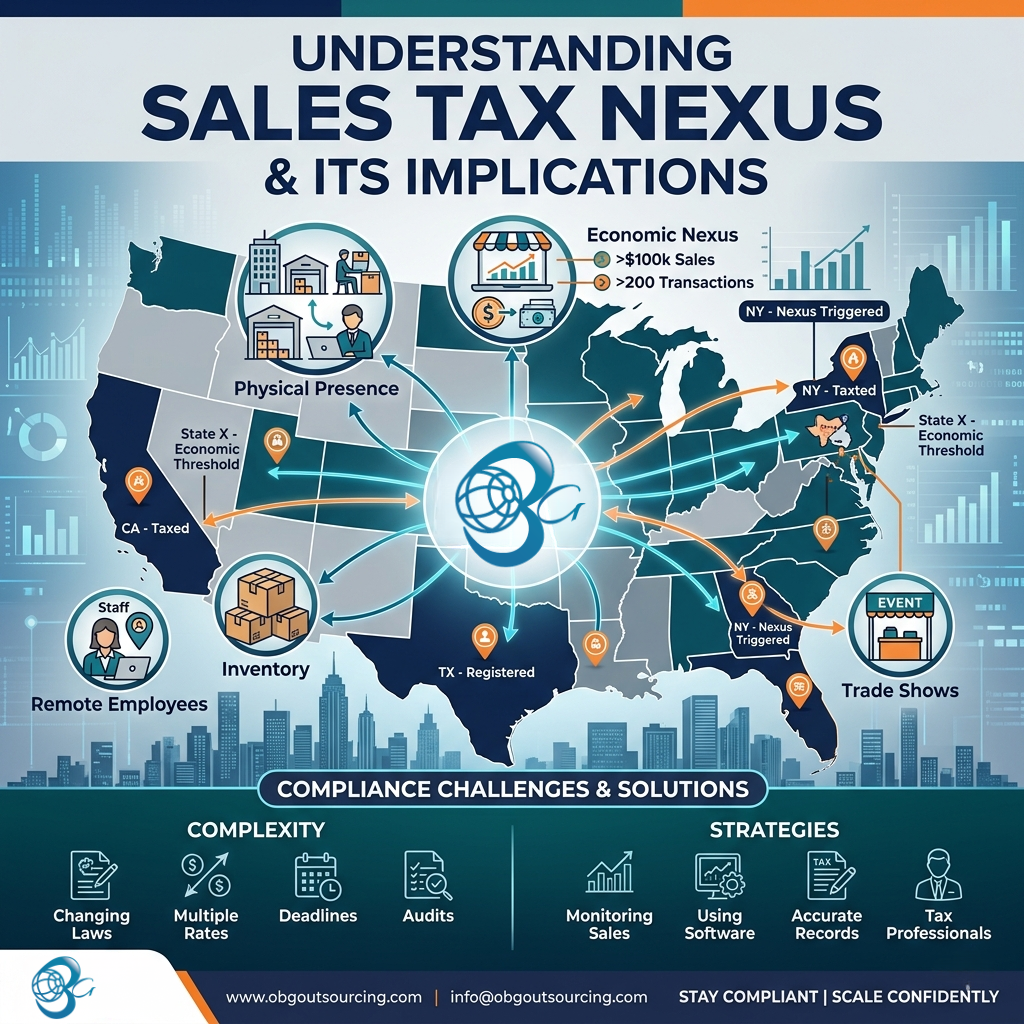
In today’s digital economy, businesses are no longer limited by geography. A company based in one state can easily sell products or services across multiple regions, creating exciting opportunities for growth. However, this expansion also introduces complex tax responsibilities that many business owners overlook — one of the most important being sales tax nexus.
For growing businesses, understanding the sales tax nexus is essential for staying compliant, avoiding penalties, and maintaining smooth financial operations. Whether you operate an eCommerce store, offer digital services, or manage a multi-state business, sales tax nexus directly impacts how and where you collect taxes.
At OBG Outsourcing, we help businesses simplify complex financial processes so they can focus on scaling with confidence.
What Is the Sales Tax Nexus?
Sales tax nexus refers to the connection between a business and a state that requires the business to collect and remit sales tax in that state. In simple terms, if your business has a significant presence or activity in a particular state, you may be legally obligated to charge sales tax to customers located there.
Traditionally, nexus was based on physical presence, such as:
Having an office or warehouse
Employing staff in the state
Owning inventory
Operating a retail location
However, the rise of online commerce has expanded the definition significantly.
The Rise of Economic Nexus
A major shift occurred after the 2018 South Dakota v. Wayfair Supreme Court decision. This ruling allowed states to enforce sales tax collection based on economic activity rather than just physical presence.
Today, many states apply economic nexus rules that trigger tax obligations once a business exceeds certain thresholds, such as:
A specific amount of annual sales revenue
A minimum number of transactions within the state
For example, if your online business generates substantial sales in another state, you may be required to register and collect sales tax there even if you have no physical office in that location.
This change has created new compliance challenges for businesses of all sizes.
Common Activities That Create Nexus
Many businesses unknowingly create nexus through everyday operations. Common triggers include:
Remote Employees
Hiring remote employees or contractors in another state can establish a nexus and create tax obligations.
Inventory Storage
Storing products in third-party fulfillment centers or warehouses may trigger nexus.
Trade Shows and Events
Participating in temporary business events or exhibitions in another state can create a taxable presence.
Affiliate Relationships
Working with affiliates, marketers, or referral partners in certain states may establish a nexus.
Online Sales Volume
Exceeding a state’s economic threshold through eCommerce sales is one of the most common nexus triggers today.
Why Sales Tax Nexus Matters
Ignoring sales tax nexus can lead to serious financial and legal consequences. Businesses that fail to comply may face:
Tax penalties
Interest charges
Backdated tax liabilities
Audits and investigations
Reputational risks
Sales tax errors can accumulate quickly, especially for businesses operating in multiple states. In some cases, companies may owe years of unpaid taxes.
Proactive compliance protects your business from unnecessary financial exposure.
Challenges Businesses Face With Nexus Compliance
Sales tax regulations vary significantly between states, making compliance difficult for growing businesses.
Some of the most common challenges include:
Constantly Changing Laws
Tax thresholds and regulations frequently change, requiring ongoing monitoring.
Multiple Tax Rates
Different cities, counties, and states may apply unique tax rates.
Product Taxability Differences
Certain products and services may be taxable in one state but exempt in another.
Registration Requirements
Businesses must often register separately in each state where nexus exists.
Filing Deadlines
States have different reporting frequencies and filing schedules.
Without proper systems in place, managing these obligations can become overwhelming.
How Businesses Can Stay Compliant
Managing the sales tax nexus effectively requires a strategic approach.
Monitor Sales Activity
Regularly review sales volume and transaction counts across all states.
Track Business Presence
Keep records of employees, inventory locations, and operational activities.
Use Automated Tax Software
Modern accounting and tax software can help calculate rates and track nexus thresholds.
Maintain Accurate Financial Records
Detailed bookkeeping is critical for tax reporting and audit protection.
Work With Tax Professionals
Experienced accounting and outsourcing professionals can help identify nexus exposure and ensure compliance.
The Role of Outsourcing in Sales Tax Management
As businesses grow, sales tax management becomes increasingly time-consuming. Outsourcing accounting and tax support can help companies:
Reduce compliance risks
Improve financial accuracy
Save administrative time
Stay updated on tax law changes
Manage multi-state reporting efficiently
At OBG Outsourcing, we provide reliable financial support tailored to modern businesses navigating complex tax environments.
Future Trends in Sales Tax Compliance
Sales tax regulations will likely continue evolving as digital commerce expands. Governments are increasing enforcement efforts and adopting more advanced reporting technologies.
Businesses should prepare for:
Greater digital tax monitoring
Increased audit activity
Expanding economic nexus rules
Automated tax reporting systems
More complex cross-border tax obligations
Companies that invest in strong compliance systems today will be better positioned for long-term success.
Final Thoughts
Sales tax nexus is no longer just a concern for large corporations. Small and mid-sized businesses operating online or across state lines must also understand their obligations.
By identifying nexus early, maintaining accurate financial records, and working with experienced professionals, businesses can avoid costly penalties and focus on sustainable growth.
Navigating sales tax compliance does not have to be overwhelming. With the right financial strategies and expert support, businesses can remain compliant while confidently expanding into new markets.
_(6).jpg)


1.png)
_(5).jpg)
.jpg)
_(4).jpg)
_(1).jpg)
_(2).jpg)
.png)