 USA
USA UK
UK Australia
 UAE
UAE Canada
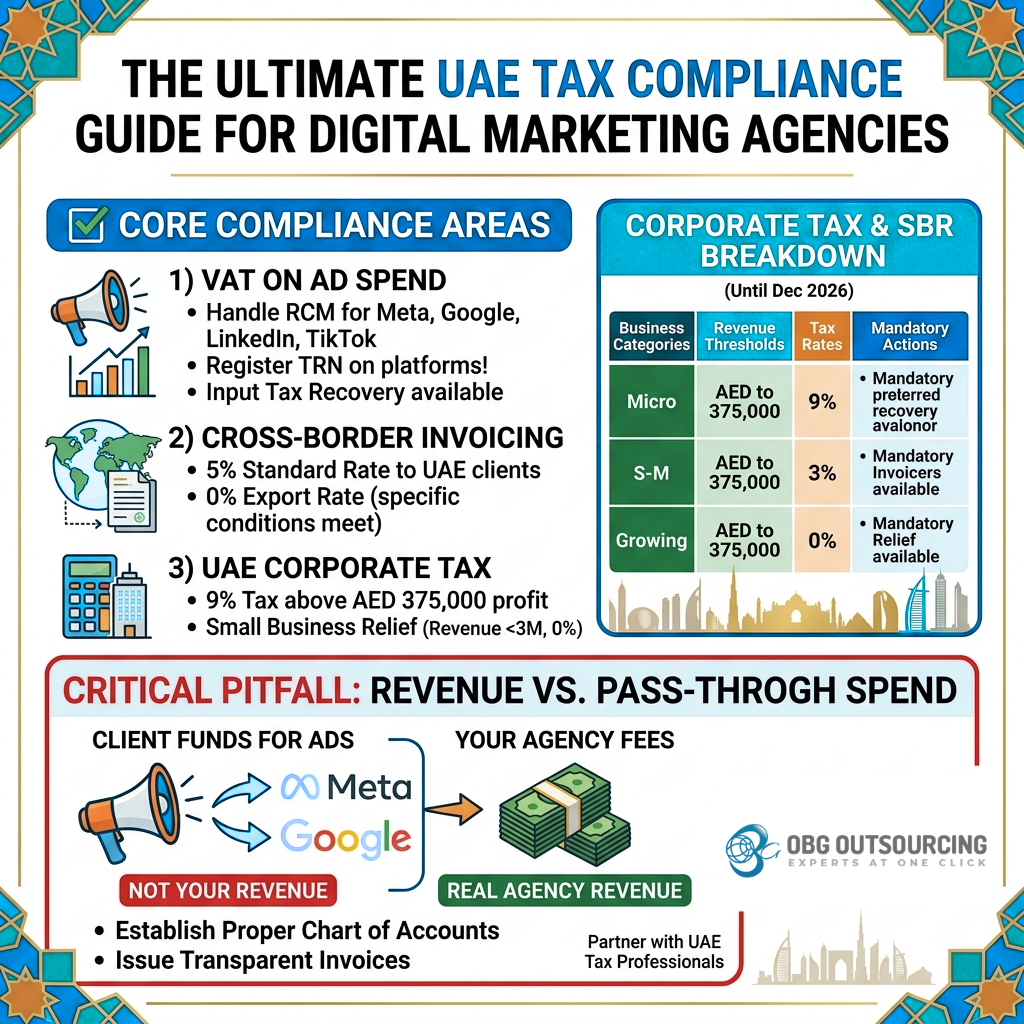
Starting a digital marketing agency in the UAE means operating within an industry whose relentless pace never slows down. You have to track revenue growth from client renewals, balance income and expenses for media placements, and hire to expand your creative team—with so many tasks piling up, tax compliance often gets pushed to the very bottom of your to-do list. But now the Federal Tax Authority (FTA) has been strictly enforcing relevant regulations. If your company’s financial structure is not sorted out, hefty administrative fines will directly eat into your profits. Whether you operate from Dubai Media City, a Free Zone, or the UAE Mainland, to uphold your compliance baseline, you must understand how local tax laws apply to three core areas of your business: your ad spend, cross-border invoicing, and client advance payments. The checklist below is the ultimate UAE tax compliance guide, curated exclusively for agency founders and finance leaders.
VAT on Ad Spend, covering the Reverse Charge Mechanism (RCM) and Input Tax Recovery. For digital marketing agencies, one of the most perplexing accounting tasks is managing media placement spend on global platforms including Meta, Google, LinkedIn, and TikTok. The most common pitfall here is that most of these international tech giants issue invoices from overseas entities, such as Meta Ireland or Google Ireland, and these invoices typically do not state the 5% VAT required by UAE local regulations. The corresponding compliance requirement is that as a UAE-based business receiving overseas services, you must apply the Reverse Charge Mechanism (RCM). When filing your regular VAT returns, you must declare this portion of tax in both the buyer and seller capacity. There are also clear rules for Input Tax Recovery: if your company is already VAT-registered, you can apply to recover this input VAT as long as you hold a valid tax invoice, and the ad spend is genuinely used for taxable business activities. There is an additional mandatory check item that will be audited for all companies: you must confirm that you have entered your company’s official Tax Registration Number (TRN) in your billing accounts with Meta and Google. An omitted or incorrect TRN will make this VAT unrecoverable, or lead to errors in cross-border transaction declarations.
Taxation for Cross-Border Invoicing, covering the distinction between the 0% rate and the 5% Standard Rate. When issuing service invoices to clients, whether you charge 0% or 5% VAT depends on the client’s registered location and the actual place of use of the services. First, the Standard Rate (5%): all clients based in the UAE, regardless of whether you provide digital marketing, SEO, creative design, or consulting services, must be charged this rate. The 0% rate (Export of Services exemption) is only applicable if specific conditions are met: you can apply this rate when providing services to international clients outside the UAE, but you must satisfy all conditions set out in the UAE VAT Law. These conditions are: the client’s business entity is registered outside the UAE; the actual place of use of the services is outside the UAE; the services have no direct connection to real estate located within the UAE.
UAE Corporate Tax and Small Business Relief
Under Federal Decree-Law No. 47 of 2022, the UAE Corporate Tax regime states that any portion of a business’s taxable income exceeding AED 375,000 is subject to a 9% tax rate; profits up to AED 375,000 are taxed at 0%.
| Business Category | Revenue Threshold | Tax Rate | Mandatory Action |
| Micro-Agency / Freelancer | Under AED 375,000 | 0% | Tax registration, file Annual Return |
| Small to Mid-Sized Agency | AED 375,000 – 3,000,000 | 0% (requires election for Small Business Relief) | Tax registration, file Annual Return |
| Growing Agency | Above AED 3,000,000 | 9% on taxable net profits exceeding AED 375,000 | Tax registration, maintain Audit Readiness, file Annual Return |
All agency founders must memorize the following key points to avoid errors or omissions. First, the Small Business Relief (SBR): this policy is not permanent, it is only valid until December 31, 2026. You are only eligible to apply if your corresponding tax period ends on or before this date. If in a single tax period, your company’s total revenue is below AED 3,000,000, you can elect for this policy. Once approved, your company will be deemed to have no taxable income, and therefore will not owe Corporate Tax on that portion. Even if you meet the criteria and benefit from the 0% rate under this policy, two requirements are non-negotiable: you must first complete Corporate Tax registration, and submit a simplified tax return as required. Missing either step puts you out of compliance.
In addition, if you run a company based in a UAE Free Zone, there is a critical note to prioritize: if you want to apply the 0% exemption rate to your “Qualifying Income”, you must meet a series of very strict compliance requirements to retain that exempt status. If your Free Zone company regularly conducts business and transactions with UAE Mainland businesses, this exemption status is very likely to be revoked, and you will then be required to pay Corporate Tax at the standard 9% rate.
Disambiguating Agency Revenue from Pass-Through Media Spend
When handling their accounting, digital marketing agencies often fall into a common pitfall: mixing client-transferred ad placement budgets with their own monthly client service fees in their bookkeeping, which artificially inflates the company’s reported revenue. First, you must distinguish what counts as reimbursable funds: if a client transfers money to your company first to cover ad spend on media platforms, which you then pass on to platforms like Meta and Google, these funds only flow through your accounts and are ultimately paid to third parties—they are Reimbursable Expenses. You must correctly record these outlays as pass-through payments, and never conflate them with your own agency’s revenue.
If you fall into this pitfall and classify pass-through ad spend as your agency’s direct revenue, the most immediate consequence is an artificial inflation of your total reported revenue. This inflated figure may cause your agency to lose eligibility for Small Business Relief, which you would have otherwise qualified for, by pushing your revenue over the AED 3,000,000 threshold. It could also trigger the mandatory VAT registration threshold of AED 375,000 prematurely, creating a host of additional compliance obligations that you would not have needed to address ahead of schedule. For this reason, you must establish a Proper Chart of Accounts in advance, issue clear and transparent invoices to your clients that fully separate pass-through costs from your agency’s actual gross profit, and close this loophole through standardized processes.
Partner with UAE Tax Professionals
Handling matters like VAT compliance, cross-border invoicing, and Corporate Tax structure setup cannot be done through self-guided trial and error—these tasks require specialized accounting knowledge to execute correctly. OBG Outsourcing Private Limited provides dedicated tax consulting services exclusively for digital marketing agencies and growing businesses across the entire UAE. We manage end-to-end accounting, tax registration and filing, and financial structure planning for digital marketing agencies, so you can focus on growing your business without any worries about compliance.
_(6).jpg)


1.png)
_(5).jpg)
.jpg)
_(4).jpg)
_(1).jpg)
_(2).jpg)
.png)