 USA
USA UK
UK Australia
 UAE
UAE Canada
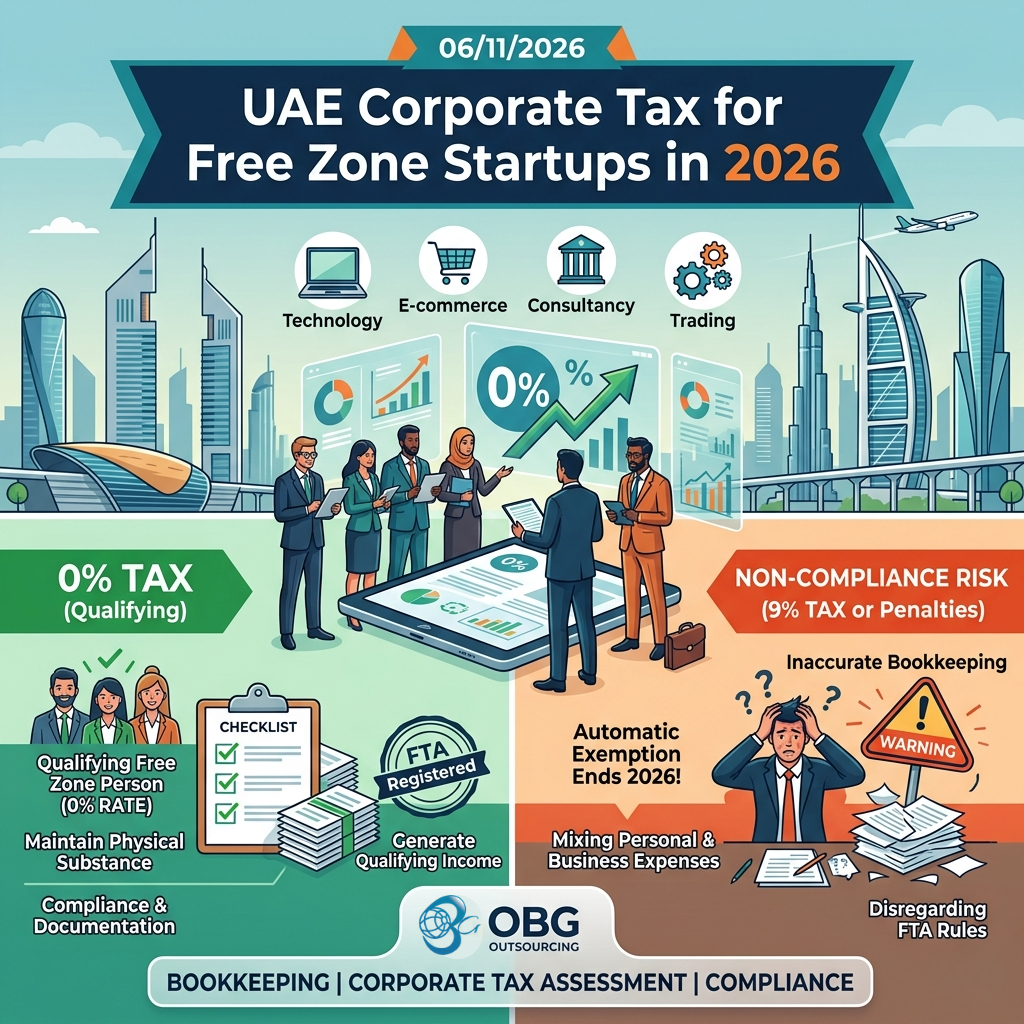
Establishing a corporate presence within the United Arab Emirates (UAE) free zones continues to be a highly appealing strategy for entrepreneurs, consultancies, technology firms, e-commerce platforms, trading entities, agents, and the global startup community. These designated zones provide substantial advantages, such as 100% foreign ownership, streamlined incorporation procedures, adaptable workspace solutions, global market accessibility, and a 0% corporate tax rate on qualifying income.
Nevertheless, effective 2026, operating within a free zone will no longer guarantee an automatic exemption from corporate tax liabilities. Emerging businesses will be required to meet five key compliance mandates: comprehending UAE corporate tax regulations, maintaining standardized financial records, registering with the Federal Tax Authority (FTA), submitting corporate tax returns, and assessing their eligibility for the 0% tax bracket.
Frequently, startups operate under the misconception that professional accounting, tax filing, and compliance support are unnecessary misjudgment that can precipitate significant operational risks. To mitigate these challenges, OBG Outsourcing offers comprehensive solutions, encompassing corporate tax assessment, accounting management, the preparation of compliant financial documentation, and end-to-end regulatory compliance support.
What Is UAE Corporate Tax?
The United Arab Emirates (UAE) corporate tax operates as a federal levy assessed on business profits within the jurisdiction. Applicable entities encompass UAE mainland corporations, free trade zone entities, and foreign enterprises fulfilling designated criteria. A 0% tax rate is applied to taxable income up to AED 375,000, whereas any income exceeding this threshold is subject to a standard 9% rate. Additionally, qualifying free zone companies that satisfy specific regulatory prerequisites may benefit from a preferential 0% rate on their eligible earnings. Ultimately, the effective tax liability for startup enterprises is contingent not solely upon their jurisdiction of incorporation, but also hinges on various factors, including revenue classifications, operational activities, client demographics, transactional structures, and regulatory compliance.
Does Corporate Tax Apply to Free Zone Startups?
The UAE corporate tax framework is applicable to start-ups registered within Free Trade Zones (FTZs). Under this regime, the tax obligations for standard FTZ-registered enterprises are explicitly outlined: such entities are required to complete corporate tax registration, maintain accurate accounting records, file tax returns, and ensure full compliance with all applicable tax regulations.
However, the 0% corporate tax incentive is exclusively reserved for qualifying FTZ entities that meet specific statutory criteria, and this preferential rate applies solely to their qualifying income. Consequently, a critical distinction exists regarding the tax eligibility of these two entity classifications. It is essential to recognize that a zero-tax treatment across all revenue streams is not an automatic entitlement derived merely from FTZ incorporation.
What Is a Qualifying Free Zone Person?
The United Arab Emirates (UAE) Corporate Tax Law explicitly outlines the definition of a Qualifying Free Zone Person. Entities that achieve this classification are eligible to benefit from a 0% corporate tax rate on their qualifying income. To preserve this advantageous status, organizations must satisfy seven mandatory conditions: maintaining adequate physical substance within the UAE, generating qualifying income, restricting non-qualifying income to prescribed regulatory limits, complying with transfer pricing regulations, retaining compliant documentation, preparing audited financial statements, and refraining from electing the standard 9% corporate tax regime. Consequently, it is highly recommended that startup enterprises initiate comprehensive tax planning upon incorporation, rather than deferring these critical preparations until the end of the fiscal year.
Why Free Zone Startups Should Not Ignore Corporate Tax
Many founders of start-ups located within the free zones of the United Arab Emirates (UAE) operate under the misconception that corporate tax is exclusively a concern for large enterprises. Even if a small start-up incurs zero tax liability, it remains obligated to fulfill standard compliance requirements. These mandatory duties include tax registration, meticulous bookkeeping, the preparation of financial statements, and formal tax filing.
Start-ups that fall under any of following operational scenarios must exercise heightened diligence regarding these regulatory requirements.
Sell services to UAE Mainland clients
Sell products inside the UAE
Trade internationally
Work with related parties
Have shareholders or group companies outside the UAE
Receive management fees, consulting income, royalty income, or commission income
Operate through online platforms
Provide digital services or software subscriptions
Have employees or contractors
Plan to raise investment or apply for banking facilities
Such scenarios include providing services to the local market, engaging in international trade, maintaining overseas shareholders, operating online, and preparing to secure external financing, among others. Ultimately, implementing a robust accounting system is essential for a start-up to accurately substantiate its revenue and expenditures, thereby ensuring the successful fulfillment of all corporate compliance mandates.
0% Corporate Tax for Free Zone Startups
Numerous startup founders elect to establish their corporate structures within the United Arab Emirates (UAE) Free Zones, primarily driven by the appeal of a zero-percent corporate tax policy. However, this favorable tax rate does not serve as a universal exemption; it is strictly contingent upon a company satisfying specific eligibility criteria and generating qualifying income. Prior to incorporation, below mentioned critical elements must be thoroughly evaluated:
What activity is mentioned on the trade license
Where customers are located
Whether customers are Free Zone, Mainland, or overseas clients
Whether the income is from qualifying activities
Whether any excluded activity is involved
Whether the company has proper substance in the UAE
Whether proper accounting records are maintained
Whether audited financial statements are required
Whether related-party transactions exist
The business activities outlined on the trade license, the geographical location of clients, the classification of the client entity (Free Zone, Mainland, or international), the generation of qualifying operating income, the presence of excluded activities, adherence to operational substance requirements, the maintenance of compliant accounting records, the provision of audited financial reports, and the management of related-party transactions. Ultimately, founders must avoid the misconception that all generated revenue automatically qualifies for the zero-tax benefit.
Common Example: Free Zone Startup Selling to Overseas Clients
Startups registered within a United Arab Emirates (UAE) free trade zone that provide software development services to international clients are eligible to apply for a 0% preferential corporate income tax rate. However, this tax benefit is not granted automatically. Entities must strictly adhere to all accounting and statutory compliance obligations; any regulatory violations will result in the forfeiture of this preferential tax status and expose the business to potential tax penalties.
Common Example: Free Zone Startup Serving Mainland UAE Clients
Consider a startup operating within a UAE free zone that delivers marketing, consulting, and IT services to domestic clients. It is essential to recognize that certain segments of this local revenue may not qualify for the UAE’s 0% corporate tax rate. However, only the specific non-qualifying income is excluded from this preferential treatment; the enterprise does not forfeit its broader tax benefits. Furthermore, relying exclusively on bank statements for tax documentation is inadequate. To ensure full regulatory compliance, businesses must maintain a comprehensive portfolio of records, including sales data, formal invoices, contracts, detailed client information, and complete accounting reports.
Small Business Relief and Free Zone Startups
Under the United Arab Emirates (UAE) Corporate Tax regime, eligible entities with revenues falling below the statutory threshold may benefit from the Small Business Relief provision. Generally, however, businesses designated as a Qualifying Free Zone Person are ineligible for this exemption.
Consequently, startups operating within free zones must carefully evaluate their tax positions by analyzing their specific revenue streams, business models, client profiles, and long-term strategic objectives. Prior to submitting their tax declarations, the majority of these enterprises will require a comprehensive compliance review conducted in partnership with qualified tax professionals.
Accounting Requirements for Free Zone Startups
For startups registered in the United Arab Emirates (UAE) free trade zones, standardized bookkeeping is no longer an optional practice. These entities are mandated to maintain accurate financial records from their date of incorporation, requiring the retention of following distinct categories of accounting materials.
Sales invoices
Purchase bills
Bank statements
Expense receipts
Payroll records
Loan documents
Shareholder transactions
Contracts with customers and suppliers
Free Zone license documents
VAT records, if registered
Related party agreements
Fixed asset records
Financial statements
Implementing standardized accounting practices is essential not only for facilitating corporate tax and Value-Added Tax (VAT) filings, compliance reporting, and banking documentation, but also for enabling founders to accurately evaluate their enterprise's profitability.
Why Startups Need Bookkeeping Before Tax Filing
Founders of early-stage startups frequently postpone organizing their financial records until the corporate tax filing deadline. This delay not only generates unnecessary stress but can also lead to financial complications mentioned below
Unreconciled bank accounts
Incorrect revenue classification
Personal expenses mixed with business expenses
Unclear shareholder withdrawals
Wrong treatment of owner contributions
Missing supporting documents
Incorrect VAT records
Poor expense categorization
Difficulty identifying qualifying income
Missing invoices
Corporate Tax Registration for Free Zone Companies
All enterprises operating within the free zones of the United Arab Emirates (UAE) are required to review the prerequisites and deadlines for corporate tax registration. It is mandatory that all registration procedures be executed solely through the EmaraTax platform. Applicants must compile a comprehensive portfolio of seven document types, encompassing business licenses, company incorporation records, the authorized representative's passport and Emirates ID, alongside other essential materials. Start-ups are strongly urged to process their applications promptly, as any delays in registration or tax filing will incur financial penalties.
Corporate Tax Return Filing for Free Zone Startups
Startups registered within free zones are mandated to file corporate tax returns, even if they hold a tax-exempt status. These submissions must accurately reflect the entity's tax standing and be substantiated by formal, standardized financial documentation. Prior to filing, a comprehensive review of ten specific components, including revenue and expenditures, is essential. Expedited or unverified submissions can result in subsequent complications should the Federal Tax Authority (FTA) request further clarification regarding the filing.
Audit Requirement for Free Zone Startups
Start-ups registered within a free trade zone (FTZ) must submit audited financial statements under two primary circumstances: to maintain their Qualifying Free Zone Person status and to comply with mandatory directives from FTZ authorities. These enterprises can determine their specific auditing obligations by evaluating seven key verification dimensions, which encompass FTZ regulations, corporate tax policies, revenue thresholds, license classifications, and other relevant factors. Furthermore, businesses must proactively manage their accounting processes to prevent the operational delays and supplementary costs associated with hasty, year-end financial compilations.
Common Corporate Tax Mistakes Free Zone Startups Make
Free Zone startups often make similar mistakes. Some of the most common are:
1. Misinterpreting Free Zone Status as a Tax Filing Exemption
Operating within a free zone does not absolve an enterprise of its corporate tax reporting and compliance obligations.
2. Failing to Verify Qualifying Income for the 0% Tax Rate
Enterprises must proactively assess and confirm the eligibility of their income to ensure it qualifies for the 0% corporate tax rate.
3. Commingling Personal and Business Expenses
Business and personal expenditures must be strictly segregated for accurate financial accounting and reporting.
4. Relying Exclusively on Bank Statements
Enterprises must maintain comprehensive and compliant accounting ledgers rather than depending solely on bank transaction histories.
5. Disregarding Related-Party Transaction Regulations
All financial disbursements to related parties must be substantiated with fully compliant supporting documentation.
6. Improperly Accounting for Domestic Revenue
Enterprises must ensure stringent and compliant accounting practices for revenue generated from domestic customers based within the UAE mainland.
7. Postponing Accounting Tasks Until Filing Deadlines
Delaying financial reconciliation until the immediate tax deadline significantly increases the risk of accounting inaccuracies and subsequent punitive measures.
8. Neglecting Value-Added Tax (VAT) Compliance
Proper adherence to both corporate tax and VAT regulations necessitates the continuous maintenance of robust and qualified accounting records.
Corporate Tax Planning Tips for Free Zone Startups in 2026
The authors of this paper delineate essential practical strategies for tax planning, specifically customized for startups operating within United Arab Emirates (UAE) free trade zones in 2026. At the outset, the document emphasizes that these enterprises must prioritize corporate tax compliance from their inception.
Here are some practical tips:
Set up accounting software early
Open a dedicated business bank account
Keep all invoices and receipts
Review trade license activity
Separate Mainland, Free Zone, and overseas income
Review qualifying and non-qualifying income
Maintain contracts with customers and suppliers
Track-related-party transactions
Reconcile bank accounts every month
Review of VAT registration requirements
Prepare annual financial statements
Check whether audit is required
File Corporate Tax returns on time
Work with an accountant familiar with UAE Corporate Tax
How OBG Outsourcing Helps UAE Free Zone Startups
OBG Outsourcing Services specializes in comprehensive financial and tax compliance outsourcing tailored specifically for startups operating within United Arab Emirates (UAE) free trade zones. The firm’s core expertise encompasses the entire spectrum of accounting, bookkeeping, value-added tax (VAT), and corporate tax management.
Accounting setup
Chart of accounts creation
Monthly bookkeeping
Bank reconciliation
VAT record maintenance
Corporate Tax registration support
Corporate Tax return preparation support
Qualifying Free Zone Person review support
Free Zone income classification
Financial statement preparation
Audit support schedules
Document organization
Tax compliance reminders
Management reporting
We help founders keep their books clean, tax-ready, and easy to understand.
Why Choose OBG Outsourcing?
Startups frequently lack practical accounting support and can become overwhelmed by intricate tax terminology. As founders focus their efforts on business expansion, they often have limited time to manage financial and tax compliance.
Our services are transparent, standardized, consistently compliant, and delivered on schedule, all supported by clear and straightforward communication. Operating across multiple locations in the United Arab Emirates (UAE)—including Dubai, Abu Dhabi, and all UAE free trade zones—we are fully equipped to manage your company’s finances and ensure comprehensive fulfillment of all corporate tax obligations.
File Your Tax Return Correctly
_(6).jpg)


1.png)
_(5).jpg)
.jpg)
_(4).jpg)
_(1).jpg)
_(2).jpg)
.png)