 USA
USA UK
UK Australia
 UAE
UAE Canada
After the United Arab Emirates (UAE) formally implemented its federal Corporate Tax (CT), the operating logic of local businesses has undergone a fundamental shift. The former practices of casual bookkeeping on spreadsheets and last-minute rushed accounting to patch records are no longer compliant. The UAE’s Federal Tax Authority (FTA) enforces strict regulatory oversight, so corporate financial records have transitioned from internal management tools into statutory documents subject to official review.
For small business owners and finance managers in the UAE, we remind you that the preparation period before the tax filing deadline is critically important. Misreporting caused by disorganized financial records can lead to severe fines, trigger tax audits, and result in the overpayment of taxes. To address this issue, we have launched a step-by-step practical guide to help you organize your accounts, achieve full compliance, and produce flawless, gap-free financial statements.
Why a Bookkeeping Cleanup is No Longer Optional
Under the corporate tax framework of the United Arab Emirates (UAE), the quality of accounting data directly impacts the compliance of tax filings.
Data flaws can easily trigger compliance risks, and comprehensive bookkeeping cleanup delivers three core values: First, it enables accurate calculation of taxable income,allowing businesses to pay the correct amount of tax per their actual circumstances and fully utilize all lawful deductions;
second, it achieves audit readiness, enabling businesses to respond to the document retrieval requirements of the UAE’s Federal Tax Authority (FTA);
third, it realizes compliance alignment, allowing for seamless connection between corporate tax filing data and historical value-added tax (VAT) filing data.
Step-by-Step Checklist for Your Bookkeeping Cleanup
This paper compiles a practical operational guidance for sorting out accounting and tax compliance prior to annual tax filing, which is tailored to meet the United Arab Emirates (UAE)’s local regulatory requirements. This guidance is designed for use by the in-house finance teams of UAE-based local enterprises, or their partnered outsourced accounting service providers.
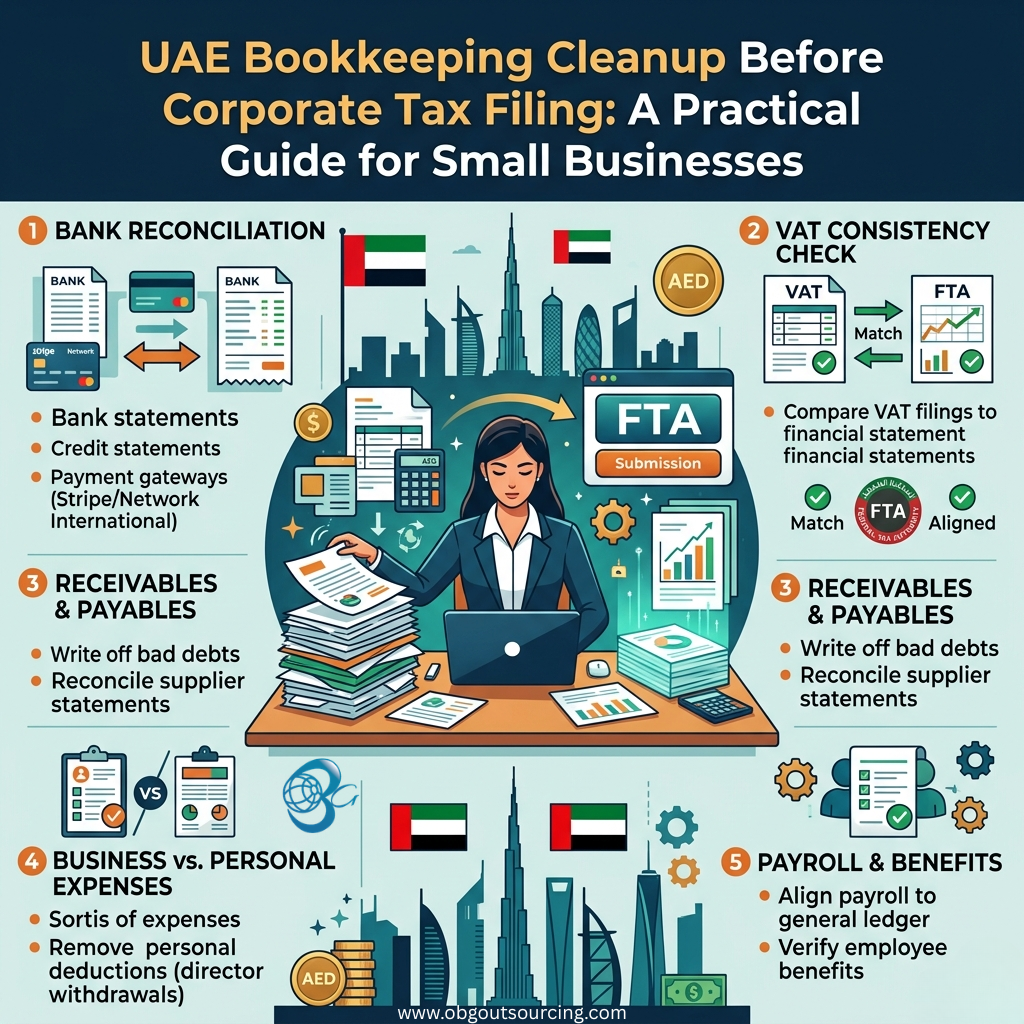
To help enterprises organize their accounts in line with tax requirements, we have defined five core operational procedures, all of which are strictly aligned with localregulatory rules. Unlike vague, generic guidance, this framework is highly actionable:
First, complete reconciliation of all bank and payment channel records. Reconcile fiscal year-end data for all bank accounts, credit cards, and payment gateways including Stripe and Network International, identify long-outstanding checks and ghost transactions, and correct common financial errors that cause mismatches between bank statement data and accounting software records;
Second, complete cross-verification of value-added tax (VAT) filings and financial statements to meet the consistency requirements of the UAE’s Federal Tax Authority (FTA). Align the total revenue from quarterly or monthly VAT filings with the total revenue recorded in the annual income statement, identify discrepancies such as out-of-scope transactions incorrectly categorized as tax-exempt or zero-rated, and avoid conflicts between corporate tax adjustments and past VAT filings;
Third, clean up accounts receivable and accounts payable. Write off bad debts that meet tax deduction conditions in accordance with UAE Corporate Tax (UAE CT) rules, and reconcile supplier statements to avoid understating liabilities;
Fourth, clarify the boundary between business and personal expenses. Audit directors’ current accounts and owner withdrawals, confirm that personal expenses paid through corporate accounts are not eligible for corporate tax deductions, and must be removed from the income statement;
Fifth, verify employee salaries and benefits. Align payroll records with the general ledger, and accurately accrue and categorize salaries, bonuses, and end-of-service benefits in compliance with the deduction limits set by UAE labor laws and UAE CT rules.
Corporate Tax vs. Accounting: Key Adjustments to Look For
The Value of Outsourcing Your Tax Readiness
If your small and medium-sized enterprise (SME) in the United Arab Emirates (UAE) relies solely on a lean in-house team to both complete the backtracking and cleanup of past accounting records and support daily business operations, your team will quickly become overwhelmed.
This is the core reason why a growing number of UAE businesses are choosing local professional accounting and corporate tax services at present.
OBG Outsourcing Private Limited can deliver three core values for your business:
First, end-to-end compliance, which covers the full process of daily bookkeeping, payroll management, VAT declaration, and year-end financial reporting;
second, expert oversight: our team is well-versed in the regulations of the UAE Federal Tax Authority (FTA), and conducts accurate account adjustments to reduce the risk of fines;
third, controllable costs: you can access senior tax expert resources and mature accounting infrastructure without bearing the operating costs of a full-time in-house finance team. We urge you to sort out your accounting records as early as possible.
Our exclusive services are opened specifically for UAE-based SMEs, and you may book a comprehensive book health check immediately.
Clean Up Your Books Today
_(6).jpg)


1.png)
_(5).jpg)
.jpg)
_(4).jpg)
_(1).jpg)
_(2).jpg)
.png)