 USA
USA UK
UK Australia
 UAE
UAE Canada
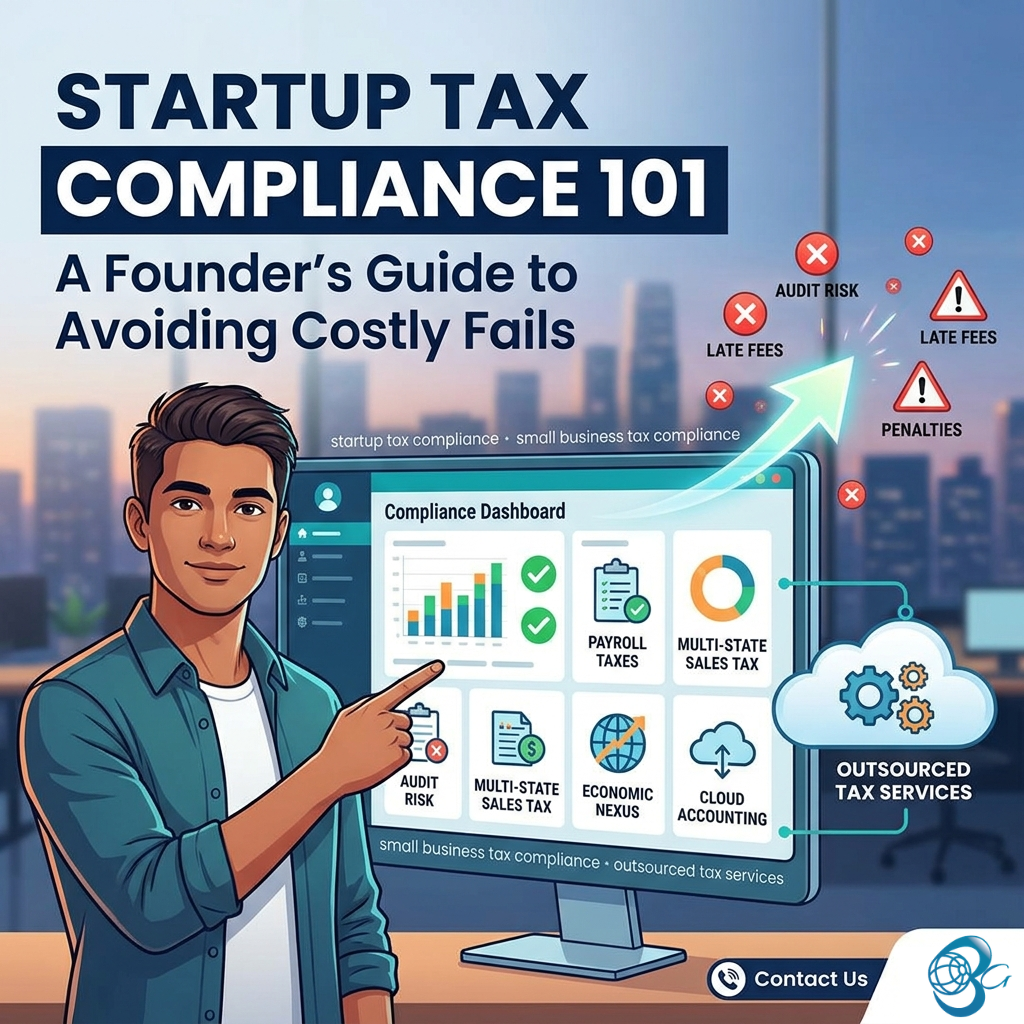
Let’s be honest: You didn't launch your startup to spend late nights squinting at tax code. You are here to build a product, scale operations, and disrupt your market.
But as your business gains traction, an inevitable partner enters the chat: the tax authority.
For new entrepreneurs, navigating tax compliance can feel like deciphering an alien language. But ignoring it isn't just a bad idea—it can actively kill an early-stage startup. Let’s break down exactly what you need to know to stay compliant, highly optimized, and audit-proof from day one.
What is Tax Compliance (and Why Does It Drag Startups Down)?
Many founders confuse tax strategy with tax compliance.
The Quick Distinction:
Tax Strategy: Legally restructuring your finances to minimize what you owe.
Tax Compliance: The mandatory operational rules that keep your business legal and your doors open.
Tax compliance means accurately tracking, filing, and paying your liabilities on time across local, state, and federal levels. When you’re scaling quickly, manual workflows invite human error—and tax authorities do not accept "we were too busy growing" as an excuse.
The 4 Compliance Pillars Every Modern Founder Must Master
Depending on your entity structure (LLC, C-Corp, or S-Corp), your exact footprint will vary. However, almost every modern startup has to manage these four core areas:
1. Corporate Income Tax
This is tax paid on your net business profits. If you operate as an LLC or S-Corp, this often "passes through" to your personal tax return. If you're a C-Corp, the business is taxed as its own entity.
The Catch: Missing deductions or failing to report freelance side revenue can trigger immediate penalties or flag you for an IRS audit.
2. Multi-State Sales Tax & "Economic Nexus"
If you operate an e-commerce or SaaS platform, you might owe sales tax in states where you don’t even have a physical office. Passing a state’s economic nexus threshold (usually a specific revenue target or transaction count) legally requires you to register, collect, and remit sales tax to that state.
3. Payroll Tax Liabilities
Hiring your first employee is a milestone. It also triggers strict withholding rules for Social Security, Medicare, and unemployment taxes.
The Risk: Falling behind on payroll compliance can result in severe penalties that place direct, personal financial liability on you as the founder.
4. Estimated Quarterly Taxes
Because businesses don't have taxes automatically deducted from their revenue, you must estimate and pay your taxes four times a year. Underestimating your earnings can result in unexpected interest fees at the end of the fiscal year.
3 Fatal Compliance Traps Growing Startups Fall Into
Trap 1: Co-mingling Funds Creates messy ledgers & audit risks.
Trap 2: Contractor Errors Misclassifying 1099 vs W-2 talent triggers massive fines.
Trap 3: Delayed Tracking Waiting until tax season to clear a year of back-bookkeeping.
Avoiding these traps is simpler than it looks, provided you shift from a reactive mindset to an automated one.
How to Automate Your Tax Workflow Without Losing Focus
You should be focused on product-market fit, not calculating local tax brackets. Building an automated, modern financial stack is the key to scaling sustainably.
1.Deploy a Cloud Accounting Stack:
Ditch spreadsheets. Adopt modern cloud software like QuickBooks, Xero, or NetSuite. Connect your corporate bank feeds directly so every expense is captured and categorized automatically in real time.
2.Establish Automated Compliance Systems:
Integrate specialized automation tools to automatically track your multi-state sales tax thresholds and process payroll deductions. This eliminates manual calculation errors before they happen.
3.Outsource to Elite Professionals:
Once your transaction volume scales, hand off the operational burden. Partner with an expert outsourced team to handle your monthly reconciliations, tax preparation, and audit trails securely in the background.
Scale Your Vision. Let OBG Manage the Math.
Tax compliance shouldn't be the anchor that slows your startup's momentum. When your financial backend is handled by experts, compliance transitions from a source of stress into a competitive advantage.
At OBG Outsourcing Private Limited, we act as the tech-driven, global accounting arm for fast-growing startups and enterprises. We provide end-to-end cloud bookkeeping, payroll administration, and multi-jurisdictional tax compliance services. Our specialists combine industry-leading automation tools with meticulous human oversight to ensure your business remains perfectly compliant—allowing you to focus entirely on raising capital and winning customers.
Don't let tax complexities stunt your growth. Contact OBG Outsourcing today to build an audit-proof financial engine for your business.
Outsource Your Startup Tax
_(6).jpg)


1.png)
_(5).jpg)
.jpg)
_(4).jpg)
_(1).jpg)
_(2).jpg)
.png)