 USA
USA UK
UK Australia
 UAE
UAE Canada
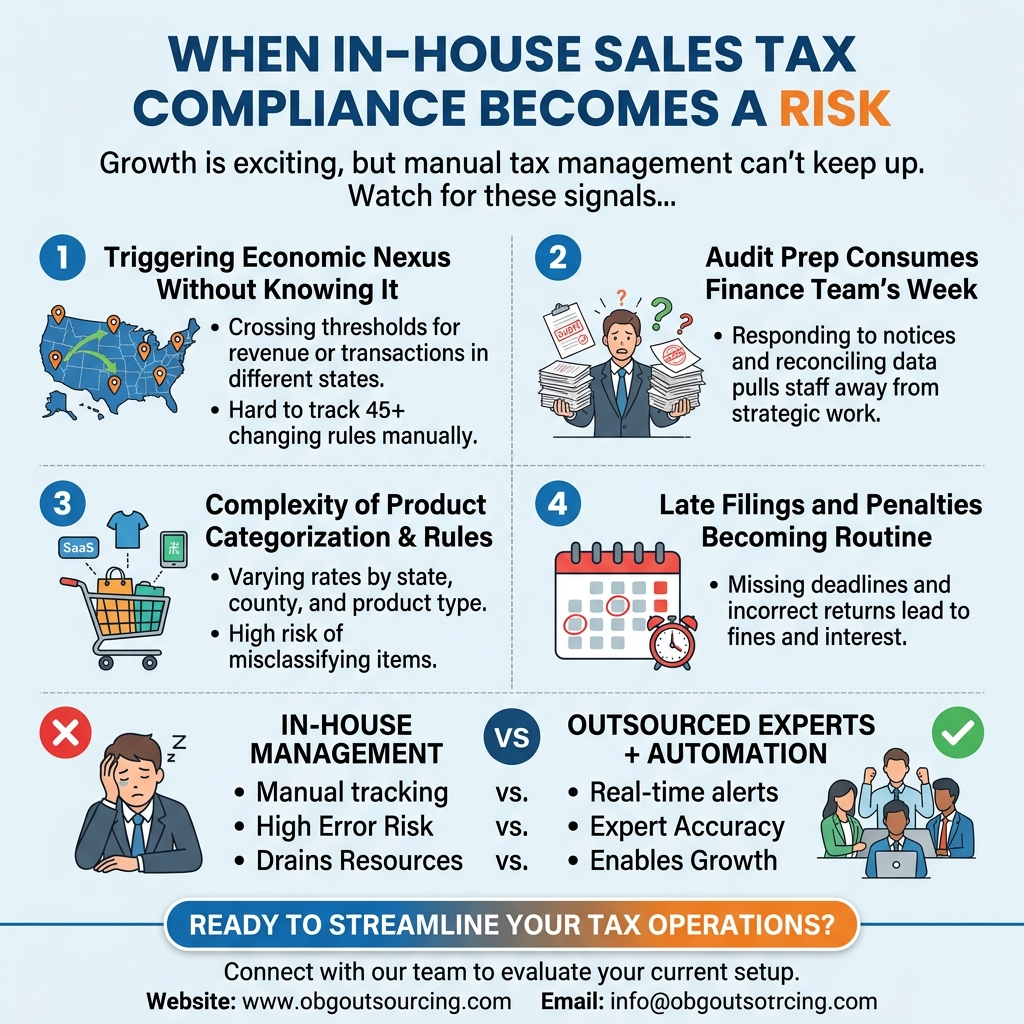
Managing sales tax internally works seamlessly in the early stages of a business. A few states, straightforward product lines, and manageable transaction volumes keep compliance simple. However, as your business expands—entering new channels, hitting economic nexus thresholds, or launching digital offerings—the manual effort required for sales tax compliance grows exponentially.
Eventually, reliance on internal resources shifts from a cost-saving measure to a bottleneck that exposes your organization to financial and audit risks.
Key Indicators Your In-House Sales Tax Process Is Failing
1. You are triggering new economic nexus thresholds without knowing it
Following the Wayfair ruling, physical presence is no longer required to create tax obligations. If your revenue or transaction volume in a state crosses state-specific thresholds, you must register, collect, and remit sales tax. Tracking these thresholds manually across 45+ states with differing rules creates huge blind spots.
2. Audit preparation consumes your finance team’s week
If state tax notices, audit inquiries, or discrepancy reconciliations regularly pull your accounting team away from strategic forecasting and core operations, your system is no longer scalable.
3. Product categorization and rules are getting too complex
Sales tax rates and rules vary not just by state, but by county and district—often down to specific product categories or SaaS delivery models. Manual filing increases the likelihood of misclassifying items, leading to under-collected tax and steep penalties.
4. Late filings and penalty notices are becoming routine
Missing filing deadlines, failing to track rate changes, or miscalculating tax return schedules are clear indicators that your in-house team is at capacity.
In-House vs. Outsourced & Automated Compliance
| Area | In-House Management | Outsourced Experts + Automation |
|---|---|---|
| Nexus Tracking | Manual monitoring of state revenue limits | Automated real-time threshold alerts |
| Audit Risk | High exposure to human error and missed notices | Low; filing accuracy backed by domain experts |
| Resource Allocation | Draws finance team away from core initiatives | Reclaims internal focus for business growth |
| Scalability | Struggles to handle sudden multi-state expansion | Seamlessly adapts to new markets and channels |
The Safer Path: Pairing Automation with Dedicated Expertise
Software automates calculation at checkout and generates filing reports, but software alone cannot handle state registrations, notice management, complex exempt-entity certificates, or audit defense.
Combining smart tax automation with dedicated outsourced tax experts delivers a complete compliance framework:
End-to-End Filing & Remittance: Returns are prepared, reviewed, and remitted accurately and on time across every required jurisdiction.
Proactive Nexus Monitoring: Receive timely notifications before crossing state-specific thresholds to avoid surprise retroactive assessments.
State Notice Management: Expert handling of correspondence, inquiries, and audits from state departments of revenue.
Scale Securely with OBG Outsourcing
At OBG Outsourcing Private Limited, we provide specialized sales tax compliance services designed to remove the complexity of multi-state tax management. By combining proven processes with scalable tax automation, we help growing businesses eliminate compliance risks, reduce overhead, and protect their bottom line.
Ready to streamline your tax operations? Connect with our team to evaluate your current setup.
Website: www.obgoutsourcing.com
Email: info@obgoutsourcing.com
_(6).jpg)


1.png)
_(5).jpg)
.jpg)
_(4).jpg)
_(1).jpg)
_(2).jpg)
.png)