 USA
USA UK
UK Australia
 UAE
UAE Canada
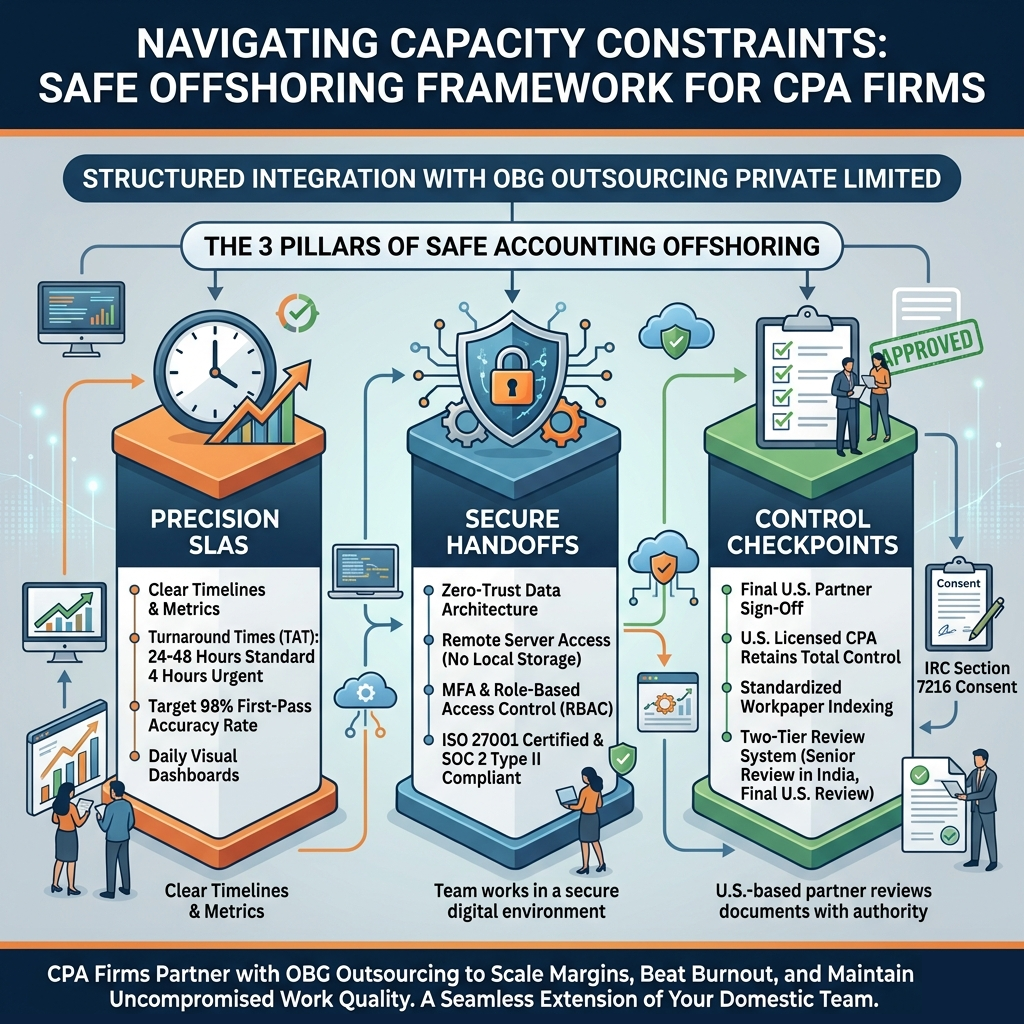
For today's certified public accountant (CPA) firms, there is only one top-priority task: withstand the pressure of business volume while strictly adhering to regulatory requirements, without any slack. These firms specialize in handling professional accounting and auditing work for clients, and most of them now have to overcome two major hurdles: first, they have received far too many orders, and their available manpower and office space cannot support the current workload; second, all their business processes and outcomes must fully comply with all industry regulations, with no room for any errors. Doing these two things well is the core, highest-priority requirement across all work, and no other task can take precedence over it.
If a firm wants to build an overseas delivery center to expand its production capacity, so that it can take on more business by setting up exclusive local work nodes overseas, there are two non-negotiable requirements: data must be absolutely secure—no leakage or misuse of any information related to clients or business is allowed—and the delivered work results must be completely error-free, with every calculation and every report accurate and flawless.
There is now a ready-to-implement action plan, specifically created for the partners and operations heads of CPA firms—the former are core managers who co-founded the firm and share its responsibilities, while the latter are leaders who oversee the daily operation of all the firm's business matters. By advancing step by step in accordance with this plan, firms can collaborate with OBG Outsourcing Private Limited to build a secure and smooth overseas outsourcing business process, and fully uphold the aforementioned bottom lines of security and accuracy throughout the entire process, avoiding any disruptions.
The 3 Pillars of Safe Accounting Offshoring
1. Defining Airtight Service Level Agreements (SLAs)
This implementable set of service level agreements is specifically designed to align the expectations of U.S. management partners and offshore execution teams, eliminating mismatches in the two sides' understanding of work requirements and delivery standards.
Turnaround Protocols: Strict Turnaround Times (TAT) rules must be set for all work. Turnaround time refers to the total duration from receiving a task to completing and submitting it—routine work such as regular bookkeeping and tax preparation must be completed within 24 to 48 hours; in the event of an urgent inquiry from a client, it must be handled within 4 hours.
Error Tolerance Thresholds: We have set a non-negotiable bottom line for the error rate. Before internal managers conduct audits, the First-Pass Accuracy Rate of submitted work must not be lower than 98%, meaning that for every 100 pieces of delivered work, at least 98 must be completely correct on their first submission.
Communication Cadence: The frequency and method of communication must be standardized. A visual dashboard is updated daily, allowing both sides to clearly view the progress of all work at a glance. Meanwhile, asynchronous messages are sent via Slack/Teams to synchronize progress—these are work updates that do not require an immediate reply from the recipient, which eliminates communication barriers caused by time zone differences, avoiding the scenario where one party is working while the other has already ended their workday and cannot receive messages.
2. Bulletproof Data Handoffs & Security
In cross-border financial services, you will always encounter a variety of issues that slow down progress. Among them, the most prominent and impactful barrier is the universal data security concern that plagues all parties.
By building a Zero-Trust data architecture, you can fully comply with all U.S. privacy-related regulations and avoid any violations.
The following are the specific configurations of this security system, detailed one by one:
Security Layer Standard Protocol OBG Operational Benchmark
Data Residency Remote Server Access: No data is stored locally; all operations are performed directly in the client's cloud/VPN environment, leaving no work data on the user's own local device.
Control: Supports Multi-Factor Auth (MFA); paired with hardware security keys for Role-Based Access Control (RBAC). These two mechanisms manage who can access data, reinforcing access barriers.
SecurityRestricted Office AccessBiometric: Only authorized personnel may enter the office, with biometric access required. A desktop cleansing policy is enforced, and camera-free work zones are established to block access from unauthorized personnel at the premises level.
Compliance requirements: Sign basic non-disclosure agreements NDA; relevant processes hold ISO27001 certification and comply with SOC 2 Type II specifications, meeting compliance standards across the entire chain, from foundational agreements to operational workflows.
3. U.S. Tax Control & Quality Assurance Checkpoints
Handing over the tax preparation work to others does not mean you can also shift off your responsibility. Even if you entrust part of the preparation work to others, if any problem arises in this matter, you still have to take on all the responsibility that originally falls on you, and you cannot shirk even a tiny bit of it.
To conduct solid quality control, you must not wait to conduct a single round of leak-checking at the last minute. Instead, you need to embed corresponding inspection nodes at every step throughout the entire tax filing process, to verify the status at any time:
IRC Section 7216 consent requirement: Before transferring any Tax Return Information (TRI for short) to overseas staff, you must first obtain the client’s explicit written consent that allows you to disclose such information. Without obtaining this consent, you must never even entertain the thought of transferring these tax-related documents that concern the client’s privacy overseas.
Standardized Workpaper Indexing: You must use workpaper software with a fixed structure, such as SurePrep and Engagement, to ensure that overseas tax preparation staff can organize and archive relevant materials line by line in accordance with unified standards. No matter who takes over the same set of materials, they can find the corresponding content following the unified index, without causing any chaos.
Two-Tier Review System: Every tax return must first undergo a round of review by an Indian Senior Reviewer, with all problems at this stage screened out, before it is transferred back to US-based reviewers to enter the next round of verification.
Partner Sign-Off: A US-licensed CPA must firmly control the final review, tax filing strategy and all signing authority, and hold onto all decision-making power for this last checkpoint from start to finish, and must not hand over this core power to others.
Why CPA Firms Partner with OBG Outsourcing
At OBG Outsourcing Private Limited, we are not an outsourced service provider disconnected from your team. Instead, we are an extension that can perfectly align with the pace of your in-house team — weadvance work smoothly alongside your own employees, with no disjointed disruptions, just like your team has gained a group of reliable backend support. All of our accounting professionals are based permanently in India, each with abundant work experience, and the accounting and finance work they handle is proficient and trustworthy. More importantly, in all our work, we meticulously and strictly adhere to U.S. compliance standards, never letting up in the slightest. If you run a CPA firm, partnering with us will tangibly boost your profit margins; you will no longer have to fear that an overwhelming backlog of work will crush your in-house employees, pushing them to the point of burnout where they can no longer keep up. At the same time, the quality of all delivered work remains consistently stable, with no compromises whatsoever.
_(6).jpg)


1.png)
_(5).jpg)
.jpg)
_(4).jpg)
_(1).jpg)
_(2).jpg)
.png)