 USA
USA UK
UK Australia
 UAE
UAE Canada
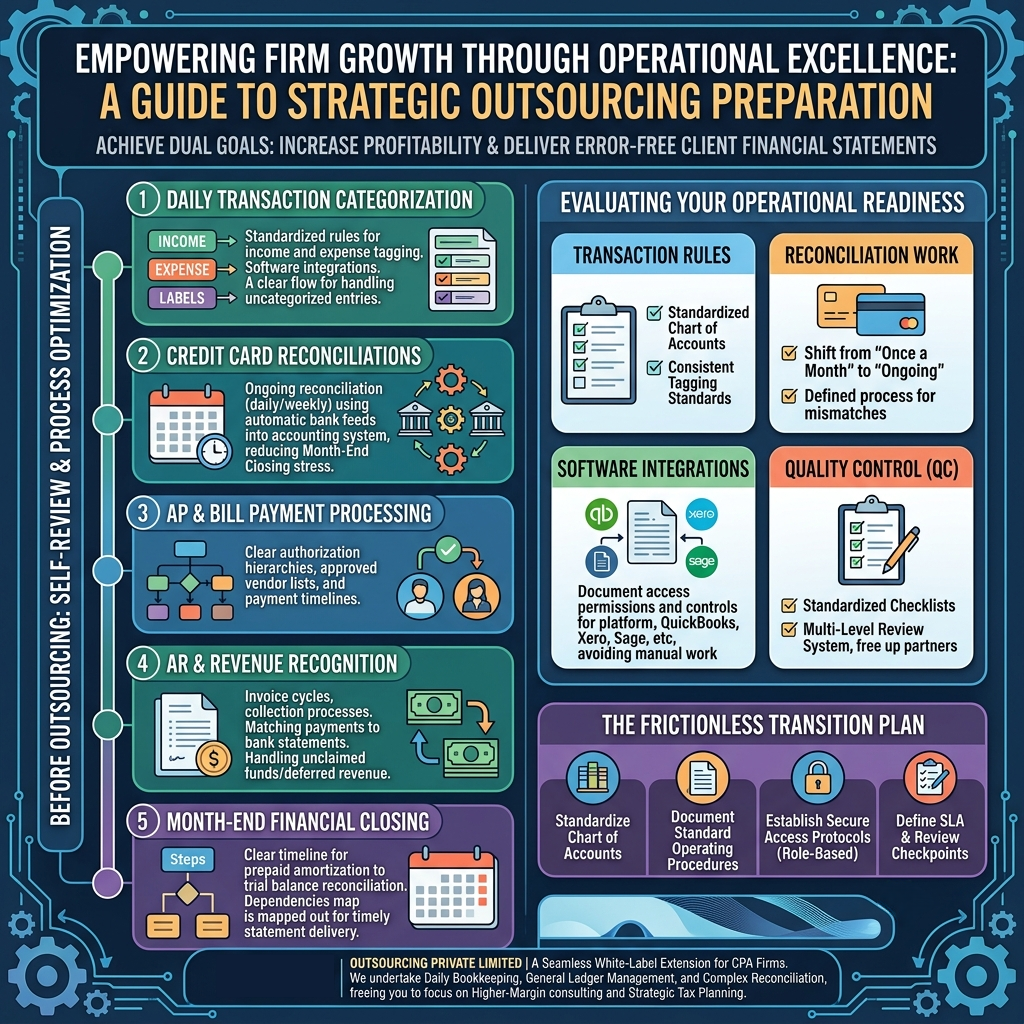
Growing accounting firms or mid-sized financial services institutions hold two hard goals that must be achieved simultaneously: one is to increase their own profits, and the other is to deliver error-free financial statements to clients. To deliver on both of these, they must first straighten out their internal operational processes, standardize and clarify every step of operation, and avoid any ambiguity or chaos.
Those repetitive, uniformly standard routine transaction processing tasks do not need to be shouldered by their core in-house employees. By outsourcing this type of work to a specialized bookkeeping services team, the CPA-leading partners can free up these high-value internal employees to reassign them to higher-margin business lines—either to work on consulting projects that create more value for clients, or to tackle more complex and rewarding strategic tax planning, focusing their efforts on areas that truly generate more revenue.
Before fully handing over their work, the firm's operations leaders must not rush to sign a contract and offload responsibilities. Instead, they must systematically conduct a self-review of their internal core workflows first. Many people mistakenly view outsourcing as a one-size-fits-all cure-all, but it is not—if your own work processes have flaws, chaotic division of labor, and poor handovers, outsourcing will not fix these problems. On the contrary, it will amplify the original minor issues, which eventually accumulate into unmanageable major troubles.
Core Workflows to Assess Before Delegating
To successfully hand over accounting work to an outsourcing team, you must first sort out the following core workflows clearly, conduct a self-review and organization of each item one by one, then hand over the organized rules, so as not to carry over old problems into the outsourcing stage.
Daily Transaction Categorization: First organize the tagging rules for income and expense items in all client accounts. Clarify how each credit and debit entry is categorized and tagged in each client's account. Establish unified standards in advance for software integrations, rule-based automated processing, and the handling of uncategorized entries, to avoid work backlogs and prevent the general ledger from falling into disarray. Set unified rules for how all financial software are connected and integrated, which routine accounts can be pre-configured for automated processing, and what process to follow for scattered entries that cannot be directly categorized. Only then can you avoid accumulating mountains of pending work, and prevent the general ledger that consolidates all accounts from becoming a tangled mess.
Credit Card Reconciliations: Audit the current timeline you use to match balance sheet accounts with real-time statements. Verify whether your scheduled reconciliation progress is reasonable—that is, how frequently you cross-check the balance sheet account data recorded in your books with the real-time statements issued by banks. Standardizing daily bookkeeping and reconciliation processes allows you to identify errors immediately, instead of waiting to address problems during the high-pressure Month-End Financial Closing period. By locking the daily bookkeeping and regular reconciliation processes into unified standards, errors can be spotted and corrected on the spot, rather than having a flood of problems emerge that require emergency fixes at the end of each month, when everyone is overwhelmed by the rush to complete the closing and meet deadlines.
Accounts Payable (AP) and Bill Payment Processing: Reorganize authorization hierarchies, vendor qualification standards, and approval circulation paths. Clarify what level of authorization application is required to make a payment, which vendors can be added to theList of Collaborators, and which people a bill's approval application must pass through, in what order. Outsourced accounting partners need to receive clear rules, including single-entry approval requirements, the monetary threshold for dual-person authorization, and payment timelines, to safeguard cash flow security. The outsourced accounting team that takes over the work must be given unambiguous operating rules—what requirements each entry's approval must meet, what payment amount requires two people's signature authorization, and what timeline to follow for scheduling payments for different types of funds. Only when all rules are clear can the company's cash flow security be protected and avoid problems.
Accounts Receivable (AR) and Revenue Recognition: Sort out invoice generation cycles, payment collection processes, and rules for matching incoming payments to bank statements. Clarify the cycle for issuing invoices to clients, the process to follow for following up and collecting overdue payments after a client has been invoiced, and how to match incoming payments from clients one-to-one with records in bank statements. Establish clear processing specifications for unclaimed funds and deferred revenue, to be able to output accurate dynamic financial reports. By setting clear processing rules for temporarily unassignable unclaimed funds and deferred revenue that must be recognized later, the dynamic financial reports you produce will be accurate and reliable.
Month-End Financial Closing: List the specific time nodes for each closing step into a clear process—this includes everything from prepaid expense amortization and journal entry submission to trial balance reconciliation. From the amortization of prepaid expenses, the submission of journal entries for each account, to the final reconciliation of the trial balance, write out clearly when each step should be completed and what needs to be done. Document the dependencies between each step to deliver financial statements smoothly each month. Record which steps can only start after the previous work is completed, and what binding requirements exist between each link, so that each month's financial statements can be delivered on time without bottlenecks.
Evaluating Your Operational Readiness
The first core workflow focus area to sort out is Transaction Rules.
Before outsourcing routine financial work, you must first organize the most basic account classification logic on your end. There are two common internal bottlenecks in this area: first, different employees have completely inconsistent standards for tagging each account line item. One person categorizes an entry under this category, another records it under that item, and over time, the second problem emerges—expenses that cannot be clearly classified pile up more and more, turning into an unmanageable mess of unorganized accounts. To reach the ready state for outsourcing this work, you must first have two things in place: you need a set of Standardized Chart of Accounts, and you must also set clear, dedicated tagging rules tailored to the specific situation of eachCooperationclient. All staff will follow the same standard for bookkeeping, eliminating classification chaos.
The second core workflow focus area to sort out is reconciliation work.
Reconciliation is a critical step to verify that each credit and debit entry matches bank statements. If this area is not properly organized, it will lead to major problems later on. A common internal bottleneck for many teams is putting off all reconciliation work until the end of each month, causing it to pile up until it cannot be completed in time. When tax season arrives and materials must be submitted, they are forced to work overnight to rush through the work, leading to a very high probability of errors and omissions. To reach the ready state for outsourcing, you must adjust the reconciliation rhythm from "accumulating once a month" to "following up on an ongoing basis": bank statement data can be automatically synced into the system daily or weekly, eliminating the need for manual file uploads. You must also set rules in advance: if a mismatch or deviation is found in the accounts, what process to follow to report the issue and who to assign it to, so that every step is orderly, problems can be addressed the day they arise, and they do not drag on into major burdens.
The third core workflow focus area to sort out is Software Integrations.
Currently, many online tools are used for financial work, and if tools are used chaotically, integration becomes a major problem. A common internal pitfall is that the tools in use are scattered and do not form a coherent system. Every time data is exported, CSV files must be manually uploaded, which is not only tedious but also error-prone. What is more, no one tracks and records when these technical tools receive updates or what content is updated, leading to a situation where compatibility problems catch everyone off guard when they arise. To meet the standards for outsourcing, you must first clearly organize the access permissions for these software: document the access permissions for the financial software you regularly use, such as QuickBooks, Xero, and Sage, and be able to assign secure, compliant usage permissions to users in different positions. Define clearly who can view what and edit what, with clear controls, so there is no risk of unauthorized operations or information leakage.
The fourth core workflow focus area to sort out is Quality Control (QC).
The accuracy of financial data depends entirely on quality control checks. Many teams have chaotic processes in this area, and the most common problem is the lack of a standardized inspection checklist. Even for routine daily data entry, staff are afraid to proceed without review by a senior partner-level employee, which consumes a large amount of core employees' time on this basic work, making it impossible for them to work on higher-value businesses. To reach the ready state for outsourcing, you must first build several key systems: first establish a multi-level review system to lower the review threshold, so that not every issue needs to be escalated to a partner. You must also write clear inspection checklists that specify what to check for each item and what standards must be met to pass. Before the final financial materials are delivered to clients, all review processes can be completed according to the checklist, which can both enforce quality standards and free up core employees' energy.
Building a Frictionless Transition Plan
To successfully complete the handover of work, you must implement the following items one by one:
Standardize the Chart of Accounts: Align industry-specific sub-accounts, so that the offshore team can accurately and standardize entries from their first day on the job.
Document Standard Operating Procedures: Establish clear, explicit processing rules for special circumstances, missing receipts, and suspicious client transactions, so that even a new employee who has never been exposed to this business will not get stuck due to uncertainty about the rules.
Establish Secure Access Protocols: In platform suites such as QBO, Xero, and NetSuite, adopt secure credential management methods and assign role-based access permissions, so that staff in different positions can only access the financial data within their scope of responsibility. This will not hinder work progress, while also upholding the bottom line of data security.
Define SLA and Review Checkpoints: Set completion timelines for daily statement synchronization, weekly reconciliation, and month-end closing. Lock in the delivery nodes for each work item clearly, to avoid process delays and disconnected work handovers.
OBG Outsourcing Private Limited is a seamless white-label extension team that provides services for CPA firms. We undertake firms' daily basic bookkeeping, multi-entity general ledger management, and complex reconciliation work, helping growing firms improve their capacity to take on new business, maintain strict compliance standards, and focus on their own development.
_(6).jpg)


1.png)
_(5).jpg)
.jpg)
_(4).jpg)
_(1).jpg)
_(2).jpg)
.png)