 USA
USA UK
UK Australia
 UAE
UAE Canada
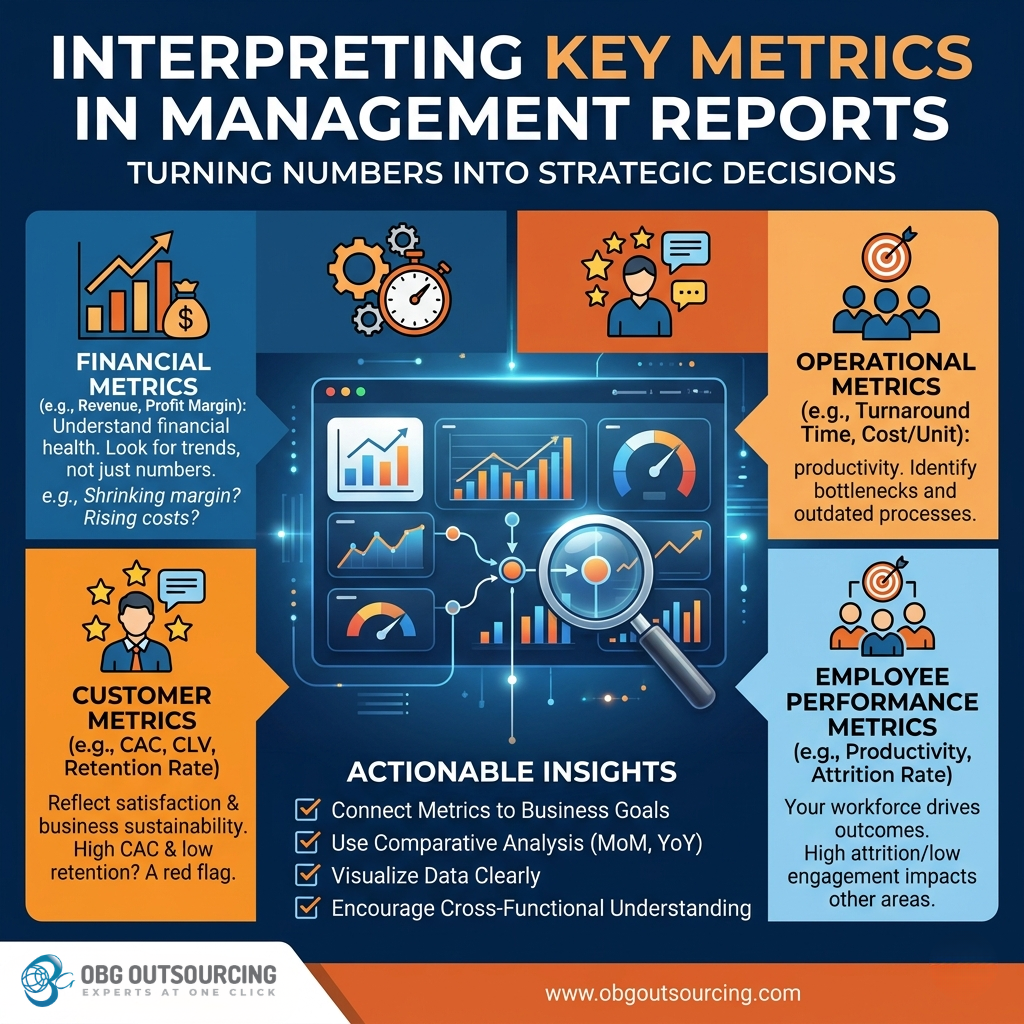
In today’s data-driven business environment, management reports are no longer just static documents—they are powerful decision-making tools. Yet, many organizations struggle not with collecting data, but with interpreting it correctly. Numbers alone don’t drive growth; insights do.
At OBG Outsourcing (www.obgoutsourcing.com), we believe that understanding key metrics is what transforms reports into roadmaps for success. This blog explores how to decode management reports effectively and use them to guide smarter business decisions.
Why Metrics Matter More Than Ever
Modern businesses generate vast amounts of data daily—sales figures, operational costs, customer behaviors, and more. However, without proper interpretation, these metrics can become overwhelming or even misleading.
The real value lies in:
- Identifying trends early
- Spotting inefficiencies
- Making proactive decisions
- Aligning teams with strategic goals
The Core Categories of Management Metrics
Understanding metrics begins with grouping them into meaningful categories:
1. Financial Metrics
These provide insight into the company’s financial health.
Key examples:
- Revenue growth rate
- Net profit margin
- Operating expenses ratio
- Cash flow trends
How to interpret:
Look beyond surface numbers. A revenue increase with shrinking profit margins could indicate rising costs or pricing issues.
2. Operational Metrics
These measure efficiency and productivity.
Key examples:
- Process turnaround time
- Capacity utilization
- Cost per unit
- Error or defect rates
How to interpret:
Consistent delays or rising costs per unit may signal bottlenecks or outdated processes.
3. Customer Metrics
These reflect customer satisfaction and business sustainability.
Key examples:
- Customer acquisition cost (CAC)
- Customer lifetime value (CLV)
- Retention rate
- Net Promoter Score (NPS)
How to interpret:
A high CAC with low retention is a red flag—it means you're spending heavily to gain customers who don’t stay.
4. Employee Performance Metrics
Your workforce drives your outcomes.
Key examples:
- Employee productivity rate
- Attrition rate
- Training effectiveness
- Engagement scores
How to interpret:
High attrition combined with low engagement can directly impact operational performance and customer satisfaction.
Common Mistakes in Interpreting Metrics
Even experienced managers can misread reports. Here are pitfalls to avoid:
? Focusing on isolated metrics
Looking at a single KPI without context can lead to incorrect conclusions.
? Ignoring trends
A one-time spike or drop may not be significant—but consistent patterns are.
? Overlooking external factors
Market conditions, seasonality, or industry shifts can influence results.
? Data overload
Too many metrics can dilute focus. Prioritize what truly matters.
Turning Data into Actionable Insights
To make management reports truly effective, follow these principles:
? Connect metrics to business goals
Every number should answer a strategic question.
? Use comparative analysis
Compare:
- Month-over-month
- Year-over-year
- Against industry benchmarks
? Visualize data clearly
Charts, dashboards, and summaries make interpretation faster and more accurate.
? Encourage cross-functional understanding
Finance, operations, and marketing teams should interpret metrics collaboratively.
The Role of Outsourcing in Better Reporting
Many businesses struggle due to limited expertise or time constraints. This is where outsourcing can make a significant difference.
At OBG Outsourcing, we help organizations:
- Design customized management reports
- Identify the most relevant KPIs
- Provide expert analysis and interpretation
- Enable data-driven decision-making
With the right support, your reports can evolve from routine documents into strategic assets.
Final Thoughts
Interpreting key metrics isn’t just a technical skill—it’s a strategic advantage. Businesses that master this capability can anticipate challenges, seize opportunities, and stay ahead of the competition.
Remember:
Data tells you what happened. Interpretation tells you what to do next.
_(6).jpg)


1.png)
_(5).jpg)
.jpg)
_(4).jpg)
_(1).jpg)
_(2).jpg)
.png)