 USA
USA UK
UK Australia
 UAE
UAE Canada
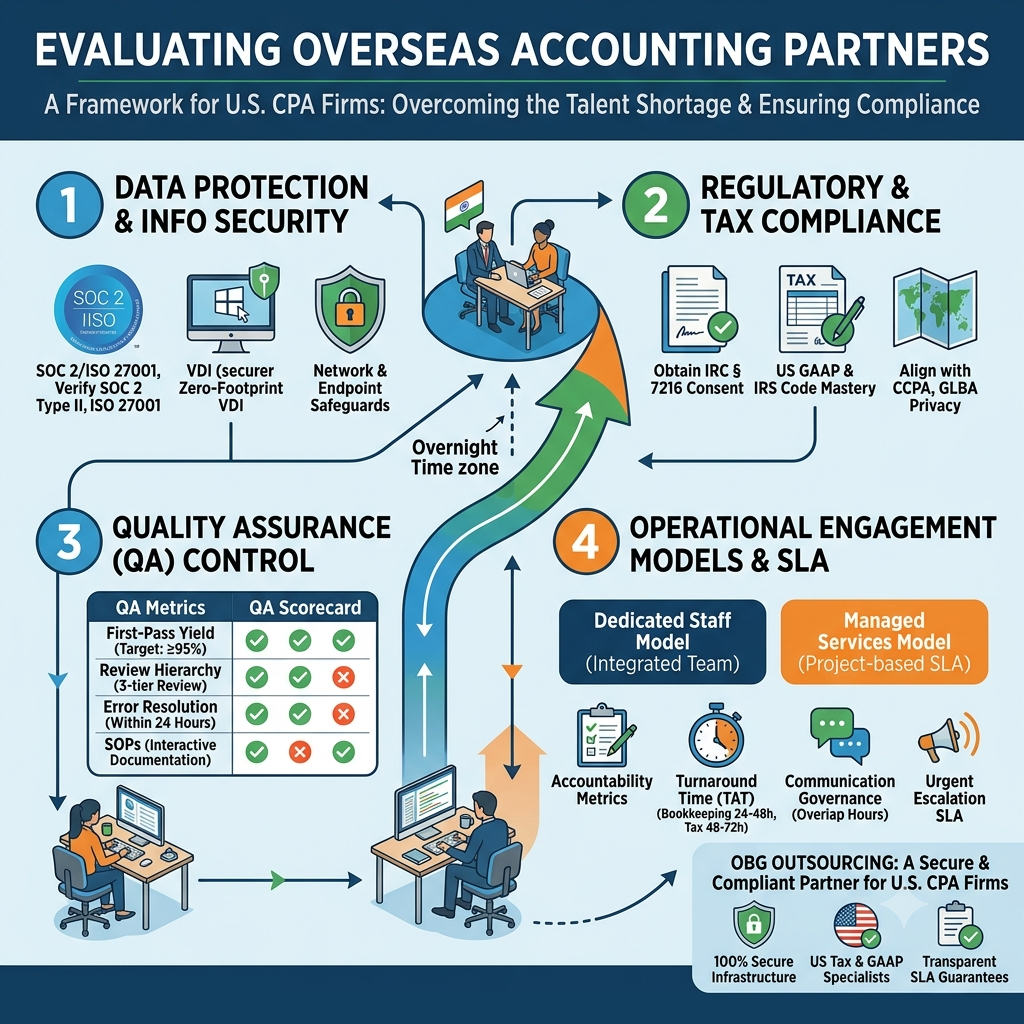
There is a severe shortage of qualified accounting professionals locally within the United States. For mid-sized to large Certified Public Accounting firms, leveraging overseas manpower has become a necessary operational choice. Among such firms, over 35% outsource their back-office functions to India, to reduce costs while accessing the region’s mature pool of certified accounting talent, and to achieve overnight delivery via time zone differences—work handed over when the U.S. team clocks out is completed by the Indian team overnight, ready for the U.S. team to take over when they start work the next day, keeping operations running 24 hours nonstop.
However, outsourcing tax preparation services and entrusting core accounting work is not as simple as picking any overseas team; strict due diligence must be conducted first. Choosing an unqualified overseas service provider could expose the firm to three tangible risks: leakage of clients’ private data, penalties for violating IRC § 7216, and delayed delivery of deliverables to clients, which damages the firm’s own reputation.
This evaluation framework is developed for the partners and operations leaders of CPA firms, guiding them step-by-step to verify the qualifications of overseas accounting partners, ensuring they can always maintain strict oversight and quality assurance standards, and avoid losing control after handing over work.
Evaluate Data Protection Protocols and Information Security capabilities
Accounting work involves access to clients’ most core private information: clients’ Taxpayer Identification Numbers (TINs), bank statements, and sensitive payroll data. To process this information, service providers must have complete technical and physical security measures in place, with no room for error.
The first item to verify is SOC 2 Type II & ISO 27001 certification: require the other party to provide the latest third-party audit report, proving compliance with SOC 2 Type II requirements—meaning it covers the three core standards of security, availability, and confidentiality—while also meeting ISO/IEC 27001 standards. These two are the most authoritative general certifications in the information security field, and both are mandatory.
Item is to implement Zero-Footprint Delivery Infrastructure: confirm that the overseas partner uses secure virtual desktop infrastructure (VDI), disables local storage, USB ports, screenshot functions, and remote printing functions, ensuring all client data can only reside in the firm’s own systems, leaving no exportable, storable traces on the local devices of the overseas team, plugging the risk of data leakage at the source.
Item to verify is network and Endpoint Safeguards: confirm that they have implemented multi-factor authentication (MFA), end-to-end data encryption—AES-256 encryption for data at rest, TLS 1.3 encryption for data in transit—and continuous endpoint detection and response (EDR) monitoring, closing security loopholes across the entire process from login, transmission, to daily use.
Next, Verify Regulatory and Tax Compliance Standards
Offshoring core accounting and tax work is not just about offloading tasks; it requires compliance with a series of legal requirements specifically set by the United States, and the consequences of violating these rules are far more severe than being understaffed.
First, meet IRC Section 7216 compliance: according to US tax law, transferring and disclosing taxpayer information outside the United States requires obtaining explicit consent from the taxpayer themselves, and signing a written disclosure document. Confirm that the service provider can provide standardized processes that meet the requirements of IRC § 7216 to manage clients’ consent documents, so the firm does not violate the law due to process oversights.
Then, check US GAAP & IRS Code Mastery: evaluate whether the overseas team has completed verified continuing professional education (CPE), with learning content that must cover US GAAP, federal/state tax laws, and updates to mainstream software—including UltraTax, CCH Axcess, QuickBooks Online, Drake, and NetSuite, to ensure the overseas team’s professional capabilities can keep up with local U.S. requirements and avoid errors due to unfamiliarity with rules.
Finally, align with Data Privacy Regulations: ensure the service provider fully complies with U.S. state-level privacy regulations, such as CCPA/CPRA, and federal-level privacy standards like GLBA (Gramm-Leach-Bliley Act), with no omissions in privacy requirements from local to federal levels.
Establish Clear Quality Assurance (QA) control mechanisms
If an outsourcing team encounters large-scale, systemic quality issues, the progress of the entire tax season will be derailed, with no way tomake up for the gaps. You can use a standardized checklist to assess whether the partner’s internal quality management system is reliable, with all requirements clearly listed:
Evaluation Criteria Red Flag Industry Standard Target
First-Pass Yield (FPY) First review accuracy below 85% Accuracy ?95% before delivery to the U.S. mainland
Review hierarchy Work delivered directly by preparers to partners Three-tier review: preparer ? Senior Reviewer ? Manager Quality Sign-off
Error Resolution Turnaround Audit feedback implemented after more than 48 hours Clear audit feedback rectified within 24 hours
Operating Procedures (SOPs) Unwritten processes relying solely on staff memory Interactive, version-controlled process documentation customized for the firm
Finally, benchmark different operational engagement models
When selecting an outsourcing partner, do not adopt the same model others use; you must choose an outsourcing cooperation framework that matches your firm’s scale and the seasonal peaks and troughs of your business, to fully realize the value of overseas manpower.
The first is the Dedicated Staff Model, where the outsourcing provider assigns fixed, exclusive accountants to your firm. These accountants fully integrate into your team and work as part of your internal staff. They use your firm’s email domain, log directly into your firm’s own cloud systems, and operate no differently from your in-house employees.
Another model is project-based, also called the Managed Services model, designed to address the sudden surge in peak-season demand for Form 1040, 1120S, or 1065 preparation work. The overseas outsourcing provider that takes on the business manages all delivered work outcomes in accordance with the pre-agreed Service Level Agreements (SLAs) between both parties, to ensure smooth work progression.
Next, you need to implement two more things: Implement Accountability Metrics, and set SLA Benchmarks.
To avoid work getting stuck at any link and slowing down progress, you must put all performance requirements in writing in the Master Services Agreement (MSA) you sign with the outsourcing provider, with specific provisions for the following items:
First is Turnaround Time (TAT): set clear maximum processing deadlines for each type of work. For example, routine bookkeeping and reconciliation work must be completed within 24–48 hours; complex individual tax return preparation work must be completed within 48–72 hours.
Second is Communication Governance: require the outsourcing team to have at least 2–3 hours of overlapping working hours with your firm’s time zone each business day. During this overlapping period, teams can hold online video meetings, or sync work progress via Slack or Teams, to resolve any issues encountered at any time.
Third is the escalation SLA for urgent issues: require the outsourcing provider to assign dedicated Account Managers in management positions, who are specifically responsible for handling sudden emergency issues. During critical tax filing deadlines, if a problem arises, this account manager must provide a response within a maximum of 2 hours, to avoid delaying work.
If you are looking for an outsourcing partner to collaborate with, you can consider partnering with OBG Outsourcing. OBG Outsourcing Private Limited specializes in providing compliant, secure, customized offshore accounting services for US CPA firms. Our team of dedicated Certified Public Accountants and finance professionals all operate in strict compliance with SOC 2-compliant data protocols, and can seamlessly expand your firm’s business capacity across all business cycles throughout the year.
Our services have three core guarantees:
First is 100% Secure Infrastructure, using an enterprise-grade VDI environment, with all firm and client data protected by end-to-end encryption to prevent leakage.
Second is that our team consists entirely of professionals familiar with US Tax and US GAAP Specialists; all team members have received training on all mainstream U.S. software suites and tax frameworks, and can meet local work requirements.
Third is Transparent SLA Guarantees: we have a strict three-tier quality control system, and all work papers delivered to you directly meet audit requirements and are ready for immediate use.
_(6).jpg)


1.png)
_(5).jpg)
.jpg)
_(4).jpg)
_(1).jpg)
_(2).jpg)
.png)