 USA
USA UK
UK Australia
 UAE
UAE Canada
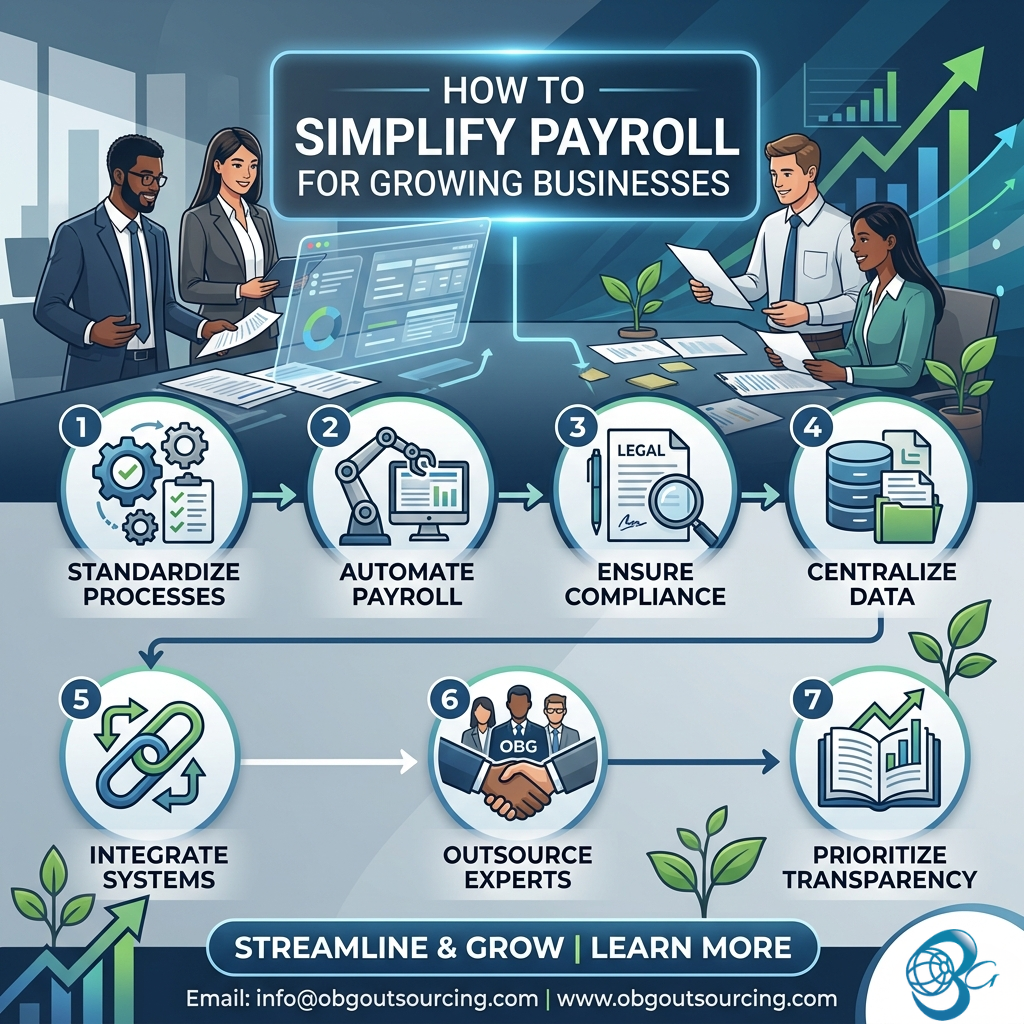
Growth is exciting—until your payroll starts to feel like a monthly obstacle course. What begins as a simple salary transfer can quickly evolve into a maze of tax calculations, compliance rules, employee classifications, benefits, and deadlines. For growing businesses, payroll isn’t just an administrative task anymore—it’s a critical function that directly impacts employee trust, legal compliance, and financial stability.
The good news? Payroll doesn’t have to be complicated. With the right approach, you can turn it into a streamlined, reliable system that scales with your business.
Why Payroll Gets Complicated as You Grow
In the early stages, payroll is often straightforward—few employees, fixed salaries, and minimal compliance requirements. But as your business expands, complexity increases:
Hiring across different locations introduces varied tax laws
Adding benefits, bonuses, and incentives complicates calculations
Compliance requirements become stricter and more frequent
Manual processes become error-prone and time-consuming
If you don’t adapt your payroll system, what once worked smoothly can start causing delays, inaccuracies, and even legal risks.
1. Standardize Your Payroll Process
The first step toward simplification is consistency. Create a clear payroll structure that includes:
Fixed pay cycles (weekly, bi-weekly, or monthly)
Defined salary components and policies
Standard procedures for reimbursements and deductions
When everything follows a predictable format, there’s less room for confusion or error.
2. Automate Wherever Possible
Manual payroll processing is one of the biggest bottlenecks for growing businesses. Automation can drastically reduce workload and improve accuracy.
Automated systems can:
Calculate salaries, taxes, and deductions instantly
Generate payslips without manual input
Track attendance and integrate it into payroll
Send reminders for deadlines and filings
Automation doesn’t just save time—it minimizes costly mistakes.
3. Stay Ahead of Compliance
Payroll compliance isn’t optional, and it becomes more complex as your workforce grows. Late filings, incorrect tax deductions, or misclassifications can lead to penalties and reputational damage.
Simplify compliance by:
Keeping updated with local labor and tax regulations
Maintaining proper documentation for every employee
Setting reminders for statutory deadlines
A proactive approach prevents last-minute stress and ensures smooth operations.
4. Centralize Employee Data
Scattered data is a silent productivity killer. When employee information is spread across spreadsheets, emails, and systems, payroll becomes harder than it needs to be.
Centralizing your data allows you to:
Access accurate employee records instantly
Reduce duplication and inconsistencies
Improve reporting and decision-making
A single source of truth makes payroll faster and more reliable.
5. Integrate Payroll with Other Systems
Payroll doesn’t operate in isolation. It connects with HR, accounting, and attendance systems. When these systems don’t communicate, you end up doing repetitive work.
Integration helps:
Sync employee data automatically
Align payroll with financial reporting
Eliminate manual data entry
This creates a seamless workflow across departments.
6. Outsource When It Makes Sense
At a certain stage of growth, managing payroll in-house can drain valuable time and resources. Outsourcing allows you to focus on core business activities while experts handle the complexities.
A professional payroll partner can:
Ensure compliance with evolving regulations
Handle calculations, filings, and reporting
Provide scalable solutions as your business grows
Outsourcing isn’t about losing control—it’s about gaining efficiency and peace of mind.
7. Prioritize Transparency with Employees
Payroll isn’t just a backend function—it directly affects your team. Clear communication builds trust and reduces confusion.
Make sure employees:
Understand their salary structure
Have easy access to payslips
Can quickly resolve payroll queries
Transparency leads to fewer disputes and a more satisfied workforce.
Final Thoughts
Simplifying payroll isn’t about cutting corners—it’s about building a system that works smarter, not harder. As your business grows, your payroll process should evolve with it—becoming more efficient, accurate, and scalable.
By standardizing processes, embracing automation, ensuring compliance, and considering outsourcing, you can transform payroll from a time-consuming task into a strategic advantage.
If your payroll is starting to feel like a burden, it’s a sign—not of failure, but of growth. The right systems and support can turn that complexity into clarity.
_(6).jpg)


1.png)
_(5).jpg)
.jpg)
_(4).jpg)
_(1).jpg)
_(2).jpg)
.png)