 USA
USA UK
UK Australia
 UAE
UAE Canada
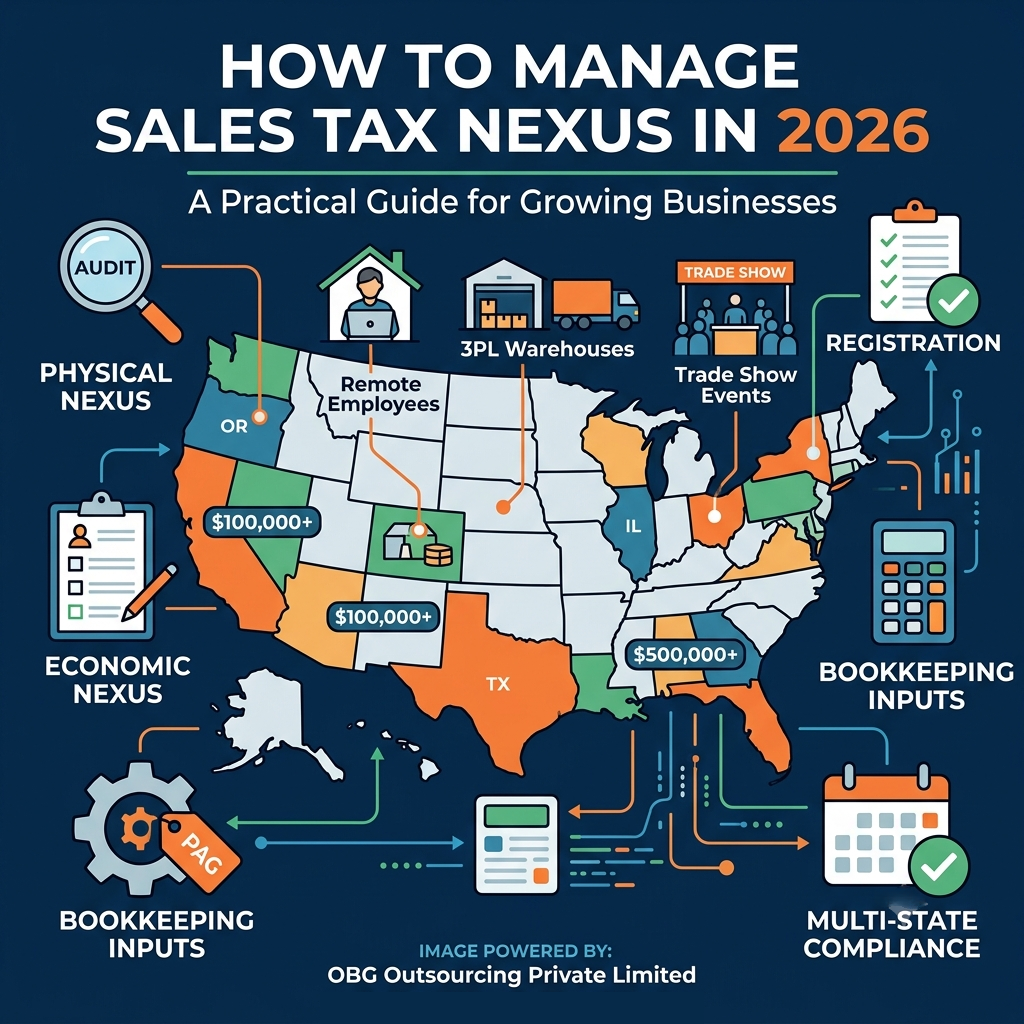
Selling products or services across state lines is one of the fastest paths for businesses to achieve large-scale expansion, but the core challenge tied to this model is: multi-state sales tax compliance has become one of the most cumbersome accounting problems for modern businesses. As tax authorities across all states tighten enforcement and remote tracking technologies gain widespread adoption, sales tax nexus management can no longer be left as a last-minute task to handle only at the end of the year.
To maintain compliance in 2026, businesses must have in place proactive tracking, structured bookkeeping entries, and reliable multi-state tax filing processes. This guide will help e-commerce brands, SaaS platforms, and service-focused businesses balance compliance requirements with business growth.
This paper first sorts out the basic rules related to sales tax nexus, laying the groundwork for the subsequent interpretation of relevant adjustments to be introduced in 2026: Sales tax nexus refers to a legal tie between a business and a U.S. state, which requires the business to collect, file, and remit sales tax for transactions within that jurisdiction. In early years, nexus was only triggered by physical presence, such as having remote employees, contractors, inventory stored in third-party logistics (3PL) warehouses including Amazon FBA, leased office space, or participating in in-state trade shows. After the U.S. Supreme Court issued its ruling in South Dakota v. Wayfair, an additional trigger called economic nexus was added: nexus can now be activated if a business’s in-state revenue or transaction volume exceeds the statutory threshold over the legally mandated lookback period. These two sets of rules jointly determine a business’s tax liability.
In 2026, states across the United States are advancing a new round of state tax adjustments, centered on two core priorities: simplifying tax collection and administration at the state level, and tightening oversight of sellers. State tax authorities have clarified three binding implementation rules: states including Illinois have repealed the original rule requiring 200 separate transactions, while large states such as California only retain revenue thresholds of $100,000 or $500,000 to enforce the economic nexus rule; the scope of taxation is expanded to cover digital goods and services, with relevant tax-exempt items gradually reduced; automated audits will be rolled out using third-party data such as platform reports to identify and investigate unregistered cross-state sellers.
As a universal principle in the management field holds: you cannot manage what you cannot measure. To meet the compliance requirements of more than 45 U.S. states that collect sales tax, a company’s accounting team must establish a continuous monitoring system for sales tax nexus.
Map the company’s omnichannel physical and economic footprints: document the physical footprint, including the locations of employees’ and contractors’ residences and inventory storage sites. Generate monthly state-by-state sales reports covering the previous 12 months, and separate sales made through the platforms Amazon, Etsy, and Walmart from independent direct sales. Even if a platform remits sales tax on the company’s behalf, total sales volume still counts toward a state’s economic nexus threshold. Teams can also set alert triggers at 80% of each state’s applicable threshold, to reserve a buffer period to complete compliance registration, and avoid retroactive back tax payments or fines.
Flawless sales tax compliance startswith a business’s general ledger—if its chart of accounts and sales data are disorganized, monthly tax filing will become a daunting nightmare. To streamline multi-state sales tax bookkeeping work, this paper outlines three core practical requirements:
Configure e-commerce platforms and enterprise resource planning (ERP) systems including Shopify, WooCommerce, and Stripe to apply destination-based sourcing rules, which calculate taxes based on the buyer’s shipping address, rather than rules that levy taxes based on the seller’s location.
Standardize product taxability rules by mapping the four SKU categories of unprocessed food, apparel, digital services, and wholesale purchases to the corresponding tax rate policies of each state, to avoid erroneous tax collection.
In B2B wholesale scenarios, store resale exemption certificates in the digital document manager linked to the associated customer account, to mitigate compliance risks.
Once a cross-state operating entity crosses the economic nexus threshold of a target state, or establishes a physical presence within that state, it will trigger the application of local sales tax nexus rules, and must follow a four-stage compliance and filing process: nexus identification ? registration and permitting ? activation of tax calculation tools ? tax declaration and payment. The specific requirements for the first three stages are as follows:
Complete the nexus determination, then apply for a sales tax permit from the state tax authority; collecting tax without a valid permit is illegal in most states. After that, the entity may integrate with mainstream billing systems such as Stripe, Shopify, and QuickBooks to calculate the amount of tax payable using standard formulas. If any abnormal balance is identified, priority should be given to investigating issues such as incorrect tax rate application and underreporting of exempt transactions.
Is the cross-state business brand you operate at risk of diverting its core focus away from business expansion to handle sales tax compliance matters? OBG Outsourcing Private Limited can assist you with managing multi-state sales tax nexus, cleaning up back-end bookkeeping, and building a hassle-freetax filing process. Starting in 2026, compliance requirements will be upgraded; schedule a consultation with our multi-state tax experts today.
_(6).jpg)


1.png)
_(5).jpg)
.jpg)
_(4).jpg)
_(1).jpg)
_(2).jpg)
.png)