 USA
USA UK
UK Australia
 UAE
UAE Canada
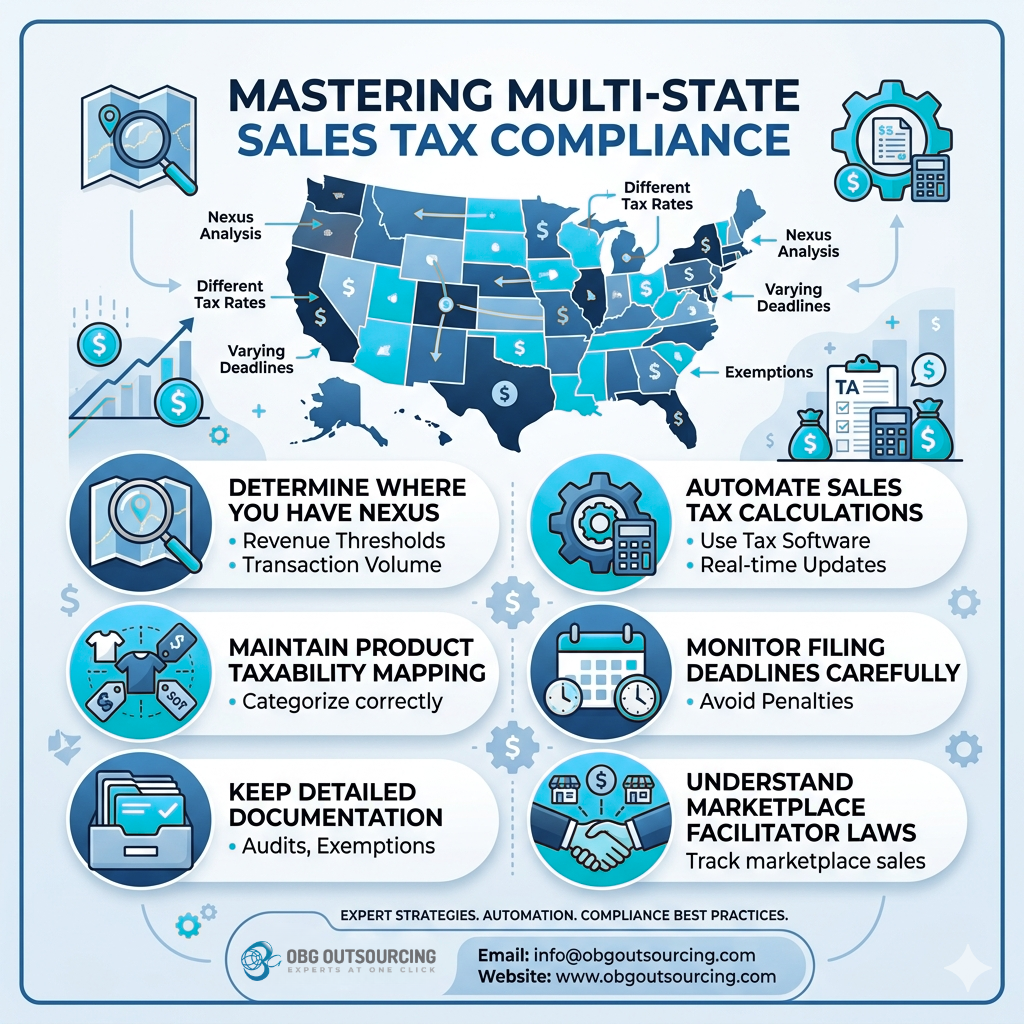
In today’s digital economy, businesses are no longer limited by geographic boundaries. Whether you operate an eCommerce store, SaaS company, wholesale business, or service-based enterprise, selling across multiple states creates one major challenge — multi-state sales tax compliance.
Managing sales tax across different states can quickly become overwhelming due to varying tax rates, nexus laws, filing deadlines, exemptions, and reporting requirements. A small compliance mistake can result in penalties, audits, and financial disruptions.
At OBG Outsourcing, we help businesses simplify complex tax operations through modern accounting and compliance solutions. Here’s a practical guide to managing multi-state sales tax compliance effectively and confidently.
Understanding Multi-State Sales Tax Compliance
Multi-state sales tax compliance refers to the process of collecting, reporting, and remitting sales tax in every state where your business has a tax obligation.
Your business may be required to register for sales tax in multiple states if you establish what is known as “sales tax nexus.”
Nexus can be created through:
Physical office locations
Warehouses or inventory storage
Employees or contractors
Economic sales thresholds
Online marketplace sales
Temporary business activities or trade shows
As states continue tightening tax regulations, businesses must stay proactive and organized.
Why Multi-State Tax Compliance Has Become More Complex
Modern businesses face growing tax challenges because:
States have different tax laws
Sales tax rates change frequently
Filing schedules vary
Product taxability differs by state
Marketplace facilitator laws continue evolving
Economic nexus thresholds require constant monitoring
For growing companies, manually tracking these changes becomes time-consuming and risky.
Key Strategies to Manage Multi-State Sales Tax Compliance
1. Determine Where You Have Nexus
The first step is identifying where your business has tax obligations.
Review:
Revenue thresholds
Transaction volume
Employee locations
Inventory storage
Third-party fulfillment centers
For example, many states require tax registration once businesses exceed a certain sales amount or transaction count.
Failing to register after crossing nexus thresholds can lead to back taxes and penalties.
2. Automate Sales Tax Calculations
Manual tax calculations increase the risk of errors.
Modern cloud accounting and tax software can automatically:
Calculate state-specific tax rates
Apply local jurisdiction taxes
Track exemption certificates
Generate tax reports
Prepare filing data
Automation improves accuracy while reducing administrative workload.
Popular platforms often integrate with:
eCommerce systems
ERP software
Accounting tools
Payment gateways
3. Maintain Accurate Product Taxability Mapping
Not every product or service is taxed equally across states.
For example:
Digital services may be taxable in one state but exempt in another
Clothing exemptions vary
Food and medical products often have special rules
Businesses should regularly review how products are categorized to avoid incorrect tax collection.
4. Monitor Filing Deadlines Carefully
Every state has unique filing frequencies:
Monthly
Quarterly
Annually
Missing deadlines can trigger:
Late fees
Interest charges
Compliance notices
Creating a centralized compliance calendar helps businesses stay organized and avoid unnecessary penalties.
5. Keep Detailed Documentation
Good recordkeeping is essential for audit protection.
Maintain:
Sales invoices
Tax filings
Exemption certificates
Nexus documentation
Customer tax records
Marketplace transaction reports
Digital document storage simplifies retrieval during audits or compliance reviews.
6. Understand Marketplace Facilitator Laws
Many online marketplaces now collect and remit taxes on behalf of sellers.
However, businesses may still need to:
Register in certain states
File informational returns
Track marketplace sales separately
Do not assume marketplaces eliminate all compliance responsibilities.
7. Conduct Regular Sales Tax Reviews
As your business grows, tax exposure changes.
Quarterly or annual compliance reviews help identify:
New nexus obligations
Incorrect tax rates
Missing registrations
Filing inconsistencies
Operational risks
Proactive reviews reduce future liabilities.
8. Outsource Complex Sales Tax Management
For growing businesses, outsourcing sales tax compliance can improve efficiency and reduce risk.
Professional outsourcing teams can assist with:
Nexus analysis
Tax registration
Multi-state filings
Audit preparation
Compliance monitoring
Tax reporting automation
At OBG Outsourcing, we help businesses manage multi-state accounting and tax compliance with scalable and technology-driven solutions.
Common Challenges Businesses Face
Constantly Changing Tax Laws
Sales tax regulations evolve frequently, requiring ongoing monitoring.
Multiple Jurisdictions
Thousands of tax jurisdictions exist across the United States, each with different rules.
Remote Sales Complexity
Remote and online sales continue creating new nexus obligations.
Audit Risks
Improper filings or inaccurate tax collection can increase audit exposure.
Time-Consuming Compliance Tasks
Manual tax management consumes valuable operational resources.
Best Practices for Long-Term Compliance Success
Businesses can strengthen compliance by:
Using cloud-based accounting systems
Automating repetitive tax processes
Reviewing nexus exposure regularly
Maintaining organized documentation
Training finance teams on tax updates
Partnering with experienced compliance experts
The goal is not just compliance — it’s creating a scalable financial infrastructure that supports growth.
The Future of Multi-State Sales Tax Compliance
Technology is transforming tax compliance rapidly.
Future trends include:
AI-driven tax automation
Real-time reporting systems
Automated nexus tracking
Advanced compliance analytics
Integrated cloud finance ecosystems
Businesses that invest early in automation and professional compliance management will gain a competitive advantage while reducing operational stress.
Final Thoughts
Managing multi-state sales tax compliance can feel complicated, but with the right systems, automation, and professional support, businesses can stay compliant while focusing on growth.
As regulations continue evolving, proactive tax management becomes essential for protecting profitability, maintaining credibility, and avoiding unnecessary financial risks.
At OBG Outsourcing, we provide reliable accounting, bookkeeping, and tax compliance outsourcing services designed to help modern businesses scale confidently in a complex regulatory environment.
_(6).jpg)


1.png)
_(5).jpg)
.jpg)
_(4).jpg)
_(1).jpg)
_(2).jpg)
.png)