 USA
USA UK
UK Australia
 UAE
UAE Canada
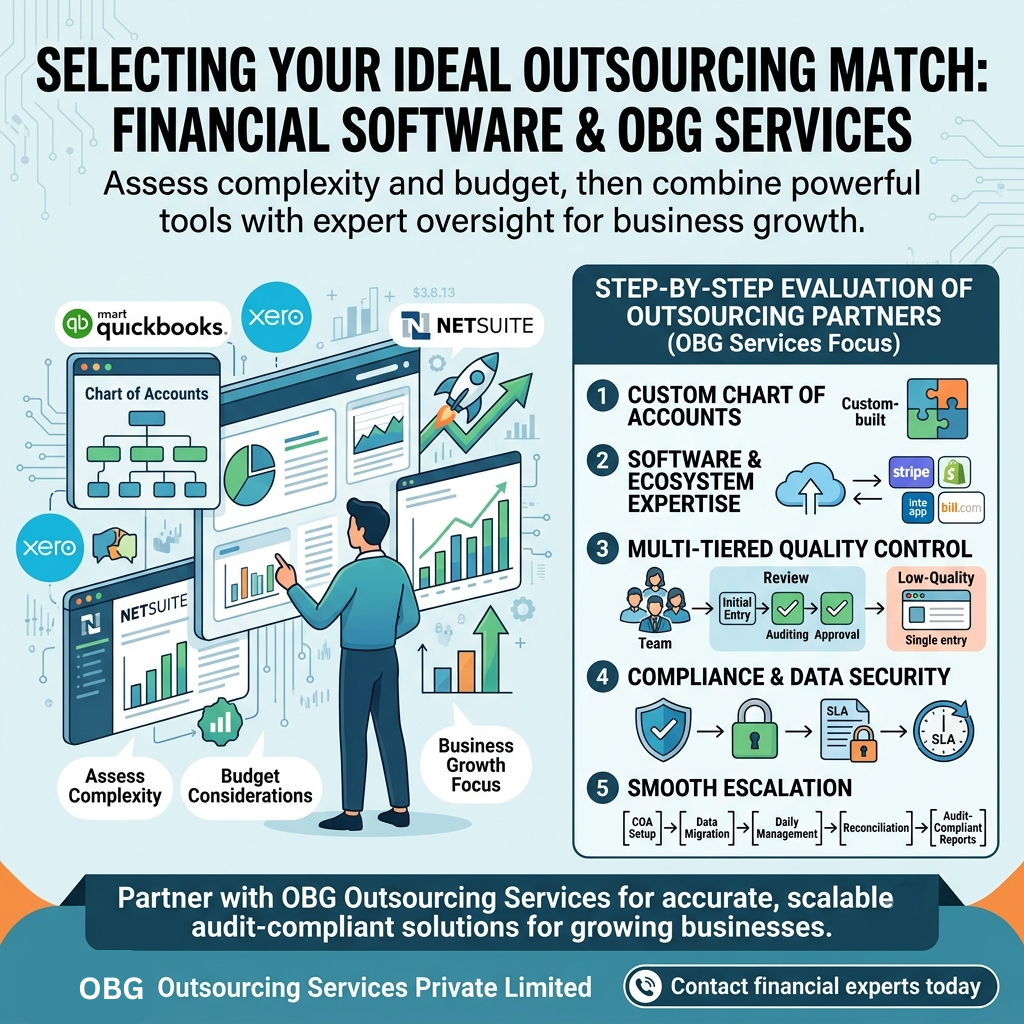
Final Thoughts: Selecting Your Match When selecting financial software, first assess your business’s complexity and budget. However, software alone is insufficient; a dedicated person is also needed to oversee related work. You can choose mainstream tools such as QuickBooks, and pair them with OBG outsourcing services. This approach not only ensures compliance to pass audits, but also allows your team to focus on business growth.
Entrusting a company's financial infrastructure setup and daily bookkeeping to a professional accounting outsourcing service provider is one of the efficient approaches to driving business expansion. However, the capabilities of these service providers vary widely. This paper will present a step-by-step guide for evaluating service providers across three core dimensions.
Step 1: Evaluate Their Approach to Chart of Accounts Customization
When selecting an accounting outsourcing partner, a critical red flag is if the provider relies on a generic, off-the-shelf chart of accounts (COA) template. Every industry has unique financial requirements: the operational logic of an e-commerce brand that tracks multi-channel cost of goods sold is completely different from that of a SaaS company that tracks recurring revenue, or a service provider that manages project-based billing. During your initial communication, you must assess whether the service provider can customize this framework to align with your business model, across the following dimensions:
Number hierarchy: Does the provider use a structured, scalable numbering system? For example, numbers starting with 1000 for asset accounts, 2000 for liability accounts, and 4000 for revenue accounts.
Balance between granularity and conciseness: A strong partner can balance detailed tracking and clarity. They will not split accounts into an excessive number of overly granular sub-accounts that disrupt the income statement, while still being able to track core revenue streams and cost drivers as separate items.
Multi-dimensional tracking: Ask if the provider uses tags, categories, or department modules to avoid redundancy and clutter in the main COA ledger.
Step 2: Test Their Software and Ecosystem Expertise
Your chart of accounts (COA) is not built from scratch; it operates on cloud platforms such as QuickBooks Online, Xero, or NetSuite. Modern outsourced accounting service providers must have in-depth mastery of how a COA interacts with automated bank synchronization feeds, third-party integration tools, and reporting modules. Ask your prospective partners these questions:
Which cloud platforms do you specialize in? If our current accounting records are disorganized, how would you handle software migration or COA cleanup work? How does the COA connect to integrated software such as Stripe, Shopify, Bill.com, or payroll platforms?
An ideal partner will set up your software environment correctly, so that automated data streams can post entries to the corresponding accounts accurately, without creating duplicate journal entries or unassigned balances.
Step 3: Inspect Their Multi-Tiered Quality Control Process
The core of ongoing bookkeeping services is to ensure the accuracy and consistency of accounting processing. However, the low-cost outsourcing model adopted by many firms hides inherent risks: all work is often handled by a single entry-level bookkeeper, with no one to review errors after they occur. The screening framework we developed helps service seekers evaluate accounting service providers.
This framework compares the differences between low-quality and high-quality providers across three dimensions: In terms of audit mechanisms, low-quality providers take sole charge of the entire process, while high-quality providers implement a multi-layered review workflow that includes initial data entry, auditing, and approval. In terms of technology integration, low-quality providers rely entirely on manual data entry, which carries high risk, while high-quality providers use artificial intelligence to detect anomalies before conducting manual rechecks. In terms of reconciliation standards, low-quality providers delay bank reconciliations until the tax filing period, while high-quality providers conduct fixed monthly reconciliations for all accounts.
Step 4: Verify Compliance, Data Security, and Turnaround SLAs
Outsourcing financial operations requires sharing sensitive financial data, bank statements, and supplier details. You must fully trust the service provider’s security protocols and operational reliability, so be sure to verify the following safeguards:
Data security protocol: Does the other party use an encrypted portal to transfer files, and has it deployed secure role-based access control?
Communication & Turnaround: What is their Service Level Agreement (SLA) for monthly closes and answering queries?
Continuity guarantee: A reliable outsourcing provider must assign a dedicated team to avoid gaps in financial oversight caused by in-house bookkeepers taking leave or leaving their positions.
Step 5: Ensure Smooth Escalation from COA Setup to Ongoing Financial Support
Building the chart of accounts is the first step, while reliable month-end closing, reconciliation, and financial report generation can create long-term value. You must ensure that your service provider's workflow integrates the initial setup directly into routine maintenance.
[ Custom Chart of Accounts Setup ] ? [ Data Migration/Cleaning ] ? [ Daily/Monthly Ledger Management ] ? [ Month-End Reconciliation ] ? [ Audit-Compliant Financial Reports ]
A smooth financial transition should seamlessly connect all stages from the initial setup to ongoing transaction categorization, bank reconciliation, accounts receivable and payable management, and ultimately the delivery of month-end balance sheets and income statements.
Partner with OBG Outsourcing Services to build a solid financial foundation for your business. Finding a partner that fully understands the logic of account setup and the mechanisms of ongoing bookkeeping is critical for long-term financial management.
OBG Outsourcing Services Private Limited delivers accurate, scalable, and audit-compliant accounting solutions for growing businesses. Whether you need a custom chart of accounts setup, bookkeeping cleanup and organization, or monthly bookkeeping services adapted for QuickBooks or Xero, our team provides multi-level quality reviews and end-to-end process support to ensure reliable data.
Looking to organize your books to drive business growth? Contact OBG Outsourcing Private Limited today to consult with our financial experts.
_(6).jpg)


1.png)
_(5).jpg)
.jpg)
_(4).jpg)
_(1).jpg)
_(2).jpg)
.png)