 USA
USA UK
UK Australia
 UAE
UAE Canada
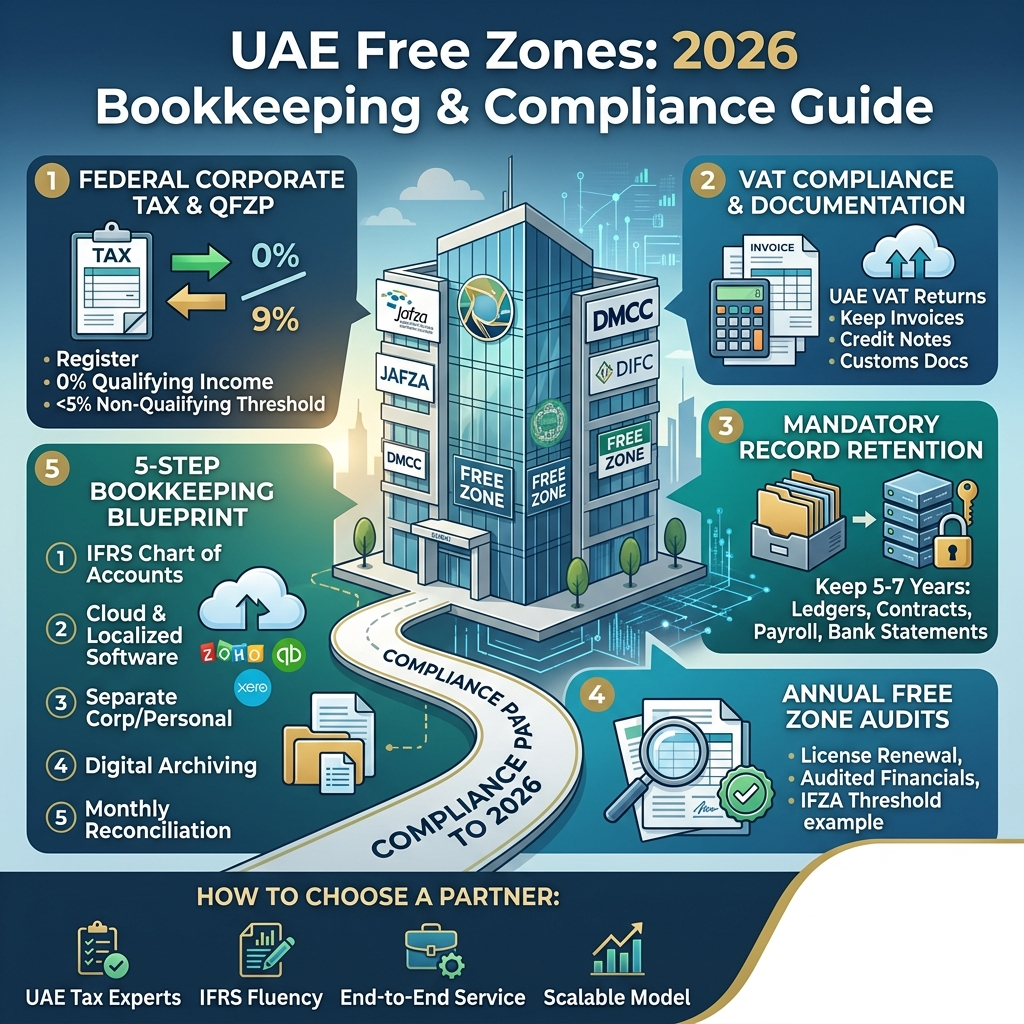
For a long time, the free trade zones (FTZs) of the United Arab Emirates (UAE) have attracted business operators worldwide with their favorable business conditions, including 100% foreign ownership, zero tariffs, and highly
streamlined administrative procedures. Starting in 2026, however, the exemption from mandatory financial bookkeeping for FTZ trade licenses will be permanently revoked. The Federal Tax Authority (FTA) will implement full enforcement of relevant regulations. Driven by three sets of compliance requirements—corporate income tax, value-added tax, and FTZ audits—real-time and accurate bookkeeping has become a non-negotiable legal obligation. This guide will establish a bookkeeping framework
that aligns with the new regulations for four types of business entities operating in the Dubai International Financial Centre, the Multi Commodities Centre, Jebel Ali Free Zone, and other general international FTZs, and will also assist these entities in selecting suitable financial service partners.
2026 Core Compliance Requirements To avoid substantial fines and retain your tax status, your bookkeeping system must cover five core compliance pillars:
Federal Corporate Tax & QFZP Status All free zone entities in the United Arab Emirates (UAE), regardless of whether they generate profits or meet the conditions for 0% tax rate, must register for corporate tax with the Federal Tax Authority (FTA). To maintain your Qualifying Free Zone Person (QFZP) status and access the 0% preferential tax rate on qualifying income, you must uphold sufficient economic substance within the free zone. Your non-qualifying revenue must not exceed the minimum threshold: it must account for less than 5% of total revenue, or must not exceed 5 million AED. Meanwhile, you must prepare and retain audited financial statements. Risk warning: If you fail to meet any QFZP requirement, your 0% tax rate will be revoked, and your enterprise will be subject to the standard 9% corporate tax rate for five consecutive years.
VAT Compliance & Documentation
Businesses whose taxable supply or import value exceeds the mandatory UAE VAT registration threshold of 375,000 UAE dirhams must file VAT returns on a regular basis. Your bookkeeping system must retain properly formatted tax invoices, credit notes, import and export documents, and customs declarations, to prove the compliance of input tax deductions during audits by the Federal Tax Authority (FTA).
Mandatory Record Retention
Under UAE tax laws, financial records including general ledgers, trial balances, invoices, contracts, payroll records, and bank statements must be retained for a minimum period of 5 to 7 years.
Annual Audits in Free Zones
Most free zone authorities, such as DMCC, JAFZA, and DAFZA, require businesses to submit audited annual financial statements when renewing their licenses. Even in free zones that have set an audit threshold for annual revenue, such as IFZA which sets the threshold at 2 million dirhams, businesses must maintain complete sets of accounting books to pass corporate tax reviews.
A 5-Step Blueprint for Free Zone Bookkeeping Setup Building an accounting framework from the first day of operations ensures the smooth advancement of business activities and meets audit requirements.
Establish a chart of accounts that aligns with IFRS standards: Align the chart of accounts with the International Financial Reporting Standards, and clearly categorize revenue into qualifying revenue and non-qualifying revenue to simplify corporate income tax calculations.
Implement Cloud Accounting & Localized Software: Phase out spreadsheets and shift to cloud platforms that meet the requirements of the Federal Tax Authority of the United Arab Emirates, such as Zoho Books, QuickBooks Online, and Xero. These platforms should be configured to support the UAE's value-added tax (VAT) rules, multi-currency transactions, and automatic bank synchronization functions.
Separate corporate and personal transactions: Ensure that a dedicated corporate bank account is linked to the accounting software. Mixing personal expenses with corporate transactions will create compliance barriers during corporate income tax filing.
Build a digital document archiving system: Create a digital repository for all original supporting documents—customer invoices, supplier bills, customs receipts, and payroll records—and establish clear links between every journal entry and its corresponding supporting files.
Schedule Monthly Reconciliations & Close Cycles: Conduct monthly reconciliations for bank accounts, VAT, and intercompany accounts. Delaying these tasks until the end of the year often leads to lost receipts, missed VAT deductions, and delayed filings.
How to Choose the Right Bookkeeping Partner Operating an in-house accounting team in the United Arab Emirates (UAE) incurs high costs, including salaries, visa fees, health insurance, software licenses, and ongoing training expenses. Outsourcing bookkeeping services not only grants you access to professional tax personnel, but also helps you control costs.
When evaluating a financial partner for your UAE free zone company, you must assess the following criteria: Expertise in UAE Tax Regulations and QFZP Rules: Verify that the service provider is familiar with free zone corporate tax rules, revenue allocation, and minimum threshold monitoring requirements.
IFRS & Cloud System Fluency: Confirm they operate on modern cloud platforms and maintain IFRS-compliant standards.
End-to-End Service Capability: Select a partner that can undertake bookkeeping, payroll processing, VAT filing, corporate tax declaration, and audit preparation work.
Scalable Delivery Model: Look for a flexible outsourcing model that can expand in tandem with your business's transaction volume and operational scope.
How OBG Outsourcing Can Help OBG Outsourcing Private Limited has launched an end-to-end, customized finance and taxation outsourcing service for enterprises operating in the United
Arab Emirates (UAE) free trade zones. All financial work carried out under this service meets the requirements of the UAE Federal Tax Authority and the free trade zones, and it covers three core business modules: tax compliance for free trade zone enterprises, monthly bookkeeping and value-added tax declaration, and audit preparation.
_(6).jpg)


1.png)
_(5).jpg)
.jpg)
_(4).jpg)
_(1).jpg)
_(2).jpg)
.png)