 USA
USA UK
UK Australia
 UAE
UAE Canada
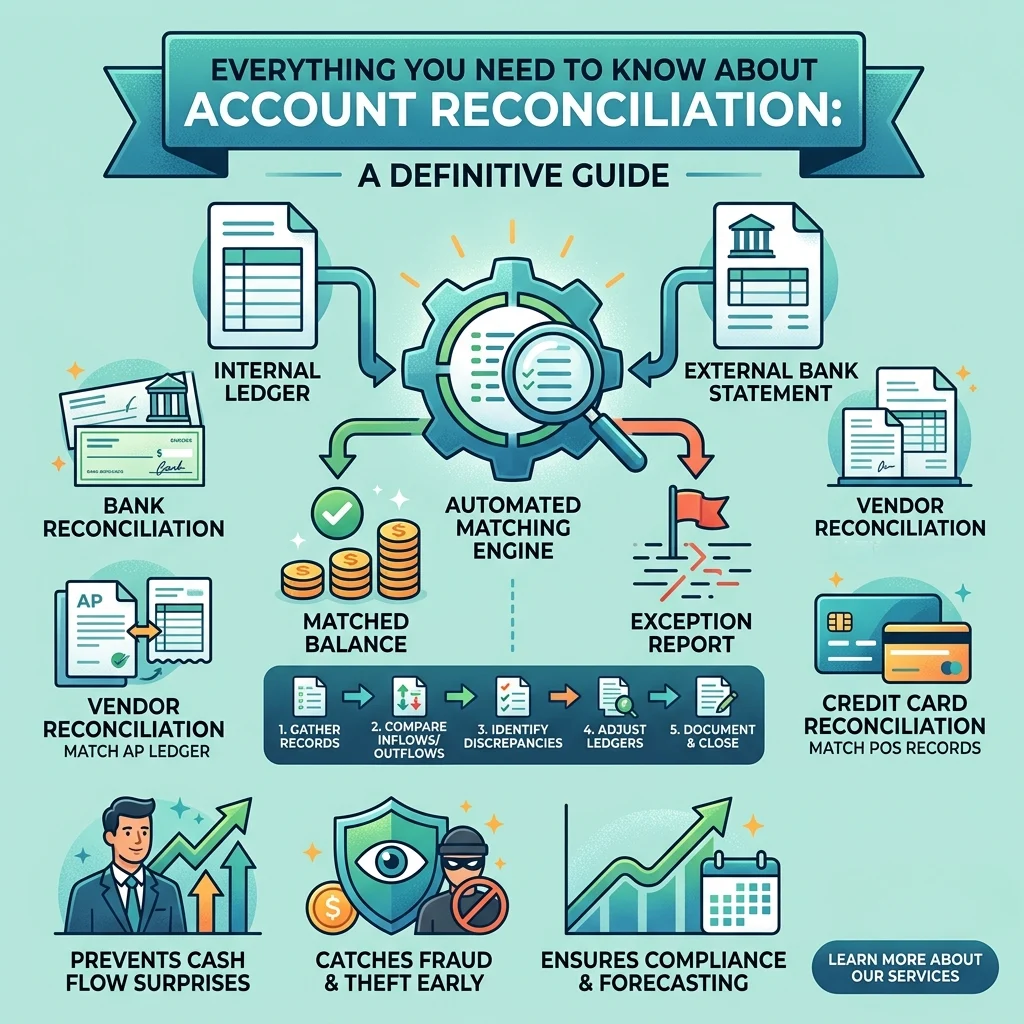
Everything You Need to Know About Account Reconciliation: A Definitive Guide
Whether you are a small business owner running a small shop or startup, or a finance manager solely in charge of a company's financial affairs, to keep your business stable, the first thing you must safeguard is the cleanliness and accuracy of your financial records, which forms the foundation of the sound operation of the entire enterprise. However, once the business takes off, the number of transactions you handle will only keep increasing—you receive a payment for goods today, pay a supplier tomorrow, and as the flow of incoming and outgoing funds grows, discrepancies between the figures in your accounts and the actual money you have will always creep up unnoticed.
This is when you need to use account reconciliation, the most basic financial control measure. It helps you confirm that the funds you remember having and believe you hold in your hands perfectly match the actual money in your bank accounts and cash drawers, with no unexplained differences arising.
This Definitive Guide will break down the entire process of account reconciliation, explain in detail what needs to be done at every step, point out the common pitfalls people often encounter in practice to remind you to avoid those easily made mistakes, and finally list practical control methods to help you manage your accounts properly and ensure your accounting records are completely accurate.
What is Accounting Reconciliation?
Accounting reconciliation refers to the process of comparing two sets of financial records related to funds—either two sets of accounts within a company, or the company's internal books with official documents issued by external institutions such as banks and payment platforms. The process goes through all records line by line to confirm that the figures on both sides match perfectly, corresponding to the same inflow or outflow of funds. Even if the figures do not align at the end, the reconciliation process helps trace the root cause of the problem: which side produced these discrepancies? Is it a timing difference in bookkeeping, such as when a company has recorded an outgoing transfer but the bank has not yet processed the deposit? Is it an operational error made during manual data entry or bookkeeping? Or is there an abnormal transaction that was not authorized through the company's formal approval process?
In the final analysis, all financial reconciliation, regardless of its specific form, addresses only one core question: do the recorded revenues and expenditures in our company's books completely align with the actual flow of real funds? There must be no incorrect entries or omitted entries, and the books must truly reflect the real status of the company's funds.
Main types of reconciliation
Bank Reconciliation: This involves comparing the cash flow recorded daily in the company's internal books with the official bank statements issued by the bank line by line, ultimately confirming that the amount of cash the company can actually use is fully consistent with the figures recorded in the books, accurate and error-free.
Customer/vendor reconciliation: This process compares the balances of the company's Matching Accounts Receivable (AR) and Accounts Payable (AP) with the counterparties' books maintained by customers and the official invoices issued by suppliers. Matching Accounts Receivable refers to funds that other companies are obligated to pay to us, which we are entitled to collect; Accounts Payable refers to funds that we are obligated to pay to our suppliers, which we need to remit. Aligning the totals of these two items with the records of the other parties prevents unclear, erroneous accounts.
Intercompany Reconciliation: This ensures that all transactions between the parent company and its subsidiaries and branches have fully matching books on both sides, with no errors of over-recording or under-recording on either side. Even for transactions between the parent company and its internal affiliates, every sum of money must be recorded clearly and accurately.
Credit Card and Merchant Reconciliation: This process compares the settlement funds remitted by payment institutions—meaning the customer payments collected on the company's behalf by the platform—with each batch of sales reports generated by the company's internal POS cash register system. This confirms that the figures align across the entire chain, from the moment a customer pays with a credit card to the final deposit of the funds into the company's account.
Why Accounting Reconciliation Matters for Growing Businesses
Without systematic transaction reconciliation, even small errors at the start—such as omitting a few cents from a record or entering a wrong digit—will snowball into a huge financial blind spot. When you stare at the numbers on your account statement, you will have no idea where things went wrong, nor will you be able to spot the massive hole hidden in your books. If you perform regular account reconciliation, that is, if you compare your internal books with external statements on schedule, you can safeguard your business across four core dimensions:
First, Prevents Cash Flow Surprises: You will not mistakenly believe there is plenty of money in your account and overspend simply because checks you issued have not yet been cashed by the bank, or merchant processing fees that need to be deducted have not yet been withdrawn. You will avoid the situation where you find the account balance is insufficient when you actually need the funds.
Second, Catches Fraud and Theft early: You can identify unauthorized transfers, duplicate payments to the same supplier, or unauthorized internal accounting alterations by company staff before losses grow to an unrecoverable level.
Third, Ensures Tax and Regulatory Compliance: Accurate bookkeeping will make tax filing smooth, eliminating the need for repeated revisions due to mismatched accounts. Even if an audit is conducted, your books will be fully defensible and free of any issues.
Fourth, Improves Financial Forecasting: All planning reports will be based on verified, real historical data instead of guesswork derived from inaccurate old books, leading to more reliable business decisions.
A Step-by-Step Account Reconciliation Process
Following this clear, structured process will significantly reduce the pressure of closing out your monthly books. You will not need to sift through months of old records to manually trace omitted entries or incorrect numbers after errors are discovered.
Step 1: Gather Records
First, collect all materials related to your accounts for the period you need to reconcile, leaving nothing out: start with your internal GL report, which is the summary of all financial transactions recorded internally by your company. Next, gather external statements, including bank transaction records, credit card bills, and supplier reconciliation invoices. Also collect supporting documents that verify every transaction, such as purchase receipts, merchant-issued invoices, and bank deposit slips.
Step 2: Compare Inflows and Outflows
After collecting all materials, you can begin transaction matching: pull every deposit, incoming transfer, outgoing transfer, and deduction recorded in your internal system, and cross-check each entry line by line with the corresponding entry on statements issued by banks or other external institutions to confirm both sides record the same sum of money.
Step 3: Identify Discrepancies
During the reconciliation process, mark all mismatched content. Specifically, flag entries that only appear in your internal books but not on bank statements, or conversely, entries that only exist on bank statements but were never recorded in your books. Also mark entries that appear on both sets of records but list different monetary amounts.
Step 4: Adjust Internal Ledgers
After identifying all discrepancies, you need to revise and adjust your internal ledgers to add all omitted content. Record all valid entries that appear on external statements but were missed in your internal books—such as bank service fees, interest earned on funds held in your account, and automatically deducted data stream service fees, to fully document all items that were not entered in time.
Step 5: Document and Close
Once all adjustments are completed, finalize the reconciliation process thoroughly. First, create a reconciliation summary sheet that lists the opening account balance at the start of the reconciliation, all entries adjusted during this process, all fully verified transactions, and the final reconciled total balance that matches across both sets of records. After completing this summary sheet, store it properly as a traceable record for future audits. This report will allow anyone to trace the origin and flow of every single entry in your books.
Practical Internal Controls for Financial Accuracy
To maintain high accuracy of accounting data without overburdening and exhausting your finance team, you can implement these practical financial control methods:
First, formulate a Strict Closing Schedule. Specifically, you must reconcile bank transactions and credit card records on a weekly or monthly basis, and backlogged unreconciled work must never exceed 30 days, so you avoid creating a mess that becomes harder to clear the longer it is delayed.
Second, Enforce Segregation of Duties. Tasks related to managing funds must not be controlled by a single person. For example, the person in charge of depositing funds or approving payments must not be the only person who reconciles bank statements. Separate unrelated financial authorities to prevent problems from going undetected.
Third, Adopt Automated Matching Tools. Current mainstream cloud accounting software, such as QuickBooks, Xero, and NetSuite, all come with rule-based AI that can automatically reconcile daily transactions synced from banks, and can handle up to 80% of routine reconciliation work automatically. This saves the finance team a great deal of effort that would otherwise be spent manually matching each transaction one by one.
Fourth, Set Variance Thresholds. Establish clear amount thresholds in advance. As long as an unexplained difference appears in the accounts and exceeds this threshold, it must be signed off by a supervisor before it can be processed, and unexplained entries must never be arbitrarily written off.
Scale Your Finance Operations with OBG Outsourcing
As your business grows, the incoming and outgoing cash flow that needs to be sorted out every day keeps increasing, you have to reconcile the books across multiple accounts, and you also have to rush to complete the full month's financial settlement at the end of each month. Relying on the internal human and material resources of your company to keep up with all these trivial tasks will only become more and more unsustainable. The energy that could have been spent on growing your business is entirely drained by these back-office chores.
We, Contact OBG Outsourcing, specialize in providing customized accounting and financial reconciliation services for small businesses and financial managers — we never use a one-size-fits-all generic template for all clients; all our work is tailored to the actual business needs of your side. Our team is made up entirely of professional accountants, who understand the industry and are proficient in the latest work tools. We manage accounts with cutting-edge automation tools, which not only helps you reconcile your books, meet compliance requirements, and avoid mistakes and setbacks, but also keeps steady pace with the expansion of your business. The money you spend on this service is less than a fraction of the cost of hiring an entire full-time in-house finance team, delivering far better cost-effectiveness.
If you are ready to sort out the headache-inducing financial processes of your company, so you no longer have to spend your energy patching up gaps? Contact OBG Outsourcing today, and see for yourself how our professional account reconciliation service can calculate a clear, accurate financial standing for your business, so you will never have to worry about messy books again.
_(6).jpg)


1.png)
_(5).jpg)
.jpg)
_(4).jpg)
_(1).jpg)
_(2).jpg)
.png)