 USA
USA UK
UK Australia
 UAE
UAE Canada
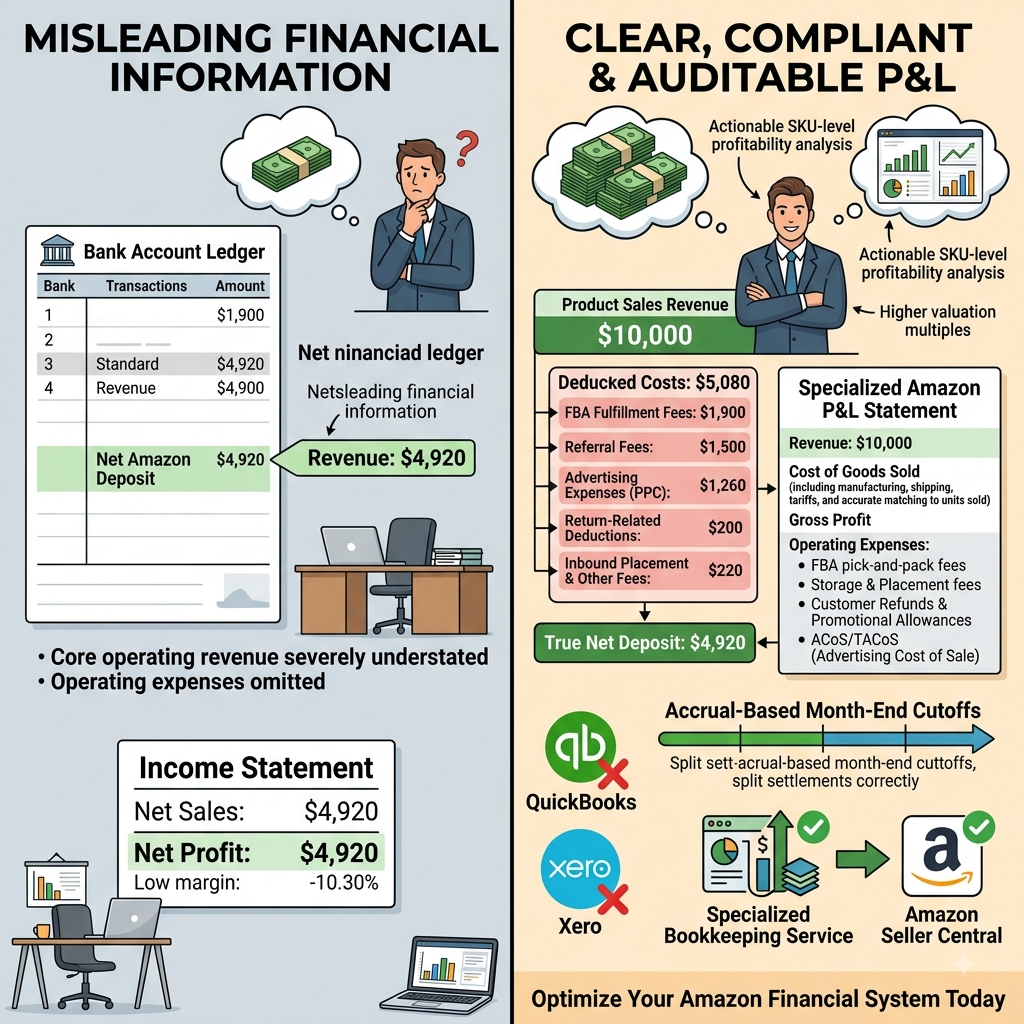
If you run a growing U.S.-based Amazon business, the transaction records in your bank account are sending you misleading financial information.
Every two weeks, Amazon deposits a net payment into your checking account. Many sellers take an easy approach and simply record this deposit as "revenue" in QuickBooks or Xero, then consider their bookkeeping done after subtracting a small amount for software subscription fees.
However, this practice hides thousands of dollars in various costs, including FBA fulfillment fees, referral fees, inbound placement fees, return-related deductions, and advertising expenses. This leads to understated recorded revenue and unreported expenses, so your income statement cannot reflect your true profit margin. To obtain a clear, compliant, and auditable income statement, you need to use a dedicated bookkeeping service specifically built to match the financial logic of Amazon Seller Central. Below, we will explain how professional e-commerce bookkeeping organizes messy payment data to generate actionable profit and loss reports, as well as the necessity of professional financial management for scaling a brand.
The Core Problem: Why Standard Accounting Fails Amazon Sellers
Standard bookkeeping rules recognize bank deposits as sales revenue. However, in the Amazon business context, a net deposit of $5,000 actually corresponds to a total product sales revenue of $10,000, while $5,080 in fees, advertising costs, product return costs, and reserve withholdings have already been deducted from that total. If you only record the $4,920 deposit:
Core operating revenue will be severely underestimated.
All deductible operating expenses will be completely omitted from records.
Cost of goods sold will be disconnected from unit sales volume, leading to distorted gross profit margins.
Your financial statements will not comply with GAAP, and lenders and investors will be unable to assess your actual business operating conditions.
Pillars of Clean Amazon P&L Reporting
Granular Amazon Fee Breakdown
Amazon’s fee system includes more than 8 categories of charges. Beyond the standard referral fees and fulfillment fees, it also covers end-to-end logistics and operation charges such as fuel surcharges, receiving and placement fees, and inventory storage penalties. The dedicated accounting service tailored
for this platform relies on the settlement reports generated by Amazon every two weeks, uses supporting forms to organize compliance-based accounting rules for all fee items, and clarifies their general ledger account classification and impact
on the income statement. Specifically, total product sales are recorded in revenue accounts to track top-line performance; referral fees are included in cost of goods sold to reflect platform commissions; FBA pick-and-pack fees are classified as delivery and freight expenses to track per-unit fulfillment costs; storage and placement fees are categorized as operating expenses to disclose inventory holding costs; customer refunds and promotional allowances are recorded as contra-revenue to reflect their related impacts; pay-per-click advertising expenses are classified as marketing costs to calculate ACoS (Advertising Cost of Sale) and TACoS (Total Advertising Cost of Sale); and rolling reserve funds are recorded as unsettled funds to prevent distortion of monthly accounting statements.
Accrual-Based Month-End Cutoffs
Amazon’s settlements follow a strict 14-day cycle, which rarely aligns with calendar months. For example, a settlement period running from September 24 to October 7 spans two separate financial cycles. Using cash-basis accounting would record the full settlement amount entirely in October, making September’s books appear unprofitable while artificially inflating October’s profits. In contrast, professional financial management for sellers uses the accrual basis principle, splitting settlement payments at midnight on the last day of each month to accurately match revenue, advertising costs, and inventory costs to the calendar month in which sales actually occurred.
Accurate COGS & Inventory Valuation
Focusing only on sales volume while failing to manage inventory costs can foster false confidence in business performance. Matching the cost of goods sold (which includes manufacturing costs, shipping fees, and tariffs) to the number of units actually delivered that month ensures gross margin accurately reflects the true per-unit cost, rather than expenses from bulk inventory purchases. If inventory changes are recorded correctly on the balance sheet and added to COGS as sales occur, your monthly profit margins will stay stable and predictable even during the large-scale restocking period of the fourth quarter.
Marketplace Facilitator & Sales Tax Accounting
Under U.S. marketplace facilitator laws, Amazon collects and remits state-level sales tax for sellers in nearly all states. However, these collected tax amounts still appear in your original settlement data. Without professional sales tax bookkeeping, these sums can easily be misclassified as taxable income or incorrectly double-counted as expenses. Standardized bookkeeping ensures that: sales tax collected by Amazon is recorded as a liability offset, not sales revenue; Amazon’s completed tax remittance properly clears the liability account; and sales from external channels including Shopify, TikTok Shop, and wholesale channels are organized separately to meet compliance requirements for state tax filings.
Standard P&L vs. Specialized Amazon P&L
The two reports show that the final total amount for this cycle is completely identical, but this dedicated profit statement can track the flow of every single fund. It explicitly discloses that PPC advertising consumed 12.6% of net sales, while FBA fees accounted for nearly 19%, providing brand owners with a precise lever to improve profitability.
Prepare Your Brand for Growth and Acquisition
Standardized financial statements do more than make tax season stress-free. If you plan to raise capital, apply for inventory financing, or exit the market by selling your brand through a brand aggregator or private equity transaction, compliant and well-organized financial data is a non-negotiable hard requirement:
Higher valuation multiples: Buyers are willing to pay a premium valuation multiple for brands that maintain verifiable, accrual-based financial statements that can be directly reconciled with the settlement data from Amazon Seller Central.
Faster due diligence processes: Unreconciled deposits and messy cost of goods sold accounting will trigger lengthy due diligence audits and earnings restatements, which often cause transactions to stall or even fall through.
Actionable SKU-level profitability analysis: With standardized monthly profit statements, you can easily break down the operational performance of individual SKUs, cut ties with loss-generating inventory, and reallocate funds to high-margin, best-selling products.
Optimize Your Amazon Financial System Today
Managing a complex expense matrix, rolling reserves, and multi-channel inventory transfers should not hold back your efforts to scale your product catalog. Partnering with a professional Amazon seller bookkeeping service ensures your data reflects your actual business conditions and supports you in making reliable, data-driven decisions. Want a clearer profit statement? Contact our team today for a comprehensive financial review, and learn how our custom e-commerce bookkeeping service built exclusively for Amazon sellers can help you protect your profit margins and unlock room for profitable growth.
_(6).jpg)


1.png)
_(5).jpg)
.jpg)
_(4).jpg)
_(1).jpg)
_(2).jpg)
.png)