 USA
USA UK
UK Australia
 UAE
UAE Canada
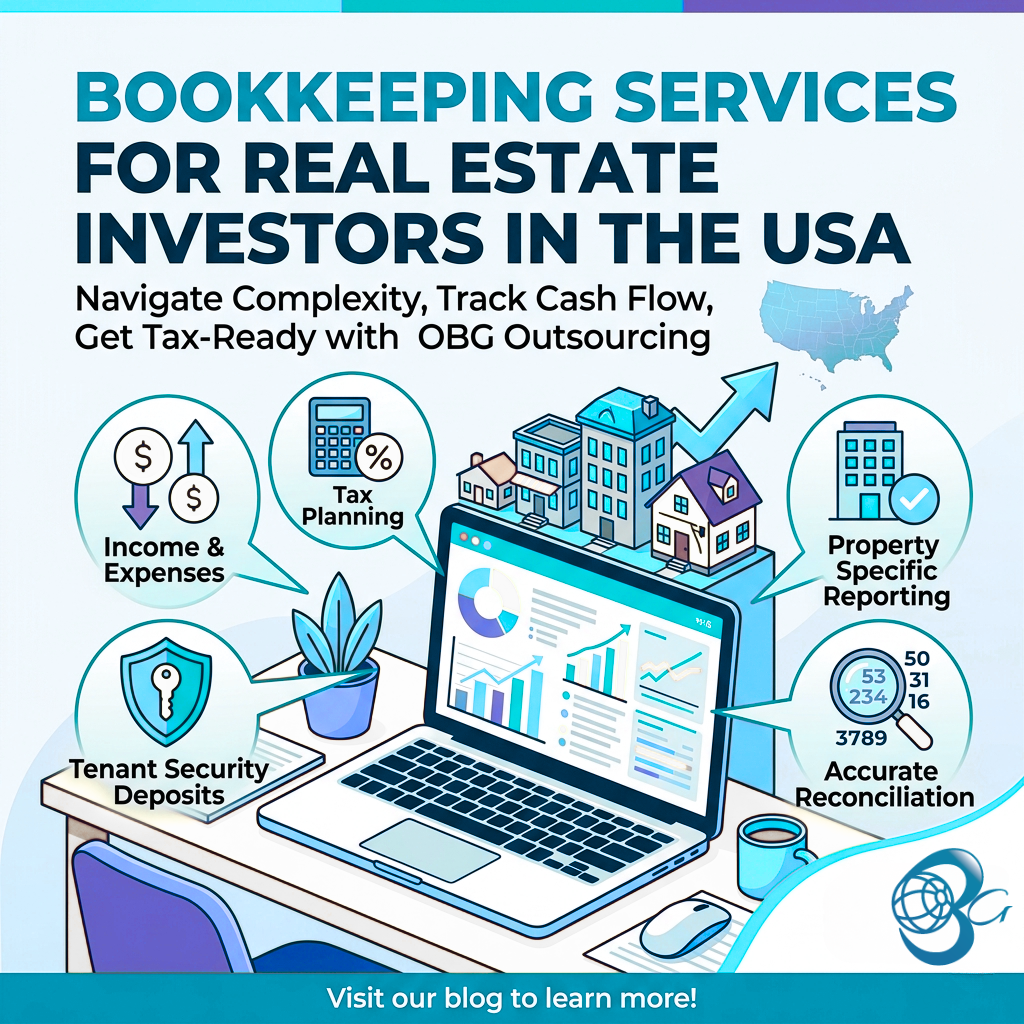
To the outside observer, real estate investing appears straightforward like acquiring a property, collection of rent, managing income and expenses, and accumulating wealth. However, anyone who has owned even a single rental property understands the inherent complexities involved.
Investors must navigate a multitude of financial variables, including payments of mortgage, Repair and maintenance costs, property taxes, insurance premiums, HOA dues, property management fees, utilities, and other balance sheets items like closing costs, escrow accounts, tenant security deposits, and depreciation schedules—often across multiple bank accounts. For those engaged in property flipping, financial tracking requires even greater perfection, as every expenditure directly impacts the final profit margin. Consequently, meticulous bookkeeping is essential.
At OBG Outsourcing, we deliver specialized accounting and bookkeeping services tailored for real estate investors across the United States. We assist property owners, landlords, house flippers, and real estate enterprises to maintain pristine, highly organized, and tax-ready financial records.
The Importance of Accurate Bookkeeping in Real Estate
While many real estate investors initially rely on simple spreadsheets to track income and expenses, this method quickly becomes unsustainable as a portfolio expands.
The financial intricacies of real estate are significant. For instance, a specific utility invoice might apply to Property A, whereas insurance premium covers Property B. Furthermore, a standard mortgage payment must be appropriately allocated among principal, interest, escrow, and insurance. It is also crucial to recognize that tenant security deposits cannot be classified as rental income, which by mistake posted in income by many bookkeepers and closing costs are rarely straightforward expenses; certain expenditures must be capitalized rather than immediately deducted. These financial distinctions are critical to your bottom line.
Without proper accounting or bookkeeping, investors lose visibility into the true profitability of individual properties. Additionally, disorganized records require tax professionals to spend excessive time reconciling accounts at year-end, which can lead to filing delays and increased accounting fees.
Comprehensive bookkeeping enables real estate investors to reliably answer vital operational questions, such as:
Which specific properties are yielding a profit?
What is the exact cash flow generated by each rental unit?
Are mortgage payments being accurately recorded and allocated?- Are repairs accurately distinguished from capital improvements?
Are tenant security deposits appropriately tracked?
Are property management fees meticulously recorded?
Are loan and escrow balances routinely reconciled?
Are your financial records fully prepared for your CPA or tax professional?
Real estate is fundamentally driven by data. Without precise and organized financial records, making informed, strategic decisions becomes significantly compromised.
Real estate investors frequently encounter a few bookkeeping challenges.
A most common issue is the mix of personal and business finances. Utilizing personal bank or credit cards or other accounts to pay property expenses or receive rental income. Which complicates the accounting process and increases the risk of avoiding valuable tax deductions.
Additionally, many investors incorrectly record the entire monthly mortgage payment as a single operational expense. A standard mortgage payment generally consists of principal, interest, escrow, property taxes, and insurance, with each component requiring distinct categorization within the financial records.
Security deposits are also frequently not handled properly and there is no proper tracking. These funds must be recorded as a liability under balance sheet until they are either refunded to the tenant or applied to outstanding balances or any dues in accordance with the lease agreement.
The distinction between routine repairs and capital improvements requires careful assessment based on the nature of spending like for long term or short term. Minor maintenance costs are treated differently than major renovations. Accurate classification is essential to ensure your CPA or tax preparer applies the correct tax treatment.
Finally, for investors managing multiple properties with assets, the lack of property-specific tracking of capital expenditures and assets, presents a significant hurdle. Without detailed reporting by class, location, customer, or project, evaluating the individual financial performance of each property is virtually impossible.
Comprehensive Real Estate Bookkeeping Services
A professional accounting service tailored for real estate business must provide value far beyond fundamental transaction categorization in accounting software or spreadsheet.
At OBG Outsourcing, our robust real estate bookkeeping support may include Rental Income Tracking, Expense categorization based on nature of spending like revenue or capital. We meticulously track rental income by property, tenant, or individual unit, customized to align with the investor's preferred management structure. This ensures all the rent received is accurately recorded and readily accessible for review.
Expense Categorization
Our team of experts classify all property-related expenditures, including repairs, maintenance, utilities, insurance, HOA fees, property taxes, management and legal fees, cleaning, landscaping, taxes and licenses and advertising costs, ensuring precise financial organization.
Bank and Credit Card Reconciliation
Monthly reconciliation is a cornerstone of accurate bookkeeping. Otherwise unable to verify all transactions considered or not in accounting, we rigorously reconcile bank accounts, credit cards, loan portfolios, and payment platforms to ensure your financial records perfectly mirror all actual transactional activity.
Property-Specific Reporting
For a Real Estate company managing multiple assets, we isolate income and expenses based on location of property or any other basis set up by the company like part of real estate property or multiple floors. This granular reporting provides clear visibility into the profitability of individual assets, highlighting high-performing properties and identifying those requiring strategic attention.
Mortgage and Loan Reconciliation
We ensure mortgage payments are accurately allocated across loan principal, interest, escrow, and associated fees on a monthly or quarterly or yearly basis based on available statements or documents. By meticulously reconciling loan balances, we guarantee the integrity and accuracy of your balance sheet and correct liability representations with related account heads expensed or presented.
Security Deposit Tracking
To maintain compliance and financial clarity, tenant security deposits must be kept strictly separated from operational rental income i.e. on the liability side of the Balance sheet. We systematically track these funds, providing a transparent view of all liabilities owed to tenants.
Accounts Payable and Vendor Management
We streamline the organization of invoices and disbursements for investors collaborating with different contractors, property managers, maintenance crews, and other service providers, ensuring seamless vendor relations and accurate expense tracking.
Remedial and Catch-Up Bookkeeping
For accounts in arrears, we offer comprehensive remediation services to reconcile prior months or years. This meticulous cleanup process is invaluable when preparing for tax season, refinancing, property sales, or loan applications.
Tax-Ready Financial Reporting
We generate polished, comprehensive financial reports designed for a seamless handoff to your CPA or tax professional. These precise documents streamline the year-end process, mitigating confusion and significantly reducing tax preparation time.
Bookkeeping Solutions for Diverse Real Estate Investors Real estate investors possess diverse financial requirements. An individual managing a single long-term rental necessitates a vastly different reporting structure than an enterprise overseeing a 25-unit portfolio or executing quarterly house flips. Consequently, bookkeeping strategies must be meticulously tailored to align with specific real estate activities.
Long-Term Rental Property Owners
Operators of long-term rentals require precise tracking of rental income, maintenance expenses, mortgage interest, property taxes, insurance premiums, HOA dues, and depreciation documentation. The primary objective is straightforward: maintain clear visibility into actual cash flow while ensuring financial records are perpetually prepared for tax filing.
Short-Term Rental Owners
Managing short-term rentals on platforms such as Airbnb or Vrbo involves accounting for cleaning charges, platform commissions, occupancy taxes, consumable supplies, utilities, repairs, furnishings, and guest refunds. Due to a significantly higher transaction volume compared to traditional rentals, bookkeeping for short-term properties demands more frequent and rigorous reconciliation.
House Flippers
For property flippers, fastidious bookkeeping is critical, as renovation expenditures directly dictate project profitability. It is essential to meticulously track materials, labor, permits, contractor disbursements, carrying costs, loan interest, insurance, utilities, and selling expenses. Standard profit and loss statements are often insufficient; flippers typically require comprehensive, project-based financial reporting.
Real Estate Developers
Developers require granular cost tracking on a per-project basis. Expenditures such as land acquisition, construction costs, architectural fees, permits, contractor payouts, financing charges, legal fees, and overhead allocations must be systematically organized and recorded.
Real Estate Agents and Brokers
Agents and brokers rely on precise bookkeeping to manage earned commissions, marketing expenditures, referral fees, office overhead, mileage, software subscriptions, professional association dues, and independent contractor payments.
Property Management Companies
Property management firms necessitate robust accounting systems to manage management fees, owner distributions, tenant remittances, trust account balances, vendor invoices, internal payroll, and general operating expenses.
Why QuickBooks Online Is Commonly Utilized for Real Estate Bookkeeping
A significant majority of real estate investors in the United States leverage QuickBooks Online due to its inherent flexibility and widespread adoption among accounting and tax professionals.
When configured correctly, QuickBooks possesses the capability to accurately track:
Properties.- Tenants
Vendors
Loans
Classes or locations
Rental income
Repairs and maintenance
Management fees
Owner contributions and draws
Security deposits
Financial reports
Nevertheless, software alone is insufficient. QuickBooks requires precise configuration. Disorganized charts of accounts or a failure to track properties individually can render financial reports ineffective. Consequently, partnering with a bookkeeping team that possesses specialized knowledge of real estate transactions—rather than just general accounting—is highly recommended.
The Advantages of Outsourcing Real Estate Bookkeeping
Real estate investors are frequently occupied with sourcing deals, managing properties, collaborating with lenders, addressing tenant needs, and strategizing future investments. As a result, bookkeeping is often neglected. Outsourcing enables investors to conserve valuable time while maintaining accurate, up-to-date financial records.
Key benefits include:
Accurate and reconciled monthly financials
Enhanced property-specific reporting
Reduced stress during tax preparation
Transparent cash flow analysis
Streamlined support for loans and refinancing
Precise tracking of repairs and capital improvements
Organized management of vendor and contractor disbursements
Accurate documentation of loans and mortgages
Seamless communication with CPAs and tax preparers
Maintaining current monthly records eliminates the need for frantic year-end catch-up work.
How OBG Outsourcing Supports Real Estate Investors
OBG Outsourcing delivers tailored bookkeeping solutions for real estate investors, landlords, property businesses, and CPA firms with real estate clientele. Our professionals assist with monthly bookkeeping, account cleanup, historical catch-up, reconciliations, financial reporting, and the preparation of tax-ready statements.
We partner with investors ranging from single-property owners to those managing extensive portfolios. Additionally, we provide backend bookkeeping support to CPA firms managing real estate accounts.
Our comprehensive real estate bookkeeping services include:
QuickBooks Online implementation and cleanup
Customized chart of accounts configuration for real estate operations
Property-specific tracking of income and expensesOur comprehensive bookkeeping services include:
Bank and credit card reconciliation
Mortgage and loan reconciliation
Rental income and security deposit tracking
Vendor and contractor payment management
Accounts payable support
Financial statement preparation
Historical book cleanup and monthly bookkeeping reviews
Comprehensive reporting for CPA and tax filing support
Our primary objective is to maintain financial records that are practical, accurate, and easily comprehensible.
Essential Financial Reports for Real Estate Investors
Relying solely on a bank balance is insufficient for real estate investors, as it does not accurately reflect true profitability. To gain a comprehensive understanding of financial health, investors should review the following reports:
Profit and Loss by Property: Details the income and expenses on a per-property basis, facilitating accurate performance comparisons.
Balance Sheet: Provides a complete overview of assets, liabilities, loans, equity, and held security deposits.
Cash Flow Statement: Illustrates the precise inflows and outflows of capital across your portfolio.
Rent Roll Analysis: Tracks expected rental income, actual receipts, and outstanding tenant balances.
Loan Balance Report: Reconciles internal accounting loan balances with official lender statements.
Repair and Maintenance Summary: Evaluates maintenance expenditures to identify properties that may require excessive or immediate upkeep.
Tax-Ready Year-End Report: Streamlines the tax preparation process, allowing your CPA or tax professional to file returns efficiently.
When to Engage a Professional Bookkeeper
Real estate investors should consider partnering with a professional bookkeeper under the following circumstances:
Managing a portfolio of multiple properties
Experiencing a backlog in financial record-keeping
Preparing for upcoming tax filings
Applying for new financing or refinancing options
Strategizing the sale of a property
Engaging in active house-flipping operations
Utilizing multiple bank accounts and credit facilities
Lacking clear visibility into property-specific profitability
Receiving requests from a CPA for more organized and accurate records
Requiring consistent, monthly financial reporting
Ultimately, engaging a professional bookkeeper extends beyond mere regulatory compliance; it is a strategic investment that empowers you to make highly informed and profitable business decisions.
While real estate investing is a powerful vehicle for building long-term wealth, sustained success relies heavily on meticulous financial management. Pristine bookkeeping empowers investors to accurately track cash flow, mitigate expenses, streamline tax preparation, and make strategic, data-driven decisions regarding property acquisition, retention, sales, or refinancing.
If you are a U.S.-based real estate investor operating with disorganized financials, now is the critical time to restore order to your accounts.
OBG Outsourcing delivers specialized bookkeeping services designed specifically for real estate investors, rental property owners, house flippers, property managers, and CPA firms. Whether your requirements include ongoing monthly bookkeeping, historical account cleanup, QuickBooks implementation, or the preparation of tax-ready financial reports, our expert team is equipped to ensure your books remain accurate, compliant, and flawlessly organized.
Simplify Your Property Accounting
_(6).jpg)


1.png)
_(5).jpg)
.jpg)
_(4).jpg)
_(1).jpg)
_(2).jpg)
.png)