 USA
USA UK
UK Australia
 UAE
UAE Canada
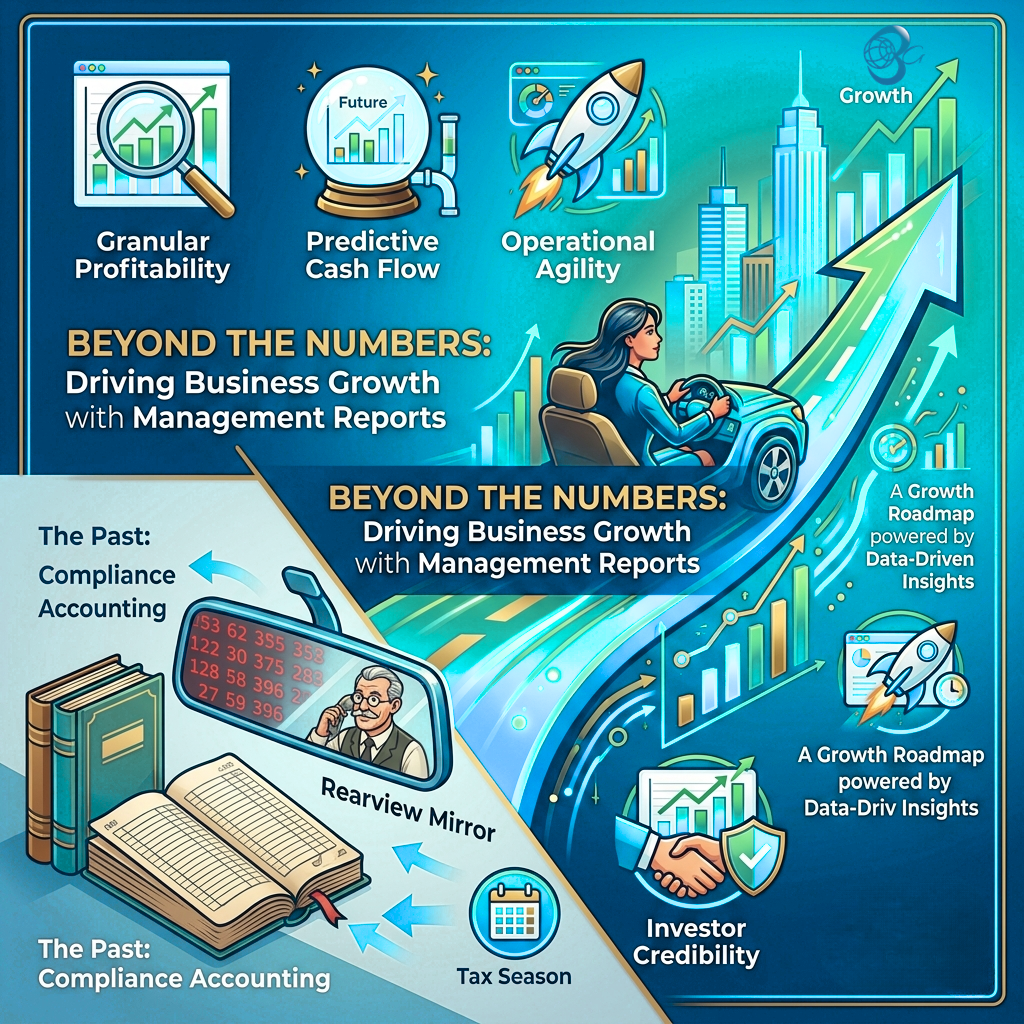
Most business owners treat financial reports like a rearview mirror—a look back at what has already happened, usually prepared just in time for tax season. But if you’re only looking backward, how do you expect to confidently steer your business forward?
Traditional compliance accounting keeps you out of trouble, but Management Reporting is what actually drives business growth.
At OBG Outsourcing Private Limited, we see firsthand how mid-sized enterprises, fast-scaling startups, and global brands transform when they shift from basic bookkeeping to strategic Management Information Systems (MIS) reporting. Here is a modern look at how data-driven insights can become your ultimate scaling weapon.
The Growth Gap: Financial Reporting vs. Management Reporting
To understand how management reporting triggers growth, we first need to clear up a common misconception. Many executives use the terms "financial reporting" and "management reporting" interchangeably. They shouldn't.
| Feature | Financial Reporting | Management Reporting (MIS) |
| Primary Audience | External (Tax authorities, banks, shareholders) | Internal (CEOs, CFOs, Department Heads) |
| Structure | Standardized (Driven by US GAAP or IFRS) | Fully Customized (Driven by your business goals) |
| Focus | Historical performance (The past) | Forward-looking insights (The future) |
| Frequency | Quarterly or Annually | Weekly, Monthly, or Real-Time |
While a standard balance sheet tells you what your business owns and owes, a custom management report tells you why your profit margins dipped in a specific region and how to fix it before next month.
4 Ways Strategic Management Reports Fuel Business Growth
When properly structured and parsed, management reports act as a blueprint for operational and financial expansion.
1. Granular Profitability Analysis (Knowing Where to Double Down)
Are your highest-revenue products actually your most profitable? Surprisingly often, the answer is no. Management reports break down your finances by product line, client account, geographical region, or department.
The Growth Impact: By isolating low-margin bottlenecks and pinpointing high-yield channels, you can confidently redirect your marketing budget and sales focus to the areas that yield the highest return on investment (ROI).
2. Predictive Cash Flow and Runway Forecasting
Growth burns cash. Whether you are expanding your team, launching a new product line, or entering a new country, you need to know exactly how your cash reserves will look 3, 6, and 12 months down the line.
The Growth Impact: Variance and forecasting reports allow you to simulate "what-if" scenarios (e.g., “What happens to our runway if we hire 5 engineers next month vs. next quarter?”). This eliminates guesswork, allowing you to take calculated risks without jeopardizing liquidity.
3. Turning Clunky Data into Instant Operational Agility
Waiting 45 days after the month closes to see your numbers means you are playing a reactive game. Modern management reporting relies on live dashboards and automated KPIs (Key Performance Indicators) tailored to your industry stack—whether you use QuickBooks, Xero, Sage, or SAP.
The Growth Impact: If a specific acquisition cost spikes or customer churn ticks upward, you see it within days, not months. This allows your team to pivot strategy immediately, saving thousands in lost capital.
4. Bulletproof Credibility for Raising Capital
If you plan to secure venture capital, a private equity investment, or a significant bank loan to fund your expansion, basic tax returns won't cut it. Investors look for sophisticated financial hygiene.
The Growth Impact: Presenting a clean, multi-tiered pack of trend analyses, budget-vs-actual reports, and operational metrics instantly builds trust. It proves to lenders and investors that you aren't just running a business—you are managing it scientifically.
Building a Modern Management Report Stack
A truly effective MIS report packet isn't a massive, unreadable spreadsheet. It is a streamlined, visual narrative. A robust growth stack typically includes:
1.The Executive Performance Dashboard:High-level KPIs.
A one-page visual snapshot of your core health metrics: Net Profit Margin, Customer Acquisition Cost (CAC), Lifetime Value (LTV), and Working Capital Ratio.
2.Segment & Divisional Breakdowns:Granular visibility.
Micro-reports tracking revenue and operational costs grouped by specific departments, project boundaries, or product categories.
3.Budget vs. Actual Variance Reports:Accountability checkpoints.
A side-by-side comparison tracking your actual spending against your projected budget, instantly highlighting over-allocations.
4.Rolling Rolling Forecasts:Forward-looking strategy.
Dynamic financial models that continuously update future projections based on real-time performance trends and market adjustments.
Supercharge Your Growth Architecture with OBG Outsourcing
Building, refining, and maintaining a high-tier management reporting ecosystem requires serious time and elite software infrastructure. For most growing businesses, handling this internally results in an expensive overhead burden or fractured data.
OBG Outsourcing Private Limited functions as a scalable, platform-agnostic extension of your global finance team. With corporate hubs bridging the USA, Canada, the UK, the UAE, and India, we help global brands transition from basic bookkeeping to advanced financial intelligence.
Platform-Agnostic Mastery: Our certified experts seamlessly manage and integrate your preferred stack, including QuickBooks, XERO, Sage, MYOB, Drake, and SAP.
Multi-Tier Quality Control: Every report package undergoes rigorous, systematic cross-checking by certified reviewers before hitting your desk.
Ironclad Security: Your corporate intelligence is safe under our strict IT workflows, protected local servers, and comprehensive data protocols.
Stop looking backward. Turn your financial data into a roadmap for expansion.
Ready to elevate your financial strategy?
Transform Your Financial Strategy
_(6).jpg)


1.png)
_(5).jpg)
.jpg)
_(4).jpg)
_(1).jpg)
_(2).jpg)
.png)