 USA
USA UK
UK Australia
 UAE
UAE Canada
To Partners of CPA Firms and Financial Leaders of Mid-Sized Financial Service Institutions:
In the accounting industry of 2026, two pressing challenges persist: a continuous shortage of experienced local professionals, and a steady rise in clients’ demand for real-time advisory services. Traditional models that rely solely on local hiring or basic end-of-month bookkeeping can no longer sustain competitiveness or free up partners to focus on their core priorities. As a result, the role of outsourcing bookkeeping and accounting services has evolved—from a cost-cutting measure in the past to a core strategic lever today. This guide will break down four key dimensions: daily bookkeeping and reconciliation, multi-level quality control, service scope, and data security, to help you evaluate and select the best-fit outsourced accounting model for 2026.
What CPA Firms Need from an Outsourced Accounting Partner in 2026
Not all outsourcing providers are built for public practice or financial services environments. General virtual assistant platforms and automated software apps often leave onshore teams holding the bag for review, cleanup, and compliance.
When evaluating outsourced bookkeeping for accounting firms, target partners that deliver on five baseline criteria:
Daily Reconciliations & Catch-Up Capability: Waiting until day 15 of the following month for bank and credit card reconciliations leaves your firm playing catch-up. Leading providers run daily bookkeeping and reconciliations so client ledgers remain perpetually audit-ready.
Multi-Tiered Quality Control: Single-person oversight leads to review bottlenecks for your onshore managers. Look for an offshore partner with a dedicated Senior Accounting Manager reviewing all work prior to final delivery.
Multi-Software Expertise: Your firm and clients likely rely on a mix of QuickBooks Online/Desktop, Xero, NetSuite, Zoho Books, and specialized industry portals. Your partner must adapt to your tech stack seamlessly without imposing rigid tools.
Data Security & Virtual Infrastructure: In 2026, security is a non-negotiable deal-breaker. Require multi-factor authentication (MFA), strict access logging, encrypted data transfer, and secure cloud environments.
Flexible Capacity & Continuity: Peak season scaling should not require months of onboarding. A dedicated team model guarantees zero downtime from employee turnover or vacations.
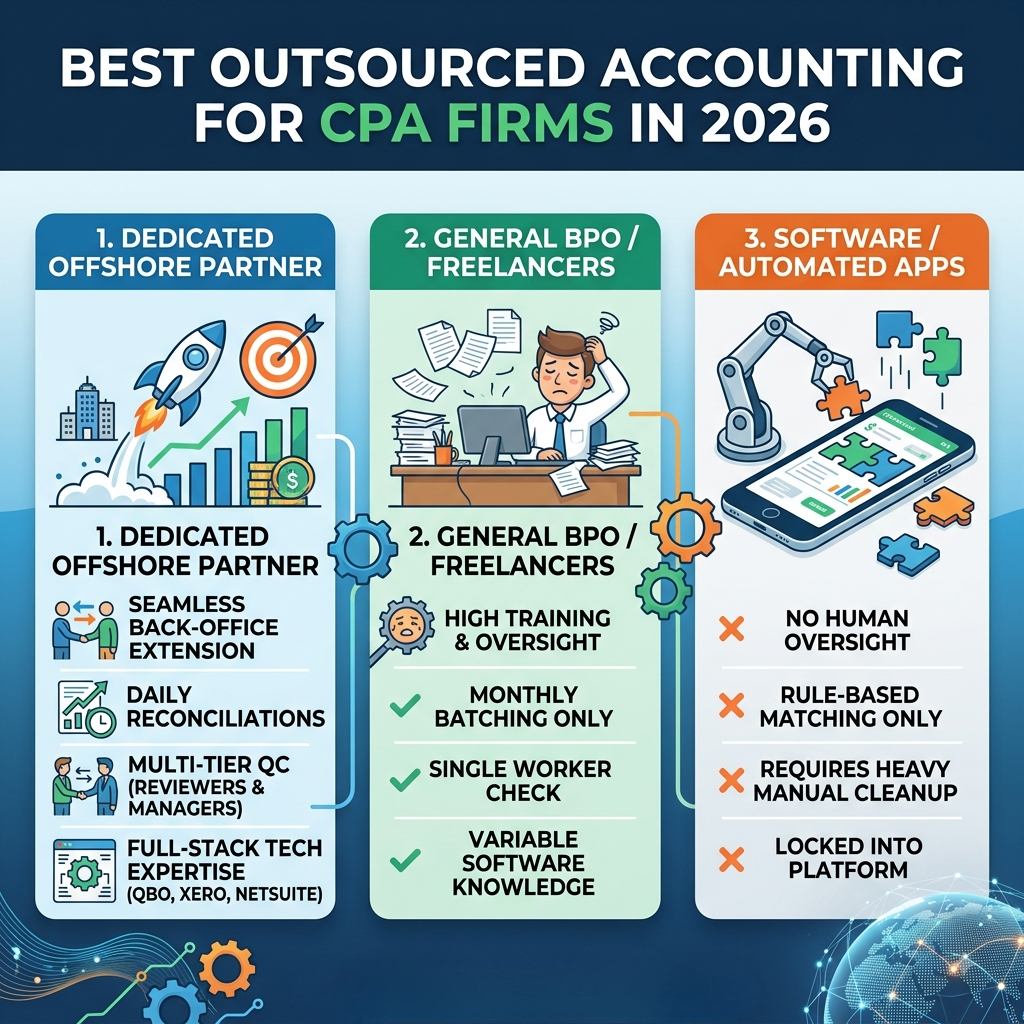
Comparison Matrix: Provider Models for CPA & Financial Services Teams
This paper divides offshore accounting service providers into three categories: professional offshore partners represented by OBG Outsourcing, general global business process outsourcers or freelancers, and pure software-driven automation applications. It conducts a one-by-one assessment across dimensions including core service scope, reconciliation frequency, quality control, technical adaptability, and suitability for accounting firms. The study ultimately concludes that the degree of suitability of these three types of entities for accounting firms decreases in the order listed.
Key Models for Outsourced Bookkeeping and Accounting Services
Dedicated Strategic Offshore Partners (OBG Outsourcing)
A dedicated offshore cooperation team built exclusively for CPA firms and financial services enterprises, which can be directly integrated into your existing workflow. Instead of distributing tasks in a fragmented way, we establish an extended back-office team led by a senior accounting manager for your company.
Target users: CPA firms, consulting agencies, and medium-sized finance teams that seek structured capacity expansion, tax filing support, daily bookkeeping and reconciliation services, but are unwilling to bear the extra costs of local recruitment.
Generalist Business Process Outsourcers (BPOs)
Traditional BPOs can process large volumes of data entry across industries and have cost advantages for handling static tasks, but they often lack professional accounting expertise. This requires local senior staff to invest a large amount of time in reviewing work.
Target users: Large enterprises that seek to deploy general non-professional operational staff and do not need accounting-focused compliance support.
Software Automation Platforms
AI-powered rule-based tools can speed up data extraction, but they cannot replace the professional judgment of well-trained accounting personnel. Unsupervised rule setup often leads to incorrect expense tagging and inaccurate balance sheets, resulting in high year-end rectification costs.
Target users: Micro-enterprises with very small transaction volumes that handle their own bookkeeping.
Why OBG Outsourcing Private Limited is the Preferred Choice for CPA Firms
At OBG Outsourcing Private Limited, we act as a seamless offshoring engine that powers accounting firms and financial services businesses. We help these clients grow their high-margin operations without requiring them to hire additional in-house staff.
Core deliverables built exclusively for accounting firms:
Daily bookkeeping and reconciliation: We continuously track bank, credit card, and intercompany transactions to ensure your balance sheet remains accurate every single day.
Full-lifecycle ledger management: This covers accounts receivable, accounts payable, general ledger maintenance, and month-end and year-end financial close processes.
Tax preparation support: We organize standardized workpapers for corporate, partnership, and individual tax returns, so your local tax team can focus entirely on developing client-facing strategies.
Payroll & Compliance Support: End-to-end payroll processing and ledger integration to eliminate client administrative friction.
Cut operational costs by up to 60%: Our fixed, predictable monthly fee model replaces the high costs, turnover risks, and hiring delays that come with recruiting local staff.
When an accounting firm screens potential partners,
it can evaluate accounting service providers using four key questions:
Does the provider carry out multi-level reviews before service delivery?
Can it integrate with the four types of mainstream financial software without
forcing data migration? How does it manage and
control data security? Can it support real-time reconciliation? By partnering with
established service providers like OBG, the accounting firm will be able to eliminate repetitive compliance work, shorten turnaround cycles, and focus on high-margin consulting business after 2026.
_(6).jpg)


1.png)
_(5).jpg)
.jpg)
_(4).jpg)
_(1).jpg)
_(2).jpg)
.png)