 USA
 UK
 Australia
 UAE
 Canada
 India

Imagine your company signs a $120,000 customer contract in January and receives the entire payment upfront. Your bank account shows $120,000, but does that mean your business has earned $120,000 in revenue?
Not necessarily.
Under ASC 606 revenue recognition rules, businesses must recognize revenue when or as they satisfy their contractual performance obligations, rather than simply when customers make payments or invoices are issued.
For SaaS companies, technology startups, construction contractors, and professional service providers, understanding ASC 606 is essential for accurate financial reporting under US GAAP.
At OBG Outsourcing, we provide outsourced ASC 606 revenue recognition accounting support to US businesses, CFOs, controllers, and CPA firms. Our services include contract accounting support, deferred revenue reconciliations, revenue recognition schedules, journal entries, and financial reporting workpapers.
What Is ASC 606 Revenue Recognition?
ASC 606, Revenue from Contracts with Customers, is the US Generally Accepted Accounting Principles (GAAP) standard that establishes how and when businesses recognize revenue from customer contracts.
Introduced by the Financial Accounting Standards Board (FASB), ASC 606 provides a consistent framework for determining revenue recognition across different industries.
The fundamental principle is that a business recognizes revenue when or as it transfers promised goods or services to customers, in an amount reflecting the consideration it expects to receive.
This means:
Receiving customer payments does not automatically create earned revenue.
Issuing an invoice does not necessarily mean revenue should be recognized immediately.
Revenue may be recognized before or after cash is collected.
Revenue recognition depends on contractual obligations and when those obligations are satisfied.
Proper ASC 606 accounting helps businesses maintain accurate financial statements, monitor contract liabilities, and prepare reliable financial information for management, investors, lenders, and auditors.
The Five-Step ASC 606 Revenue Recognition Model
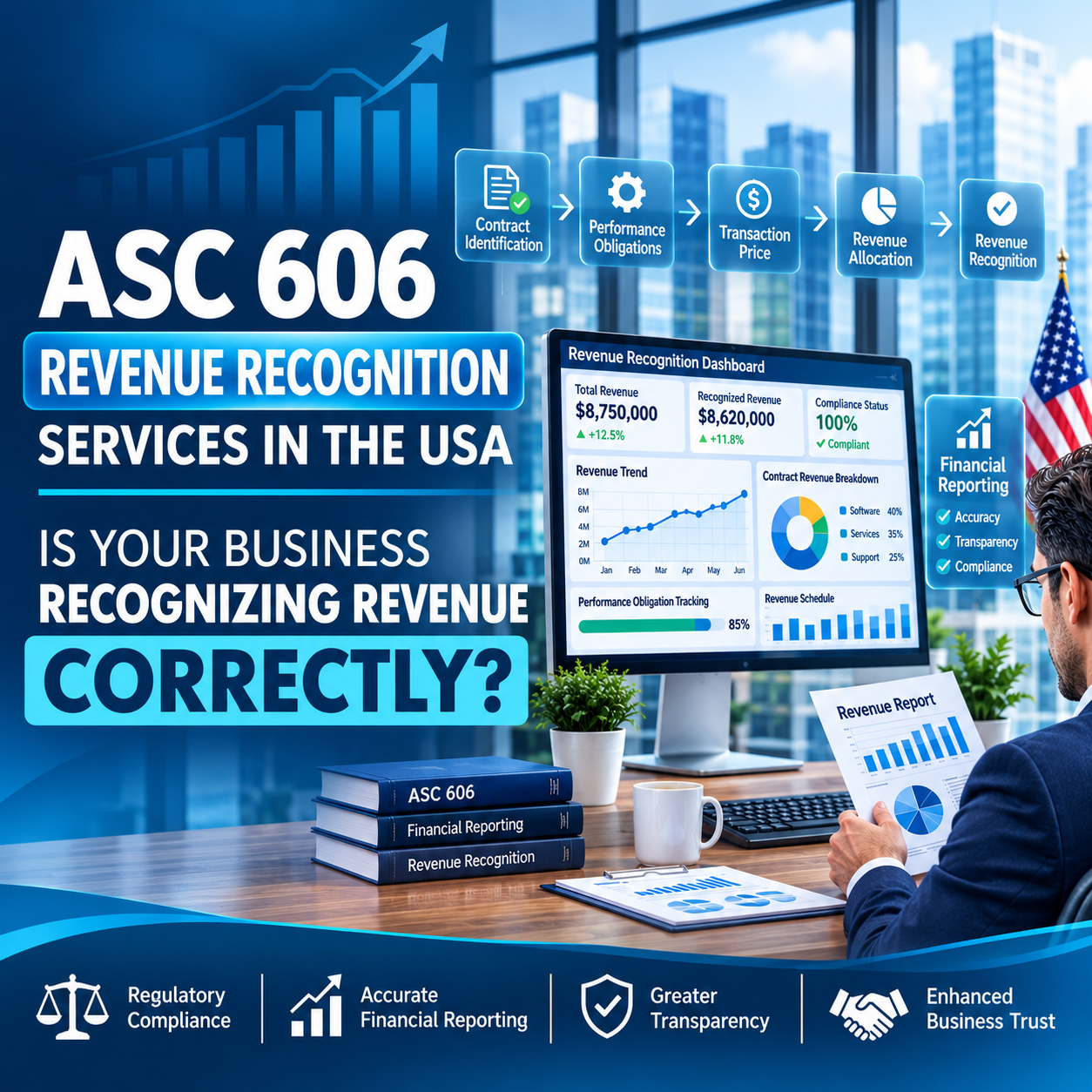
ASC 606 follows a structured five-step process for recognizing revenue from customer contracts.
Step 1: Identify the Contract with the Customer
Determine whether the arrangement meets the criteria for a contract under ASC 606. Contracts may be written, verbal, or implied through customary business practices when the required conditions are satisfied.
Step 2: Identify the Performance Obligations
Identify the distinct goods or services promised to the customer.
For example, a technology company may provide software access, implementation, training, and ongoing technical support. Each promised service must be evaluated to determine whether it represents a separate performance obligation.
Step 3: Determine the Transaction Price
Establish the consideration the business expects to receive from the customer.
This may include fixed payments, discounts, rebates, refunds, performance incentives, and variable consideration.
Step 4: Allocate the Transaction Price
When a contract contains multiple performance obligations, the transaction price is generally allocated using relative standalone selling prices, subject to the applicable guidance.
Step 5: Recognize Revenue When or As Performance Obligations Are Satisfied
Recognize revenue when or as the business fulfills its contractual obligations.
Depending on the arrangement, revenue may be recognized at a particular point in time or progressively over the service period.
ASC 606 Revenue Recognition Example
Consider a US technology company that signs a 12-month support agreement worth $60,000.
The customer pays the full amount on January 1, and the company provides services evenly throughout the year.
Assuming the contract contains one performance obligation satisfied evenly over the period:
| Particulars | Amount |
|---|---|
| Total Contract Value | $60,000 |
| Contract Duration | 12 Months |
| Upfront Customer Payment | $60,000 |
| Monthly Revenue Recognition | $5,000 |
| Revenue Recognized in January | $5,000 |
| Deferred Revenue After January | $55,000 |
Although the business receives $60,000 in January, it recognizes only $5,000 as revenue for that month.
The remaining $55,000 represents a contract liability for services still to be provided.
Example Journal Entries
When the customer pays $60,000 upfront:
Debit: Cash — $60,000
Credit: Deferred Revenue — $60,000
At the end of January:
Debit: Deferred Revenue — $5,000
Credit: Service Revenue — $5,000
The company continues recognizing revenue as it satisfies the performance obligation during the remaining contract period.
This example illustrates why businesses need accurate revenue recognition schedules and deferred revenue reconciliations.
Which Industries Need ASC 606 Accounting Support?
ASC 606 applies broadly to customer contracts within its scope, but certain industries experience greater revenue recognition complexity.
SaaS and Subscription-Based Businesses
SaaS companies commonly collect annual or quarterly subscription fees in advance.
Revenue recognition becomes more complex when contracts include implementation fees, onboarding services, upgrades, cancellations, discounts, and usage-based pricing.
Proper ASC 606 accounting helps SaaS businesses maintain subscription revenue schedules and deferred revenue balances.
Construction and Contracting Companies
Construction businesses often manage milestone payments, progress billings, change orders, retainage, and performance incentives.
Depending on the contract, revenue may qualify for recognition over time when the relevant ASC 606 criteria are met.
Accurate project accounting and progress measurement are essential for reliable financial reporting.
Technology Startups
Technology startups may offer bundled software licenses, implementation services, maintenance, and ongoing customer support.
Revenue recognition accounting helps startups present more reliable financial information when raising capital, applying for financing, or preparing for investor due diligence.
Consulting and Professional Services Firms
Consultants, marketing agencies, IT service providers, and other professional service firms frequently use fixed-fee contracts, retainers, and milestone-based billing arrangements.
These businesses must evaluate when their contractual services are performed rather than relying solely on billing dates.
Manufacturing and Distribution Businesses
Manufacturers and distributors may need to assess revenue recognition issues involving customer acceptance, product returns, warranties, rebates, shipping terms, and volume discounts.
Determining when control transfers to the customer is an important part of the ASC 606 analysis.
What Is Deferred Revenue Under ASC 606?
Deferred revenue generally represents consideration received or due before a business transfers the promised goods or services to its customer.
It is commonly reported as a contract liability on the balance sheet.
Businesses receiving advance customer payments should maintain accurate deferred revenue schedules showing:
Opening deferred revenue balances.
New advance payments or billings creating contract liabilities.
Revenue recognized during the accounting period.
Contract modifications and adjustments.
Closing deferred revenue balances.
Regular reconciliation between customer contracts, revenue schedules, and general ledger accounts helps reduce reporting errors.
Common ASC 606 Revenue Recognition Mistakes
Businesses may encounter revenue recognition problems when their accounting processes are based primarily on invoices or cash receipts.
Common mistakes include:
Recognizing customer payments as revenue before services are delivered.
Recording invoices as earned revenue without evaluating performance obligations.
Failing to identify separate deliverables within bundled contracts.
Incorrectly accounting for subscription upgrades, renewals, and cancellations.
Using construction progress billings as a substitute for measuring revenue earned.
Failing to evaluate discounts, rebates, performance bonuses, and other variable consideration.
Maintaining inaccurate deferred revenue schedules.
Failing to reconcile revenue recognition schedules with the general ledger.
These issues may affect reported revenue, profitability, contract liabilities, and the reliability of financial statements.
ASC 606 Revenue Recognition Services Offered by OBG Outsourcing
OBG Outsourcing provides outsourced accounting support to help businesses maintain organized and review-ready revenue recognition records.
ASC 606 Contract Review Support
We assist with organizing and reviewing customer contract information, including billing arrangements, deliverables, pricing terms, and potential performance obligations.
Complex technical accounting conclusions can be referred for appropriate CPA or management review.
Revenue Recognition Schedule Preparation
Our accounting team helps prepare monthly revenue recognition schedules based on approved accounting policies and customer contract information.
Deferred Revenue Accounting and Reconciliation
We assist with deferred revenue rollforwards, contract liability reconciliations, general ledger reviews, and supporting documentation.
ASC 606 Journal Entry Preparation
We help prepare recurring and adjusting journal entries for revenue recognition, contract liabilities, and contract assets, as appropriate.
ASC 606 Accounting Implementation Support
For businesses developing formal revenue recognition processes, we assist with accounting workflows, contract data organization, reporting templates, and month-end procedures.
Historical Revenue Recognition Cleanup
We help reconstruct revenue schedules, identify potential accounting differences, and prepare proposed adjustments for management or CPA review.
Audit Preparation and Accounting Workpapers
Our team assists with revenue schedules, contract summaries, supporting reconciliations, and accounting documentation requested during financial statement audits.
White-Label ASC 606 Accounting Support for CPA Firms
CPA firms often serve businesses with complex customer contracts, subscription revenue, deferred revenue balances, and multiple performance obligations.
Preparing monthly revenue recognition schedules and reconciliations can require substantial accounting resources.
OBG Outsourcing provides white-label ASC 606 accounting support to US CPA and accounting firms, helping them expand their back-office capacity without adding permanent staff.
Our support includes contract data organization, revenue schedule preparation, deferred revenue reconciliation, journal entry support, general ledger review, and accounting workpaper preparation.
The CPA firm retains responsibility for client relationships, technical accounting conclusions, final reviews, and engagement delivery.
Does ASC 606 Affect Business Tax Returns?
ASC 606 is a financial accounting standard under US GAAP and does not automatically determine taxable income.
Businesses may experience differences between financial statement revenue and income recognized for federal or state tax purposes.
Certain arrangements may also involve federal tax provisions, including Internal Revenue Code Section 451.
Companies should coordinate their revenue recognition accounting with their CPA or tax advisor to evaluate applicable book-to-tax differences.
When Should a Business Consider ASC 606 Accounting Support?
Specialized revenue recognition accounting support may be useful when a company:
Signs long-term or complex customer contracts.
Receives significant advance payments.
Offers subscription or bundled services.
Uses milestone-based or variable pricing.
Experiences discrepancies between billing and reported revenue.
Prepares for financial statement audits.
Seeks investment or business financing.
Needs to reconstruct historical revenue recognition schedules.
Establishing consistent monthly revenue recognition procedures can help businesses identify accounting issues before they affect year-end financial reporting.
Frequently Asked Questions About ASC 606
What is ASC 606 in simple terms?
ASC 606 is the US GAAP standard that determines when and how businesses recognize revenue from customer contracts based on the transfer of promised goods or services.
Does ASC 606 apply to small businesses?
ASC 606 generally applies to customer contracts within its scope when businesses prepare financial statements under US GAAP. Private businesses are not automatically exempt.
Do SaaS companies need ASC 606 accounting?
SaaS companies preparing US GAAP financial statements generally must apply ASC 606 to applicable customer contracts, including subscriptions and arrangements involving multiple deliverables.
Is deferred revenue the same as accounts receivable?
No. Accounts receivable generally represents an unconditional right to payment, while deferred revenue represents an obligation to transfer goods or services for consideration already received or due.
Can QuickBooks Online support ASC 606 accounting?
QuickBooks Online can record accounting entries and balances related to revenue recognition. Complex arrangements may require additional schedules, workflows, integrations, or specialized software.
Can revenue be recognized before an invoice is issued?
Yes. Depending on the contract and applicable accounting requirements, revenue may be recognized before invoicing, potentially resulting in a contract asset or receivable.
Is ASC 606 the same as IFRS 15?
ASC 606 and IFRS 15 share a broadly converged revenue recognition framework, although certain differences exist between the standards.
Can OBG Outsourcing help with ASC 606 accounting cleanup?
Yes. OBG Outsourcing provides support for historical revenue schedule reconstruction, deferred revenue reconciliation, proposed journal entries, and accounting documentation for management or CPA review.
Does OBG Outsourcing support CPA firms?
Yes. We provide white-label revenue recognition accounting support to CPA firms, including revenue schedules, reconciliations, journal entry support, and review-ready workpapers.
Conclusion: Accurate Revenue Recognition Supports Better Financial Reporting
Revenue recognition involves more than recording invoices and customer payments.
ASC 606 helps businesses distinguish between cash collected, revenue earned, and contractual obligations that remain outstanding.
For SaaS companies, technology startups, construction contractors, and professional service firms, reliable revenue recognition accounting supports accurate financial statements, stronger accounting processes, and improved audit preparation.
At OBG Outsourcing, we help US businesses and CPA firms maintain organized ASC 606 accounting records, deferred revenue schedules, journal entries, and supporting financial reporting documentation.
Need ASC 606 Revenue Recognition Accounting Support?
Whether your business manages subscription contracts, receives advance customer payments, or needs help reconciling deferred revenue, OBG Outsourcing can provide outsourced accounting support tailored to your requirements.
We also partner with CPA firms seeking dependable white-label revenue recognition accounting assistance.
Disclaimer: This article provides general information about ASC 606 under US GAAP and does not constitute an accounting opinion, independent audit, or tax advice. Actual accounting conclusions depend on contract terms, applicable accounting requirements, and professional judgment.


