 USA
USA UK
UK Australia
 UAE
UAE Canada
Today's automated accounting software can process thousands of transaction records in just a few seconds. However, the built-in algorithms it relies on can understand the entered line items, but cannot grasp the complete business scenarios behind these accounts. It only processes and verifies data one by one in accordance with pre-hardcoded rules, and is completely unable to distinguish whether an expense is the entertainment cost for the owner to entertain clients, or the welfare expense for purchasing labor protection supplies for employees. As long as the numerical format of the entry is correct, it will proceed along the workflow, with no capacity to integrate the company's actual business to judge where this entry should be classified.
Once an error occurs in any entry, such as misclassifying an account, making a deduction without verification, or misfiling a supplier's invoice, the problem will immediately propagate to the final financial statements. Not only will the data in the statements not match the company's real financial situation, but it will also trigger tax compliance risks—that is, failing to accurately report revenue and claim tax deductions as required by the tax bureau, which may ultimately lead to tax audits or fines.
At OBG Outsourcing, the AI-assisted bookkeeping and auditing service we have launched combines automatic data verification with the supervision of human experts. First, the system quickly screens all transaction flows, then financial professionals who understand both finance and business verify each account that the system is uncertain about or that is prone to errors one by one, producing accurate and reliable financial records.
The Strengths and Limits of AI Accounting Software
Today's AI accounting software is reliable for handling routine daily data work—it can smoothly complete all those repetitive, process-fixed daily operations. However, when it encounters financial decisions that require integration of specific scenarios and involve complex details, it cannot provide the necessary strategic judgment. Such decisions require integration of the actual context of the business and the ability to predict future trends, and this kind of capacity for comprehensive consideration is something that this type of software is completely unable to possess.
Below, we break down the respective responsibilities of the modern AI Accounting Software and the Human Accountant Oversight across the four core modules of accounting work:
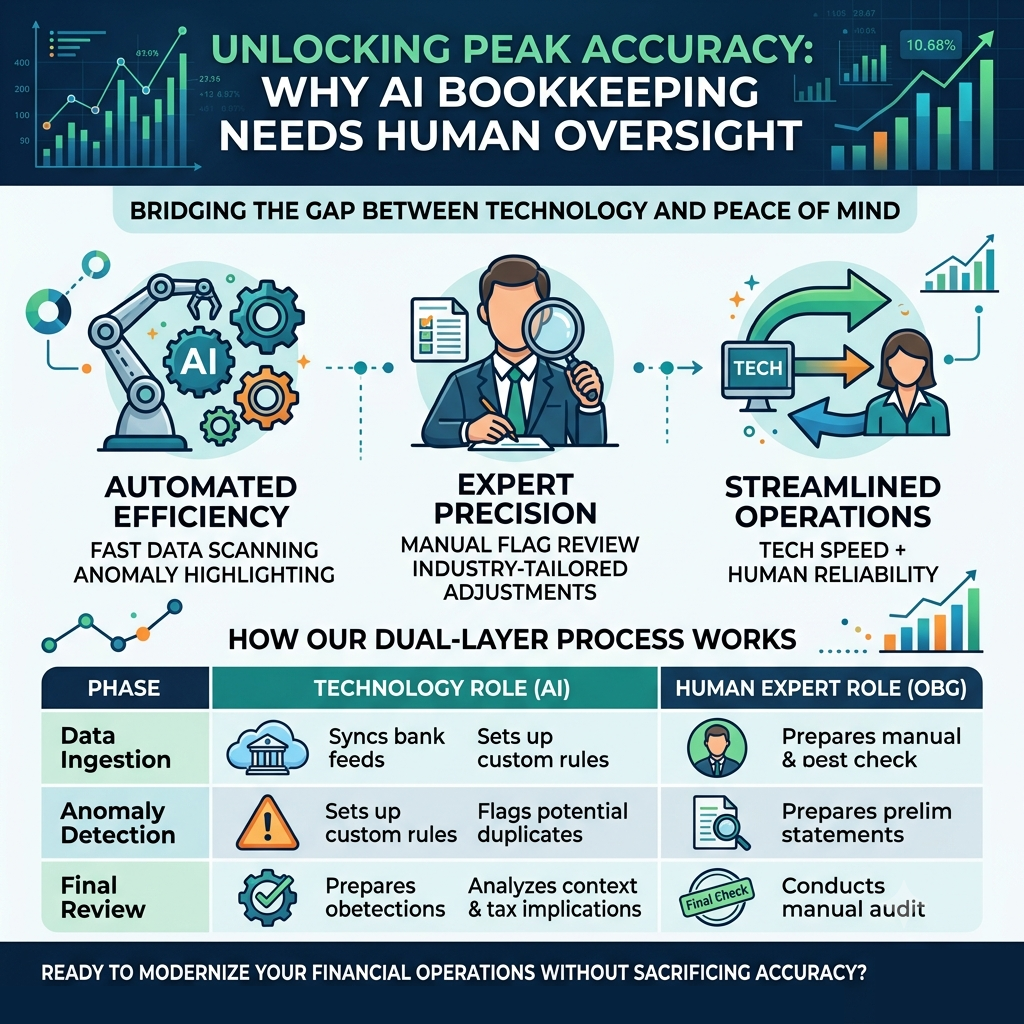
The first module is Data Ingestion. The modern AI Accounting Software can Rapidly import bank transaction records, receipts, and invoices. The human accountant in charge of oversight must closely monitor the connectivity of data interfaces and the status of system integration.
The second module is transaction matching. The modern AI Accounting Software can automatically categorize predictable, fixed and recurring expenses. All remaining special cases, complex account allocations, as well as accounts related to first-time cooperating new suppliers, are handled by the human accountant.
The third module is anomaly identification and auditing. The modern AI Accounting Software will flag entries that have been duplicated, or records with abnormal amounts. The tasks for the human accountant are to verify the accuracy of financial records, and also check the true business background corresponding to each record.
The final module is strategic guidance. The modern AI Accounting Software can generate standard report dashboards. The human accountant is responsible for interpreting the company's financial health, while ensuring all of the company's tax operations comply with regulations.
How OBG Outsourcing Combines AI and Human Oversight
This hybrid bookkeeping model we have developed is a working method that integrates the strengths of machines and human labor, advancing through a clear multi-stage workflow throughout the entire process. It can guarantee processing speed without sacrificing the accuracy of analysis, and will never miscalculate accounts or handle work carelessly just to speed up the process.
The first stage is the Automated Financial Record Verification stage: AI will continuously scan all original transaction records, identify and flag abnormal and problematic entries, sort and categorize all regular income and expense entries, and take charge of all trivial tasks that can be processed with standardization.
The second stage is the Structured Accounting Review stage: human accountants with professional qualifications take over, specifically review the flagged exception entries, correct any entries that were misclassified to their proper categories, and resolve reconciliation issues on the balance sheet—all special cases that machines cannot accurately determine are handed over to knowledgeable accountants to sort out and resolve.
The final stage is the Quality Assurance and delivery stage: experienced professional staff complete the final audit, cross-check all work completed in all preceding stages to ensure the final bookkeeping services provided are completely accurate and fully aligned with your enterprise's needs.
Why Small Businesses Need a Hybrid Approach
Combining automated precision with human expertise provides distinct operational benefits:
Higher Accuracy: AI can accurately identify anomalous values that deviate from the norm in statistical data. The remaining deeply hidden account classification errors that machines cannot understand are handed over to human accountants, who correct all these errors and omissions before the finalization and archiving of financial reports, fundamentally eliminating the possibility of data errors.
Fraud Detection: Pre-set automated rules first flag all abnormal, suspicious transactions with red alerts. Professional auditors then review each flagged payment one by one, carefully judging whether these marked payments are truly legitimate, compliant, and normal corporate expenditures, preventing fraudulent activities from slipping through the cracks.
Time and Cost Efficiency: Repetitive, cumbersome, low-skill daily tasks are all handled by automated processes. This approach not only maintains uncompromised work quality, but also reduces the number of billable man-hours charged to clients, freeing up manpower to be used in areas that require professional judgment.
Scalable Support: Even as your business grows and the number of monthly transactions surges, this hybrid man-machine collaboration system can keep up smoothly, scaling and upgrading with ease to steadily support all the needs of business expansion, without ever falling behind pace.
Automated bookkeeping can indeed greatly speed up processing, but machine speed alone is not enough. Only after repeated careful verification and review by professionals can these financial data truly hold up, building reliable trust that puts people at ease.
Partnering with OBG Outsourcing allows you to obtain financial records that are processed quickly, have high accuracy, and have undergone complete verification.
_(6).jpg)


1.png)
_(5).jpg)
.jpg)
_(4).jpg)
_(1).jpg)
_(2).jpg)
.png)