 USA
USA UK
UK Australia
 UAE
UAE Canada
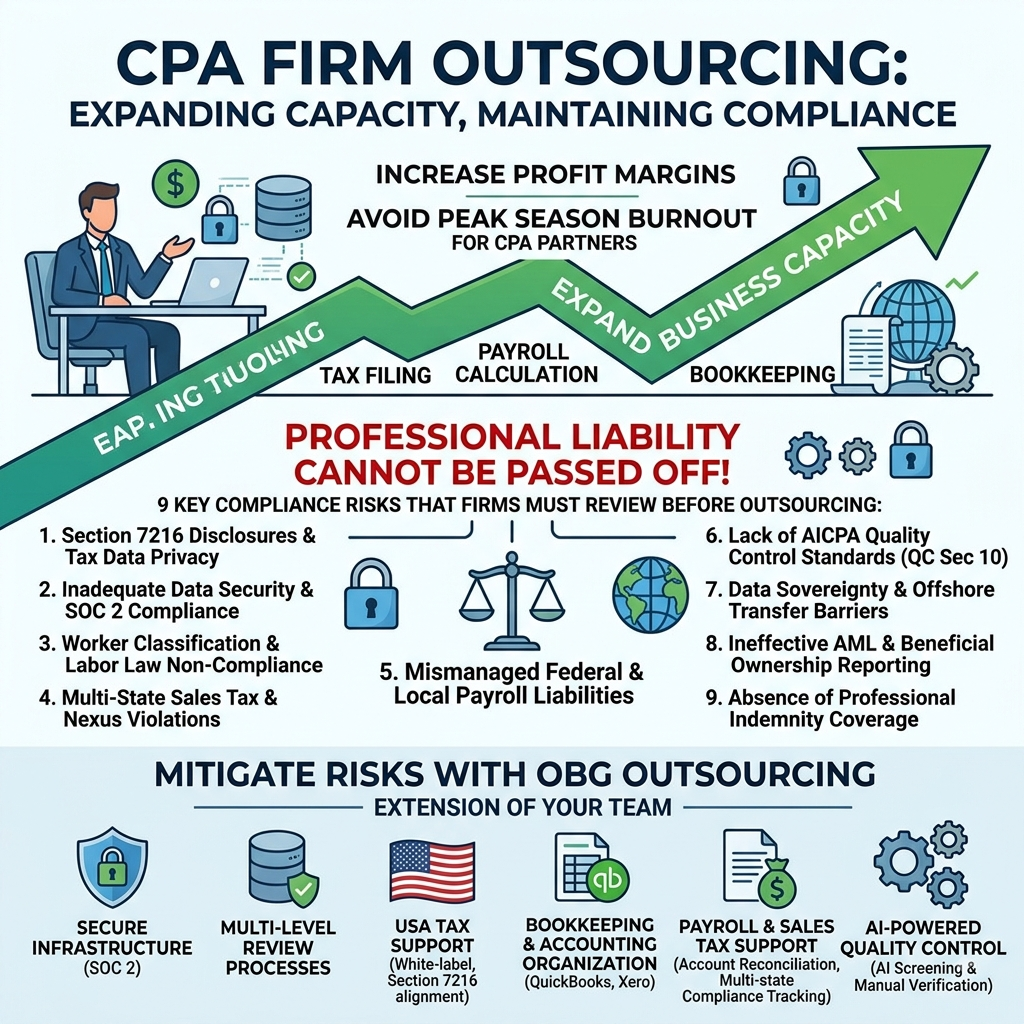
Outsourcing core tasks such as tax filing, payroll calculation, and bookkeeping is one of the fastest ways for CPA firms to expand their business capacity. It prevents partners from burning out during peak seasons while also boosting profit margins. Put simply, by transferring these core tasks that firms would otherwise keep in-house, they no longer need to struggle with hiring and scaling their internal team, can take on more client engagements, spare their core team from nonstop work that leads to emotional collapse during peak periods, and expand their profit margins.
However, do not assume that handing off work means you can shirk responsibility—even if you assign tasks to an overseas team or use a third-party accounting system, the professional liability that ultimately falls on you cannot be passed off in the slightest. Even if the work is handled by an outsourced team and the systems used are developed by a third party, if any professional issue arises, the CPA firm is ultimately responsible for bearing all consequences; it cannot escape or shift that liability.
As long as a firm uses outsourced accounting services, it must assume full responsibility for all related obligations from start to finish: it must uphold quality control for every task, comply with all regulatory requirements, and protect clients' confidential data privacy. All issues related to service quality, all explicitly stated regulatory compliance mandates, and the security of clients' private information must be fully shouldered by the firm, and cannot be passed to the outsourced service provider. If you plan to send client documents to an overseas partner team or upload them to a third-party platform, you must first thoroughly review all 9 key compliance risks one by one to maintain the firm's safe operating status, avoid crossing compliance red lines, and prevent your practice from being exposed to risk.
1. Section 7216 Disclosures & Tax Data Privacy
First, I will clarify a mandatory legal provision for everyone: Under IRS Section 7216, if you disclose or use any other person's tax-related information without the explicit written consent of the party concerned, this act constitutes a federal misdemeanor, and you will be held liable for the corresponding legal responsibilities.
Next, I will issue a reminder that there are clear risks behind this matter: if you share your client's tax data with overseas work teams or third-party service providers without obtaining compliant authorization, you will not be violating just one red line — you will not only breach the federal law mentioned earlier, but also violate the ethical standards of AICPA, and face penalties at both the legal and industry rule levels.
Finally, I will list a requirement that must be implemented in the Compliance Checklist: if you intend to initiate the outsourcing of any tax return preparation work, before you start the work, your firm must first distribute the updated consent form that meets the requirements of Section 7216, and this form must clearly state the specific countries that will process such tax information, with no omissions allowed.
2. Inadequate Data Security & SOC 2 Compliance
Outsourcing your business operations will expand the attack surface within your company's digital environment. Simply put, it opens multiple new external gaps in your originally closed corporate network, and these gaps will expose you to three categories of risks: vulnerability to ransomware attacks, data breaches, and stolen account credentials.
Where do these risks stem from? They originate precisely from the third-party service providers you collaborate with — their network protection fails to meet standards, they lack enterprise-grade encryption technology and multi-factor authentication (MFA), and they do not have strict device management rules in place, which means these external gaps are not fitted with qualified locks at all.
To address this issue, there is a Compliance Checklist that requires you to only partner with service providers that meet all of the following requirements simultaneously: hold audited SOC 2 Type II compliance qualifications and ISO 27001 certification, and be capable of providing end-to-end encryption protection for all data in transit and at rest.
3. Worker Classification & Labor Law Non-Compliance
Whether you use virtual employees to handle outsourced routine bookkeeping, or to undertake more complex consulting work, regulatory warnings may be triggered if the legal boundaries of the employment status of these people are ambiguous.
The specific risks to watch out for are as follows: incorrectly distinguishing between subcontracted personnel and employees directly hired by service providers, or violating international labor standards and local entity regulations.
You can check for risks against this Compliance Checklist: verify that the cooperating service provider is a legally registered formal legal entity, that all the employees it uses are its direct recruits, formal employees who have passed background checks, and not part of an unregulated loose network of freelancers whose practitioners have not undergone any vetting.
4. Multi-State Sales Tax & Nexus Violations
To provide sales tax and VAT-related services across multiple jurisdictions, it is not sufficient to apply a single set of general processes to all regions. Each jurisdiction has its own independent tax rules. To deliver competent services, one must track the economic nexus thresholds of various regions in real time and follow every change to local tax laws. The so-called economic nexus threshold refers to the tax filing threshold set by each region for out-of-jurisdiction businesses—once an out-of-jurisdiction business’s local operation scale reaches this standard, it is required to file taxes locally. If one misses a threshold adjustment or a tax law change, subsequent tax processing will definitely encounter problems.
When providing such cross-regional tax services, there is also a core risk to guard against: outsourcing the preparation of sales tax filings to a team that is unfamiliar with the exclusive rules of state-level platform service providers, origin/destination-based tax calculation rules, or updates to local tax rates. These rules are fragmented and geographically specific; outsiders cannot grasp their intricacies, and entrusting such a team with the work makes it very easy to prepare incorrect filing materials.
The Compliance Checklist explicitly stipulates the requirement to confirm that cooperating partners have activated an automated tax system, while also employing dedicated sales tax auditors, to prevent your clients from being fined for underreporting tax amounts. The role of this combination is to improve efficiency through the system, and place a final check with dedicated personnel, to minimize the possibility of omissions or underreporting of taxes.
5. Mismanaged Federal & Local Payroll Liabilities
Payroll management brooks no errors. Even the slightest mistake in calculating salaries during wage disbursement is absolutely unacceptable.
If you outsource the entire set of payroll workflows, there are numerous hidden risks in the process, and triggering any of them will lead to major problems: if wages fail to reach employees' accounts on time, the tax deposit deadline is missed, or the amount withheld for employees is miscalculated, your clients will directly face severe penalties from the IRS and state tax authorities.
To pass compliance reviews, you must strictly adhere to a mandatory inspection requirement: before you transfer the funds for payroll disbursement or submit tax filing documents, all payroll distribution procedures and tax declaration reconciliation work must strictly implement the Dual-Control/Sign-Off mechanism. The Compliance Checklist must be fully completed and signed off at each stage to confirm all requirements have been met.
6. Lack of AICPA Quality Control Standards (QC Sec 10)
Assigning work out does not mean the responsibility for quality control can be shed. It is not that once you hand over your tasks to an external team and everything will be settled; the burden of quality inspection must still be borne by yourself. Under AICPA standards, a CPA must oversee and manage all outsourced professional and technical work throughout the entire process.
If this oversight responsibility is not effectively implemented, tangible risks will be triggered. These specific risks include: un-reviewed financial statements, inability to locate corresponding work papers, or incorrect adoption of tax-related positions, and these problematic materials are directly delivered to the client before the CPA's proper sign-off is completed.
To avoid these risks and meet compliance requirements, there is a Compliance Checklist that must be completed before the final deliverable is submitted to the client: prior to the final delivery to the client, a unified project review process, an issue management form, and a multi-level review process must be established.
7. Data Sovereignty & Offshore Transfer Barriers
Some contracts signed with clients, government projects you undertake, or industry-specific regulations (such as ITAR, HIPAA) all have clear requirements: the data in your possession must never be stored outside the United States, nor processed outside the United States.
There is a common pitfall to watch out for: even if you never intend to violate these regulations, you are very likely to make mistakes when following standard outsourcing processes. To meet accounting compliance requirements, you outsource this work using a generic set of procedures, and you might accidentally transfer client data that is restricted from leaving the country outside the borders of the United States—that is the key risk that must be prevented.
How can you avoid this pitfall? The original text provides a Compliance Checklist that you must follow to verify each item one by one: first, check where the servers of your cooperating suppliers are located; second, check the status of the cloud storage architecture you are using; third, check the setup and configuration of your virtual desktop interface (VDI). The ultimate goal of conducting these three checks is to strictly enforce a hard rule: prohibit any data from being downloaded to local devices.
8. Ineffective AML & Beneficial Ownership Reporting
Nowadays, the regulatory requirements related to Anti-Money Laundering (abbreviated as AML) and filings under the Corporate Transparency Act (abbreviated as CTA) are becoming increasingly stringent. For every institution, throughout the entire process of completing the onboarding procedure for new customers, entering customer information into their own systems, and activating services, strict background checks must be conducted, with no room for carelessness.
Next are the risk points: many overseas teams responsible for processing accounting records are completely incapable of identifying and marking three types of problematic information—namely suspicious fund transactions, the establishment structure of shell companies, and company ownership data that fails to meet compliance requirements. If these hidden risks are overlooked, serious problems are very likely to occur.
Finally, the mandatory requirements in the Compliance Checklist are listed: all institutions must ensure that their standard operating procedures (abbreviated as SOPs) explicitly include two core elements. One is the guiding rules for identifying abnormal signals, and the other is the escalation reporting path to be followed when suspicious activities appear in accounting records. Every step must be clearly defined, leaving no room for ambiguity.
9. Absence of Professional Indemnity Coverage
If you outsource work to an external team, and that team makes a major mistake that causes losses to your client, you may originally rely on the insurance you purchased earlier to cover this amount. But there is a pitfall here that is easy to fall into: if you did not complete a strict vetting process when selecting that outsourcer, the regular Professional Indemnity (E&O) professional liability insurance you bought may have its claim rejected by the insurance company.
There are tangible risks behind this issue: if the outsourcer's liability insurance has gaps that cannot cover all losses, you will ultimately have to bear full responsibility alone for all compensation arising from the overseas outsourcing team's data calculation errors or missed deadlines, with no one to share the burden with you.
To avoid these troubles, you need to check item by item against the Compliance Checklist, and implement two things: first, confirm that the outsourcing service provider you work with has indeed purchased sufficient error & omissions liability insurance; second, confirm that the contract you signed clearly specifies the cap of liability that the outsourcer must undertake.
Mitigate Compliance Risks with OBG Outsourcing
Many teams considering accounting outsourcing face a dilemma: if they hand over their business to an overseas team, they can clearly expand their business scale and secure higher profits, yet they worry about violating local regulatory red lines in the USA, leaving them unable to balance both sides. In fact, when conducting accounting outsourcing for the USA, it is entirely possible to fully meet all compliance requirements, without having to sacrifice the business growth and profit margins that an overseas team can bring just to follow the rules.
OBG Outsourcing Private Limited does not position itself as an external service provider that only takes on contracts; instead, it operates as an extension of your business team. While we build a secure infrastructure that meets SOC requirements to lay a solid security foundation for all your business operations, we also implement strict multi-level review processes internally to contain risks at every link within our team. All of this is done solely to help you safeguard the reputation your company has built, and all core business lines under your management can enjoy this guarantee.
USA Tax Support: White-label preparation for 1040, 1065, 1120, and 1120S returns with Section 7216 alignment.
First, our bookkeeping and accounting organization services: we use QuickBooks, Xero, and other mainstream industry platforms to produce clear, complete financial statements that can be directly submitted for review, eliminating the need for you to rework and organize the materials.
Next, our payroll calculation and Sales Tax Support services: we will complete all account reconciliation for you on schedule, monitor your compliance status as you conduct business across multiple states throughout the entire process, and help you keep track of local requirements to avoid crossing any regulatory red lines.
Finally, our AI-Powered Quality Control process: before any work is handed over to the company's partners for the final review, an Advanced AI system first completes a preliminary screening, which is then paired with manual verification by professional staff, ensuring that the final work product delivered to you is completely error-free.
_(6).jpg)


1.png)
_(5).jpg)
.jpg)
_(4).jpg)
_(1).jpg)
_(2).jpg)
.png)