 USA
USA UK
UK Australia
 UAE
UAE Canada
For partners and practice leaders at today's accounting firms, one headache returns every tax season: balancing their available in-house staff capacity with the workload they can take on. Even a small misstep can lead to major problems, and the precision required to pull this off is akin to walking a high-risk tightrope. In recent years, it has become increasingly difficult to find staff capable of handling tax-related work, widening the industry's labor gap. The window to complete all tax filing procedures has also shrunk compared to previous years. Even the firm's own permanent staff have grown increasingly burnt out from working consecutive overtime shifts, with more and more people unable to sustain the workload. Against this backdrop, outsourcing tax filing work to third-party agencies is no longer a discretionary, optional extra that firms only considered when their business volume overflowed. It has become a core strategy that must be incorporated into planning and implemented well in advance.
However, if a firm rushes to hand over all its tax return work without fully vetting a third-party service provider, or without completing even the most basic due diligence checks, very real operational, compliance, and reputational risks will immediately materialize. Choosing the wrong partner can trigger a string of problems that are not easy to resolve. First, a firm may cross regulatory red lines and receive fines and penalties from governing authorities. Next, the private data and financial information clients stored in documents may be compromised, leading to client data breaches. Finally, the firm will have to spend a huge amount of time reexamining the low-quality work completed by the provider, redoing all the botched tasks.
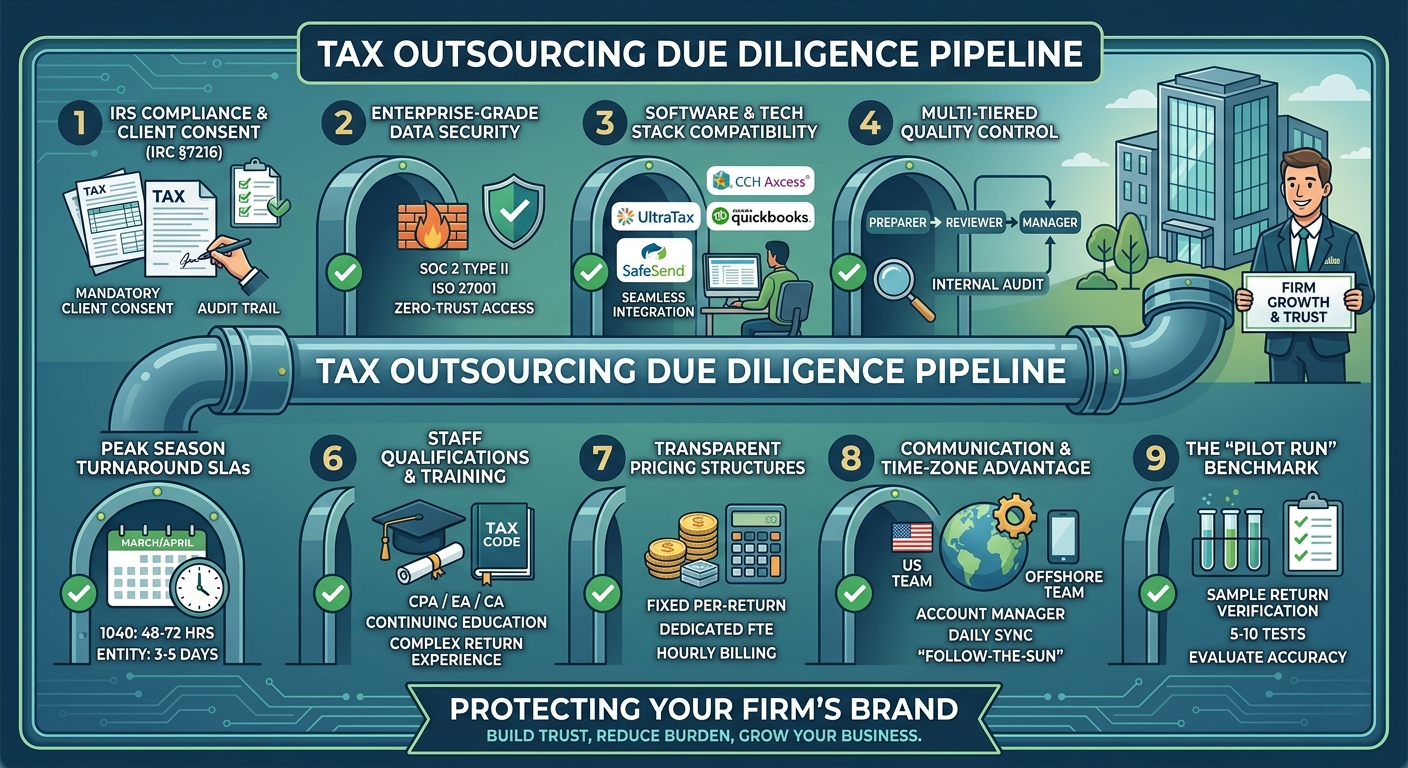
Before handing over any client's tax filing documents, every potential service provider must pass all 9 non-negotiable due diligence checks. These checks cover three dimensions: compliance, security, and quality, and not a single one can be omitted.
1. IRS Compliance & Mandatory Client Consent (IRC §7216)
When outsourcing tax-related work in the USA, the biggest compliance pitfall most commonly encountered is the failure to comply with IRC §7216 and §6713. Simply put, any entity that hands over its own tax work to another organization to handle must abide by local US rules, and violating these rules will lead to major problems—and the requirements laid out in these two provisions are exactly where most people are most likely to run into trouble.
Provision 7216, in particular, draws a strict red line: disclosing a taxpayer's information to a third-party service provider without first obtaining the client's explicit, written consent directly constitutes a federal felony. If the tax return preparation service provider you hire is located outside the USA, the constraints imposed by this rule only become stricter, with no room for ambiguity whatsoever.
To address this requirement, you must ask your service provider two core questions: "Can your platform smoothly manage the client consent-related processes required by §7216? Will you maintain strict audit trail records for all operations that involve disclosing information to clients?"
2. Enterprise-Grade Data Security & Regulatory Standards
Taxation data stores a large volume of sensitive financial and personal information, making it a high-value target for cybercriminals at all times. Anyone in possession of such data must withstand far greater security protection pressure than that required for ordinary data. If you plan to outsource work related to tax declaration to a third-party service provider, that provider must comply with Enterprise-Grade Data Security specifications at every step of its data processing starting from the day it first obtains your data, with no slack allowed.
Do not rely solely on verbal assurances of security from the provider; unsubstantiated promises are untrustworthy. You must demand that they produce compliance certificates issued by independent third-party organizations, to concretely confirm that all protective measures are operating normally and can truly deliver protection, rather than being empty displays for show.
The service provider you select must possess the following core qualifications and protective measures; you cannot safely entrust your data to them if any one of these is missing:
SOC 2 Type II Certification: This certification confirms that the service provider's security protection, system availability, and data confidentiality control measures have undergone long-term testing and verification, and are not temporary setups assembled only to pass inspections.
ISO 27001 Certification: This certification confirms that the service provider maintains a systematic information security management system, rather than fragmented protections that have gaps and oversights.
Zero-Trust Access Control: This measure is capable of preventing anyone from downloading customers' original materials to local devices, printing such materials, or forwarding them via external email accounts, cutting off all potential paths of data leakage at the access level.
3. Seamless Software & Tech Stack Compatibility
Hiring a third party to assist with tax-related work never forces your team to learn a whole new set of core tax software from scratch, nor forces you to discard the client portals you are currently using — you do not need to disrupt all the smooth-running rhythms of your own team to accommodate external support. A reliable CPA tax service provider will actively adapt to your existing workflows, rather than requiring you to adjust to theirs.
Before finalizing the partnership, there is one more thing you need to confirm: the staff at the provider who are responsible for preparing and filing tax content must themselves be proficient in operating the full set of software systems your team currently uses, so you do not have to spend time and energy training them from scratch, and they can start working immediately after onboarding. The specific software categories to verify fall into three types:
Tax Platforms: CCH Axcess, ProSystem fx, UltraTax CS, GoSystem Tax RS, Drake, Lacerte
Document Management and Portals: SafeSend, SmartVault, XCM, SurePrep
Accounting Backends: QuickBooks Online, Xero, Netsuite (applicable to entity tax filing businesses that require reconciliation between book records and tax records)
4. Multi-Tiered Quality Control (QC) Architecture
Outsourcing tax preparation work was originally meant to reduce the audit burden for your own company, not to multiply your workload several times over instead. If after outsourcing, your in-house team instead has to go over the submitted materials, check every detail, and fill in gaps and fix omissions, the original purpose of hiring an outsourced service is completely defeated, and you have only added a heap of unnecessary trouble.
That is why you must clarify this process when you are still selecting a service provider. Do not wait until the other party delivers the completed materials to your hands before you think of checking their quality control measures—you must ask potential partners to explain their internal quality inspection process in advance, instead of waiting until the team responsible for signing off on the work receives the materials to raise this question.
A reliable partner will establish a two-tier or three-tier audit system. Before delivering the first draft to you, they will definitely have a senior tax manager review all issues first—whether it is errors identified in diagnoses, missing supplementary schedules, or variance reports, nothing will be overlooked. They will not dump a pile of unaddressed problems on your sign-off team, forcing your own people to sort out mistakes and wrap up the work on their own.
5. Turnaround Time SLAs During Peak Tax Season
During the tax filing peak period from mid-March to early April every year, all tax preparation teams hit bottlenecks. Work that originally could be completed in 3 to 5 days is often delayed and takes the full two weeks to submit. To solve this problem, it is necessary to set accurate Service Level Agreements (SLAs) for tax filing businesses of varying complexity, clarify the service completion standards for clients in advance, stabilize all parties' expectations, and avoid disputes triggered by delays during the peak period.
Individual Returns (Form 1040): Standard processing time is 48 to 72 hours
Entity Returns (Forms 1065, 1120-S, 1120): Standard processing time is 3 to 5 working days
Expedited Processing: For late-arriving K-1 forms or urgent filings, there is a guaranteed option to complete the work within 24 hours
6. Staff Qualifications & US Tax Code Training
Currently, when seeking third-party assistance to handle accounting and tax filing in the market, there are only two options. One is to hire temporary or part-time staff who can arrange their work schedules flexibly, who can be deployed on demand to fit your own needs; the other is to engage a specialized outsourced accounting team, to hand over all accounting-related work entirely, without needing to spend your own effort overseeing the process. No matter which option you choose, the specific person who ultimately prepares and submits your tax return is the one that matters: whether this person’s professional qualifications are strong enough will directly affect the error rate of your tax return—the better the preparer’s qualifications, the lower the possibility of errors; if their qualifications are insufficient, the probability of errors will rise sharply.
Evaluate the preparers on three critical dimensions:
Whether you hire a part-time tax preparer who can work flexible shifts, or a full-scope outsourced accounting service, the qualifications of the actual person who handles your tax filing materials directly determine the probability of errors—the more solid this person’s qualifications are, the smaller the possibility of incorrect entries or omitted submissions; if their qualifications are insufficient, the risk of problems with your tax filing will be much higher. To judge whether these tax preparers are competent, you must verify them one by one across three core dimensions.
The first factor to verify is professional qualifications: they must be active CPAs, Enrolled Agents (EAs), or Indian CAs, and must also have rich professional experience in US taxation. A certificate alone is not enough—they must have practical familiarity with US tax rules.
The second factor to verify is their Continuing Education status: tax rules keep changing, so they cannot rely solely on old experience. They must complete the required Continuing Education: the cumulative annual study hours must be no less than 20 hours, and the study content must cover state tax nexus laws, TCJA updates, and recent IRS regulatory changes, to ensure their knowledge keeps up with the latest requirements.
The third factor to verify is their Complex Return Experience: they must not only be able to file simple tax returns, but must have mature experience handling complex tax filing businesses: they have managed business related to multi-state allocations, passive activity losses, foreign asset reporting (FBAR/FATCA), and tiered partnership structures, and can properly handle even troublesome tax filing scenarios.
7. Transparent & Predictable Pricing Structures
The billing amount cannot be determined in advance, and a plan originally designed to save money will instead turn into a major loophole that eats away at profits. To put it plainly: as long as you cannot pin down the exact cost of a service, even if you initially intended for it to help your business cut expenses, that uncalculable expense will in the end wipe out all the profits that should have been put in your pocket.
That is why when you select a tax compliance service, you must ask the service provider for a clear, tiered pricing plan, and never accept a vague, unitemized bill. The currently common Pricing ModelBest Used ForKey AdvantageFixed Per-ReturnSimple, their applicable scenarios, and core advantages are all listed clearly below:
Fixed fee per return: suitable for processing simple Form 1040 tax returns and corporate tax returns with clear workflows, its core advantage is that you can lock in profits for each type of return in advance, with no variables whatsoever.
Dedicated full-time staff (Dedicated FTE, i.e., Full-Time Equivalent staff): suitable for scenarios with an extremely large business volume that requires expanding staffing year-round, its core advantage is that this dedicated staff member can deeply integrate into the partnering company’s culture, and the calculated hourly rate is very low.
Hourly billing / overflow business processing: suitable for handling unforeseeable seasonal spikes in workload, its core advantage is that you do not need to bear any fixed costs during off-peak months outside of the busy peak months, so you will not waste money paying for unused services.
8. Communication Protocols & Time-Zone Advantage
Only with smooth communication can all docking links, large and small, be straightened out, so that those overlooked minor errors are not accumulated and delayed, which would eventually hold up the submission of documents.
When selecting a cooperative service provider, you must choose one that can assign you an exclusive Account Manager. This docking Account Manager must either be based locally in the US, or be able to conduct work in fluent English. You must hold a short daily progress sync meeting; if everyone cannot spare a unified real-time slot to meet, the Account Manager must still regularly sync and update the work status to you.
If you use an offshore team, you can also naturally form a "follow-the-sun" work model.
Once this relay-style work cycle is up and running, your company's internal team will receive all organized and prepared tax returns as soon as they start work every morning, and all that remains is to wait for the partner to conduct the final review.
9. The "Pilot Run" Benchmark (Sample Return Verification)
Don't rush to sign a long-term contract. You must first run a round of actual online tests, and it is only safe to sign the long-term agreement after testing the waters. Regular and reliable service providers will accept your request for a paid test. You can arrange 5 to 10 backflow tests, which can be scheduled during the off-season of your business, or at the beginning of the tax filing calendar.
During this test period, you must monitor and evaluate these key points one by one:
Whether they can process the original documents and materials you submitted smoothly, or if they often get stuck and encounter problems.
Whether the working papers and verification marks they produce are accurate, or if there are any errors or omissions.
How many internal audit comments your company's senior partners put forward for the work completed during this test phase.
Whether the generation speed of the query logs for missing information (PBC items) is fast enough.
Final Thoughts: Protecting Your Firm's Brand
Outsourcing the work of preparing tax filing documents for clients is a proven feasible solution. Every tax season, the vast majority of firms rush to complete work within a limited timeframe, and even with all employees working around the clock, they cannot keep up with the workload. Outsourcing this portion of work allows firms to avoid the continuous pressure of this period, and prevents their own staff from being overworked to the point of collapsing from exhaustion. More importantly, it also frees up all the human resources and energy originally spent on tax preparation to take on consulting services that generate far higher profits than tax filing services, expanding the firm's overall business scope.
However, you must understand that even if the tax filing work is outsourced, the final tax return is submitted to the client or the tax authority in your own firm's name. Your company's brand reputation is, from start to finish, tied to every tax return you process and submit — if any return contains an error, all responsibility will fall on your company, and you cannot shift any of it away.
To enjoy the benefits of outsourcing while avoiding mistakes, you must thoroughly vet the partner that takes on your outsourced work: you not only need to check if their information security is robust enough, but also sort out whether their entire workflow for processing tax filings is standardized, and even more critically, confirm that all operations comply with relevant regulatory requirements, with no room for ambiguity. Only by verifying all these aspects thoroughly can you reap the benefits of freeing up energy to expand your business, while safeguarding the client trust you have worked hard to build. You will not ruin your own brand or lose clients' trust due to errors arising from outsourcing.
_(6).jpg)


1.png)
_(5).jpg)
.jpg)
_(4).jpg)
_(1).jpg)
_(2).jpg)
.png)