 USA
USA UK
UK Australia
 UAE
UAE Canada
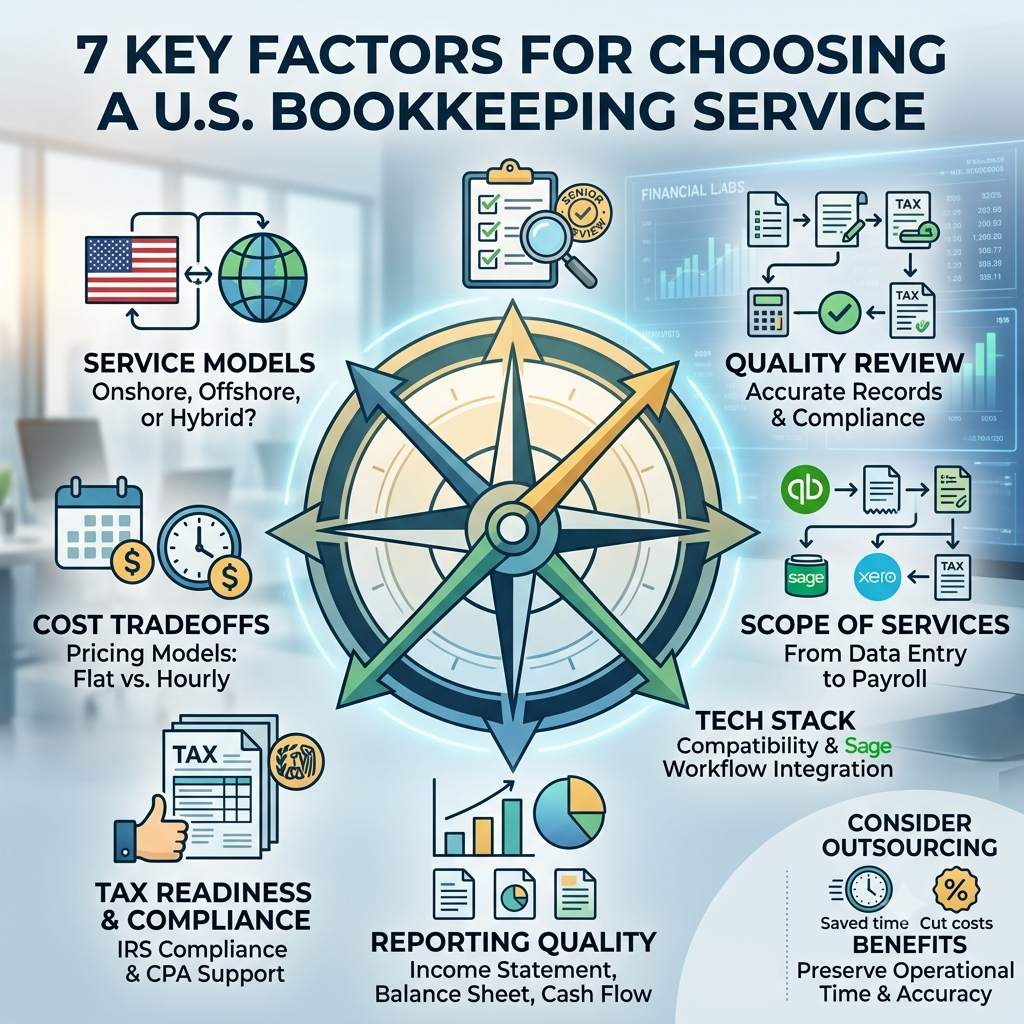
Managing daily financial records is a core challenge for small and medium-sized business owners in the United States. While outsourcing transaction tracking and account reconciliation can save precious time, choosing the wrong bookkeeping service may instead expose businesses to risks including messy general ledgers, missed
tax credits, and unexpected bills. For this reason, this article organizes seven key factors that must be evaluated before signing a contract with a U.S.-based bookkeeping service provider.
Outsourced accounting mainly falls into three service models: The onshore model, which refers to services provided within the United States, charges higher monthly service fees but boasts solid knowledge of local domestic contexts. The offshore model has lower operating costs, but may face delays in communication or work processes.
The hybrid model, which acts as a middle ground, is the most favored: local teams take charge of client management or supervision by certifiedpublic accountants, while back-office preparation work is handled in offshore locations. When selecting a service provider, evaluating its quality review process is critically important. For example, OBG Outsourcing Private Limited’s multi-level review mechanism, which relies on a dedicated senior review team, safeguards the accuracy of accounting records and compliance with U.S. regulatory standards, while retaining the cost advantages of offshore operations.
Scope of Services: Classified Bookkeeping vs. Full-Cycle Accounting Not all bookkeeping services for micro and small enterprises cover the same range of work. You must confirm in advance whether a potential service provider can handle the following tasks:
Basic data entry and bank reconciliation Accounts payable (A/P) and accounts receivable (A/R) management Payroll ledger registration, Form 1099 tracking, and sales tax filing Backlog bookkeeping entry and cleanup for overdue fiscal years Clarifying deliverables in advance can prevent process gaps between day-to-day bookkeeping and tax declaration.
Tech Stack and Software Compatibility A smooth end-to-end digital workflow must rely on the existing technology stack. When selecting a digital workflow service provider, the provider must be compatible with four major types of accounting and finance platforms, and also possess three core integration capabilities.
Reporting Quality and Decision-Ready Financials Standard financial ledgers must have clear business visibility. Standardized monthly closing procedures must produce three core financial statements: the income statement tracks revenues and expenditures, the balance sheet summarizes assets, liabilities, and equity, and the cash flow statement monitors cash reserves. During assessments, sample copies of these statements may be requested to confirm that they are easy to read and implementable.
Although bookkeepers do not directly submit tax returns, their work directly affects tax preparation costs and compliance with IRS audit requirements. When selecting a service provider, three types of compliance must be met: setting up accounts in line with IRS requirements, tracking 1099 vendors, and being able to cooperate with a certified public accountant (CPA) in tax filing.
Cost Tradeoffs: Fixed Retainers vs. Hourly Rates The outsourced accounting industry has three mainstream pricing models: Flat Monthly Fee, Hourly Rate, and Tiered Pricing. Each model has its own strengths and weaknesses, and is suited to different client use cases.
Data Security and Business Continuity Outsourcing financial record-keeping requires supporting strict data security measures. Before entering a partnership, please verify the service provider’s MFA and client portal encryption, role-based access permissions for accounting software, and business continuity plan.
Evaluating Your Options Switching from in-house bookkeeping to outsourced accounting can preserve operational time and ensure the accuracy of year-round financial records. OBG Outsourcing Co., Ltd. provides compliant bookkeeping and other related services for small businesses and U.S. CPA firms, and this approach can cut internal labor costs by up to 60%.
_(6).jpg)


1.png)
_(5).jpg)
.jpg)
_(4).jpg)
_(1).jpg)
_(2).jpg)
.png)