 USA
USA UK
UK Australia
 UAE
UAE Canada
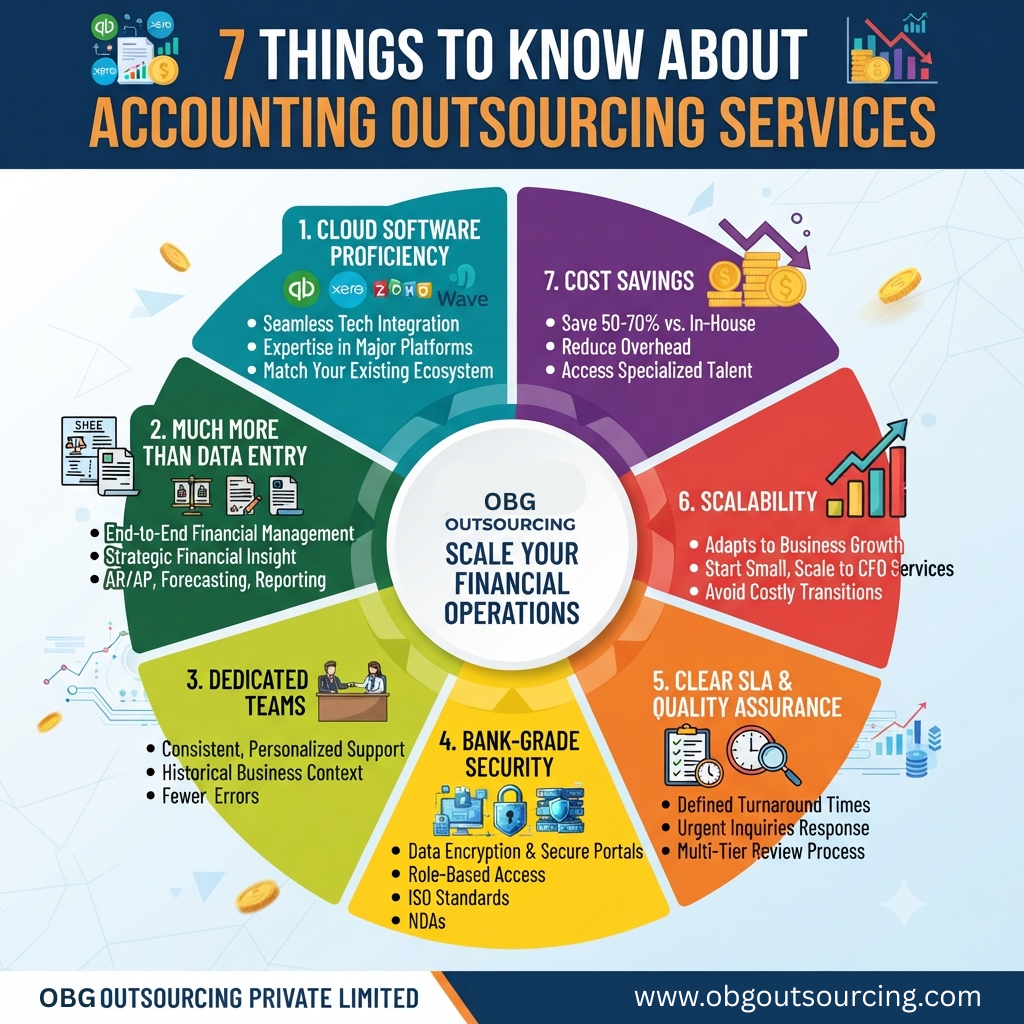
Financial management is a core driving force for growth-stage enterprises. However, bookkeeping and financial accounting often consume a great deal of energy from founders and finance managers. After small and micro businesses scale up, the complexity of maintaining accurate accounts on platforms such as QuickBooks, Xero,
Zoho Books, and Wave will only rise further. Outsourcing accounting services can help enterprises access professional expertise while cutting the labor costs of hiring a full-time in-house accountant, but not all outsourced services meet qualified quality standards. Below, we will introduce seven core indicators to screen for suitable partners and maximize return on investment.
1. Cloud Software Proficiency is Non-Negotiable
Outsourced accounting services must integrate seamlessly with a company’s existing technology stack. Qualified service providers must be proficient in all mainstream accounting software platforms, including:
QuickBooks: Suited for scenarios involving complex inventory management, project cost accounting, and customized financial reporting.
Xero: Matches the needs of real-time collaboration, bank reconciliation, and streamlined invoicing processes.
Zoho Books: Fits companies that build automated workflows within Zoho’s full ecosystem.
Wave: Ideal for small startups that require simple, efficient bookkeeping.
Service providers must align with your existing ecosystem, and must never force you to switch to incompatible software that would disrupt daily operations.
2. Outsourcing Is Much More Than Just Data Entry
Many small business owners mistakenly believe that bookkeeping is nothing more than simple transaction recording. High-value outsourced accounting services deliver end-to-end financial management, with coverage including:
Accounts Receivable (AR) & Accounts Payable (AP) tracking
Preparation of monthly, quarterly, and year-end financial statements
Payroll processing and tax compliance preparation
Budgeting, cash flow forecasting, and KPI monitoring
Basic data entry only meets compliance requirements, while strategic financial insights can help you make informed decisions to drive growth.
3. Dedicated Teams Outperform Ad-Hoc Support
Most budget outsourcing service providers share the common problem of having scattered, uncoordinated point persons. High-quality accounting support requires professionals who are familiar with a company’s business context. It is recommended to select services that assign a dedicated accounting team, as members of such a team can understand the specific details of the industry, ensure service continuity, and maintain a low error rate.
4. Security Protocols Must Be Bank-Grade
The handover of access rights to core and sensitive financial data such as bank accounts, tax declarations, and payroll details must be based on full trust.
Ensure your provider implements:
Encrypted data transmissions and secure file-sharing portals
Before signing a contract with any supplier, it is essential to verify its data security framework. The service provider must implement the following requirements: encrypted data transmission and a secure file sharing
portal, role-based access control within accounting software, compliance with ISO-certified operational standards, and strict non-disclosure agreements for all its employees.
5. Clear SLA & Quality Assurance Processes Matter
In financial management, missing deadlines can trigger supplier disputes, payroll errors, or regulatory penalties. Your service provider must adhere to strict SLAs that clearly define the following:
Turnaround time for bank reconciliation (for example, monthly close must be completed by the fifth working day)
Response time for urgent financial consulting requests
Multi-level review process that requires a senior manager to audit the work of junior bookkeepers before final delivery
6. Scalability Prevents Costly Transitions Later
If your enterprise’s accounting needs will change significantly within 12 to 24 months, you may consider choosing an adaptable accounting outsourcing model. This model helps you avoid the hassle of switching service providers later. Such service providers can scale their services steadily alongside your business’s revenue growth, expanding from 10 hours of basic bookkeeping per month to a full set of CFO-level financial support.
7. It Saves Up to 50–70% Compared to In-House Hiring
Building an in-house accounting team incurs hidden costs including competitive salaries, health insurance benefits, payroll taxes, recruitment fees, software licensing fees, and ongoing training. For
small businesses, outsourcing professional accounting services not only cuts administrative expenses and grants access to skilled accounting talent, but also frees up capital that can be invested in sales, marketing, and product research and development.
Scale Your Financial Operations with OBG Outsourcing
OBG Outsourcing Private Limited provides customized, secure, and scalable financial and accounting outsourcing services for global growth-stage enterprises. Its team of professional finance and accounting staff is proficient in mainstream software including QuickBooks and Xero. Feel free to contact us to book a consultation with a financial expert.
_(6).jpg)


1.png)
_(5).jpg)
.jpg)
_(4).jpg)
_(1).jpg)
_(2).jpg)
.png)