 USA
USA UK
UK Australia
 UAE
UAE Canada
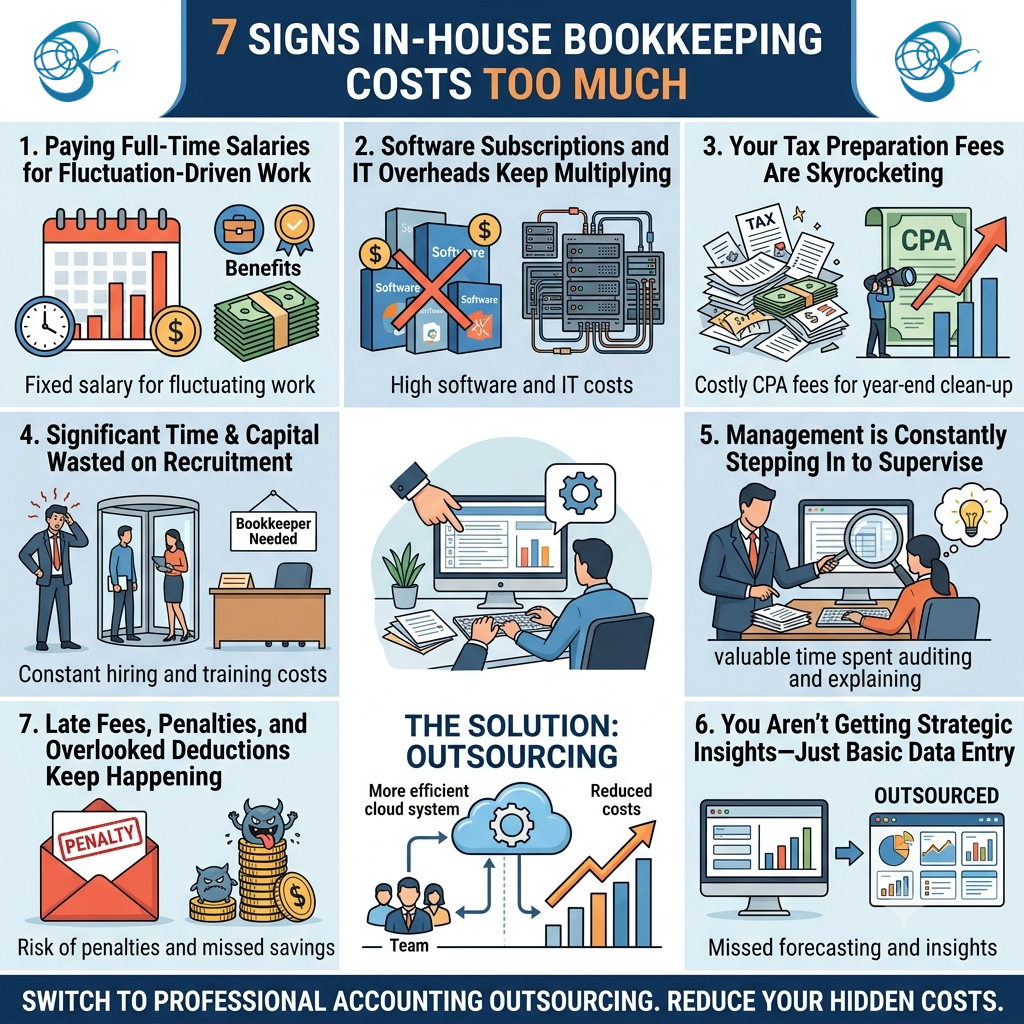
Many owners of small and medium-sized enterprises (SMEs) believe that hiring an in-house bookkeeper is the natural choice to take control of their company’s finances. However, beyond the fixed monthly salary, this investment incurs hidden costs including software licensing fees and training expenditures and also triggers a series of problems such as excessive budget consumption, limited growth, and elevated tax risks.
OBG Outsourcing Private Limited will next break down seven warning signs that in-house bookkeeping carries excessively high costs, proving that outsourced bookkeeping is a more prudent strategic choice.
The True Cost of In-House Bookkeeping: 7 Warning Signs
You Are Paying Full-Time Salaries for Fluctuation-Driven Work
The workload of corporate financial management exhibits clear fluctuations: workload surges sharply during tax filing seasons and end-of-quarter accounting close stages, while it drops substantially in regular months. Even if a company hires a full-time finance employee, it still has to pay that staff member a fixed salary, and must also bear rigid mandatory costs including benefits, insurance, and payroll taxes.
Software Subscriptions and IT Overheads Keep Multiplying
Highly efficient accounting practices rely on modern infrastructure. If enterprises purchase the four categories of accounting tools (including cloud accounting platforms) independently, their operating costs will rise substantially. Professional bookkeeping services can pool these costs, enabling clients to access high-quality tools without paying for separate high-end licensing fees.
Your Tax Preparation Fees Are Skyrocketing
Many owners of small and medium-sized enterprises (SMEs) must pay thousands of dollars to certified public accountants (CPAs) at the end of every year to sort out messy financial data for tax filing. This problem arises because their in-house bookkeepers lack professional tax knowledge, leading to a backlog of erroneous accounting entries. Opting to outsource either tax declaration work or long-term bookkeeping services can keep a company’s accounting books in good order throughout the year, significantly reducing the size of its end-of-year CPA bills.
Significant Time and Capital are Wasted on Recruitment and Retention
The accounting talent market currently faces intense competition. When an enterprise’s in-house bookkeeper resigns, the company incurs various explicit costs including those for recruitment, job posting, onboarding, and training, and may also face the risk of operational disruption stemming from a gap in financial management. Our accounting outsourcing service eliminates reliance on any single individual, and provides continuous, uninterrupted bookkeeping services.
Management is Constantly Stepping In to Supervise
For small business owners, the work that delivers the highest return on investment is expanding operations and advancing strategic initiatives. If they spend 5 to 10 hours each month auditing bookkeeping entries, explaining tax adjustments, and managing bookkeeping schedules, that amounts to a waste of their valuable time, which essentially incurs a steep opportunity cost.
You Aren't Getting Strategic Insights—Just Basic Data Entry
Many in-house financial teams at most enterprises are only capable of completing basic data entry. Our collaborative expert outsourcing team can deliver three types of proactive financial reports including cash flow forecasting, as well as executive-level insights. The total cost of this service is only a fraction of the salary of a full-time CFO, making it a cost-effective financial upgrade solution.
Late Fees, Penalties, and Overlooked Deductions Keep Happening
If enterprises miss tax declaration deadlines or miscalculate payroll deduction amounts, they will not only receive government notifications that create unnecessary mental stress but also be required to pay steep financial fines. The core cause of these problems is that a single in-house finance and taxation employee cannot cope with their excessive workload. Engaging a professional finance and taxation outsourcing service provider allows enterprises to comply with the latest regulations, maximize legally allowable tax deduction amounts, and avoid costly fines.
In-House vs. Outsourced Bookkeeping: A Quick Look
This paper first systematically compares and aligns the core characteristics of in-house bookkeeping and OBG P-based outsourced bookkeeping across four dimensions: pricing models, business continuity, professional proficiency, and technical costs. Finally, it points out that micro, small, and medium-sized enterprises (MSMEs) that rely solely on a single finance staff member commonly face the problem of overpaying for in-house bookkeeping and calls on enterprises to conduct self-examinations to verify the reasonableness of their financial costs.
Achieve Accounting Cost Reduction with OBG Outsourcing
Attention to all operators of micro and small enterprises: hidden internal operating costs are eroding your profit margins. You may consider switching to professional accounting outsourcing services, which can convert your fragmented, bloated internal expenses into streamlined, predictable, and scalable variable costs. OBG Outsourcing Private Limited provides end-to-end services covering ledger management, compliance support, and year-end tax filing. You are welcome to contact us to obtain customized financial health consulting and calculate the costs you can save.
Stop Overpaying for Bookkeeping
_(6).jpg)


1.png)
_(5).jpg)
.jpg)
_(4).jpg)
_(1).jpg)
_(2).jpg)
.png)