 USA
USA UK
UK Australia
 UAE
UAE Canada
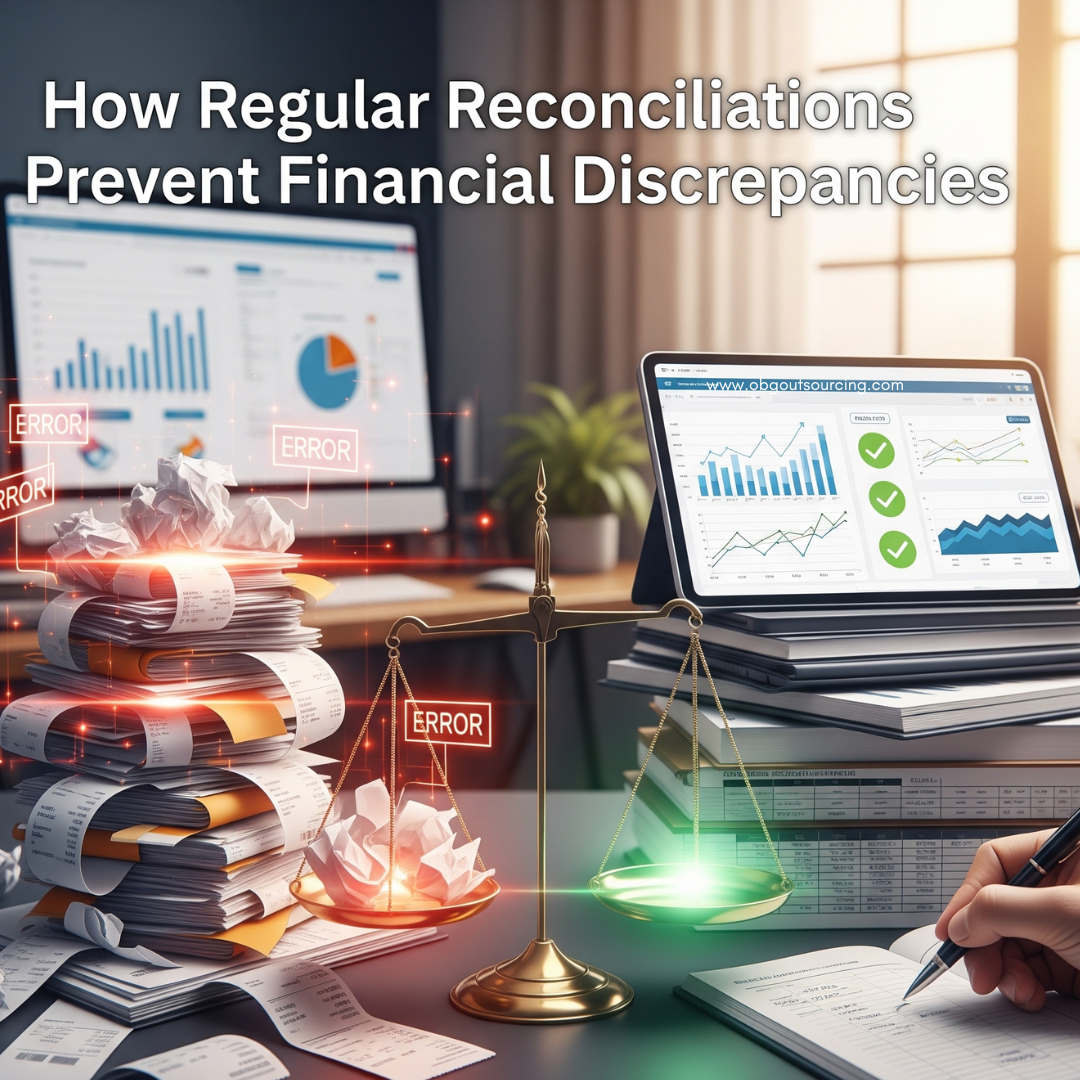
In today’s fast-paced digital economy, financial data moves in milliseconds—but mistakes move just as fast.
A duplicated payment.
A missing invoice.
An unrecorded bank fee.
A payroll miscalculation.
Individually, these seem minor. Collectively, they can distort financial reports, mislead decision-makers, and cost businesses thousands.
At www.obgoutsourcing.com, we believe regular reconciliations are not just an accounting task—they are a strategic financial control system that protects business integrity and profitability.
Let’s explore how consistent reconciliation practices prevent financial discrepancies and build long-term financial stability.
What Is Financial Reconciliation?
Financial reconciliation is the process of comparing two sets of records to ensure they match and are accurate. These typically include:
Bank statements vs. accounting records
Accounts receivable vs. customer payments
Accounts payable vs. vendor invoices
Payroll reports vs. employee compensation records
Intercompany transactions
Credit card statements vs. expense reports
When done regularly, reconciliation acts as a financial “health check” for your business.
Why Financial Discrepancies Happen
Even with advanced accounting software, discrepancies still occur. Common causes include:
Manual data entry errors
Duplicate transactions
Timing differences
Unauthorized transactions
Missed invoices
Incorrect tax calculations
System integration gaps
The longer these go unnoticed, the harder and more expensive they become to fix.
7 Ways Regular Reconciliations Prevent Financial Discrepancies
1. Early Detection of Errors
Monthly or weekly reconciliations help detect issues immediately instead of discovering them during year-end audits. Early detection reduces correction costs and prevents reporting distortions.
2. Prevention of Fraud
Regular comparison of financial records can uncover:
Unauthorized withdrawals
Altered invoices
Suspicious vendor payments
Payroll manipulation
Consistent oversight discourages fraudulent activities and strengthens internal controls.
3. Improved Cash Flow Accuracy
Cash flow decisions depend on accurate numbers. Reconciliation ensures:
No missed deposits
No overstated balances
Clear understanding of available liquidity
This improves budgeting and financial planning.
4. Accurate Financial Reporting
Financial statements are only as reliable as the data behind them. Regular reconciliations ensure:
Balance sheets reflect true positions
Income statements are correct
Tax filings are compliant
This is critical for investors, lenders, and regulatory bodies.
5. Stronger Audit Readiness
Businesses that reconcile regularly are always audit-ready. Instead of scrambling for explanations, financial teams can present organized, verified records with confidence.
6. Better Vendor and Customer Relationships
Reconciliation ensures:
Vendors are paid accurately and on time
Customer accounts are correctly maintained
Disputes are resolved quickly
Accuracy builds trust and professionalism.
7. Enhanced Strategic Decision-Making
When leadership relies on real-time, verified financial data, strategic decisions become:
More confident
Less risky
Data-driven
Without reconciliation, decisions are based on assumptions—not facts.
How Often Should You Reconcile?
The ideal frequency depends on transaction volume:
Daily – High-volume businesses
Weekly – Medium-sized organizations
Monthly – Small businesses
Quarterly – Low-activity entities
However, critical accounts such as bank accounts and payroll should never wait until year-end.
The Hidden Cost of Skipping Reconciliation
Businesses that delay reconciliation often face:
Accumulated financial errors
Penalties from tax authorities
Cash flow mismanagement
Increased audit risks
Loss of stakeholder confidence
What starts as a small mismatch can snowball into a major financial crisis.
Why Outsourcing Reconciliation Is a Smart Move
Modern businesses are increasingly outsourcing reconciliation tasks to experienced financial professionals. Here’s why:
Access to skilled accounting experts
Reduced operational burden
Advanced reconciliation tools
Stronger compliance framework
Cost efficiency compared to in-house teams
At OBG Outsourcing, we help businesses implement structured reconciliation systems that minimize risk and maximize financial clarity.
Modern Reconciliation: Beyond Manual Matching
Today’s reconciliation process is powered by:
Automation tools
AI-based anomaly detection
Cloud accounting systems
Real-time financial dashboards
But technology alone isn’t enough—expert review ensures accuracy and accountability.
Final Thoughts
Financial discrepancies don’t usually appear overnight—they accumulate silently.
Regular reconciliation acts as your financial defense mechanism. It protects your business from errors, fraud, compliance risks, and strategic missteps.
In a competitive business environment, precision isn’t optional—it’s essential.
If your business is ready to strengthen financial accuracy and eliminate discrepancies before they grow, structured reconciliation is the first step toward financial excellence.
Visit www.obgoutsourcing.com to learn how professional reconciliation services can safeguard your financial operations.
_(6).jpg)


1.png)
_(5).jpg)
.jpg)
_(4).jpg)
_(1).jpg)
_(2).jpg)
.png)